AI in Product Development: Practical Uses and Real Benefits

ON 20 December , 2025

AI in Product Development: Practical Uses and Real Benefits

Artificial Intelligence has no longer remained a thing of the future; it is already changing the way in which businesses in the U.S develop products today. From designing to testing, AI in product development helps to make every process smarter, faster, and more efficient. With the right AI development company, businesses can integrate AI seamlessly into their product lifecycle. 

Thinking about the pace of today’s market, where the preferences of the customers change overnight, competition exists in every field, and even a small mistake can prove to be costly, AI product development services have turned out to be the rescue. Traditional product development methods, even though reliable, often fall short in delivering the speed and precision that modern businesses need these days. 

AI-powered product development comes with offering data-driven insights, predictive analysis, and automation that help with smarter decision-making at each stage of the product development cycle. That’s why many U.S. businesses are turning to custom AI solutions designed to fit their specific needs.

In this blog, we will look at why the shift to AI is necessary, compare it with traditional methods, and look at a few real-life case studies, along with understanding the future trends. By the end of this blog, you will have a clear understanding of how AI-driven product development can help your business. 

AI in Product Development: What it Really Means?

AI in product development is about making smart choices at every stage of product development. Instead of guessing what customers want or simply relying on the long manual processes, AI uses data to guide the process of decision-making. It helps businesses with design testing and helps in launching products with more confidence. 


Let’s just take a simple example of Tesla. The company not only uses AI in self-driving cars but also to speed up design and prototyping. Using AI simulations, Tesla can easily test hundreds of ideas virtually without building a real model. This process helps in saving time and money, along with improving quality. That’s the power of custom AI solutions.


Nike applies AI differently in fashion. By studying customer preferences and predicting future trends, Nike designs collections that stay relevant in the market. This approach is built on strong user research and thoughtful UI UX design and development services that turn insights into real products.


Healthcare is the other major sector that has started adopting AI in product development to create smarter medical devices. These devices not only help in tracking the data of the patient, but also help in predicting future health risks, helping doctors act sooner and improve patient care. Many of these innovations rely on custom application development services to create solutions that truly fit patient and provider needs.


From all these examples, the lesson is clear: AI-driven product development is not just another buzzword. It is already here, helping companies, big or small, bring better products to market faster.

Illustration of a person working on multiple screens with code and data, symbolizing the shift to AI in product development—highlighting the need for faster, data-driven, and more efficient product innovation in today’s competitive market.

Why the Shift To AI in Product Development is Necessary 

The market today moves really fast. What is most popular this month may be outdated the next. Customers in the U.S expect smarter products, personalised, and that can be quickly delivered. This change in the market and the pressure make it really difficult for businesses to rely only on the traditional methods of product development. 

The old way has limits. Manual research takes time, prototyping is expensive, and the most difficult part is predicting customer needs, which mostly feels like guesswork.

This is the reason why most companies are turning to AI for product development. AI helps reduce risks by analyzing a large amount of data, spotting patterns that are likely to be missed by humans, and can forecast demand, suggest design improvements, and even assist in testing a product’s performance virtually. 

Thus, the result is clear: AI product development helps bring real advantages that businesses can feel right away: 

  • Shorter development cycle as the product reaches the market quickly. 
  • Fewer errors and rework as faster testing and simulations help to catch issues early. 
  • Better market fit, as products can completely align with what the market truly wants.

Traditional vs. AI-powered Product Development

For decades, the process for product development has remained similar: research, design, prototype, test, and launch. This approach worked, but proved to be slow and expensive. Teams often relied on surveys, focus groups, and trial-and-error to actually understand what the customer needs. Mistakes were common, and fixing those mistakes meant more time and higher costs. 

AI-powered product development changes this story. Instead of guesswork, businesses now have data-driven insights. AI can easily analyse customer behavior, predict demand, and even suggest design improvements way before a prototype is built. The process of testing can happen virtually, reducing the need for costly physical models. 

Traditional Product Development AI-Powered Product Development
Relies on manual research and surveys Uses real-time data and predictive insights
Long and costly prototyping cycles Virtual testing reduces costs and time
High risk of errors and delays Smarter forecasting prevents mistakes early
Products often miss market trends Products align closely with customer needs

The difference is clear. The traditional method of product development reacts to problems after they happen, while the modern AI-driven method helps to prevent these problems before they occur, leading to faster innovation and smarter decisions. 

The Current Market of AI in Product Development 

AI is growing fast. In 2024 alone, 78% of the companies worldwide have adopted AI in at least one of their business function. The U.S. is leading this shift, with private investment in AI reaching more than $100 billion in a single year. 

In product development, the numbers are just as exciting. The market for AI in product development was worth about $528 million in 2024. By 2030, it’s expected to grow to more than $3 billion. North America, especially the U.S., is the biggest player in this growth.

Overall, the AI market in the U.S. itself is booming. It’s set to reach nearly $74 billion by 2025, and it will keep growing quickly in the years ahead. 

(Data Source: https://hai.stanford.edu/ai-index/2025-ai-index-report)

For businesses, this means one thing: AI is no longer just an option. It’s becoming the new standard for creating products faster, smarter, and with less risk.

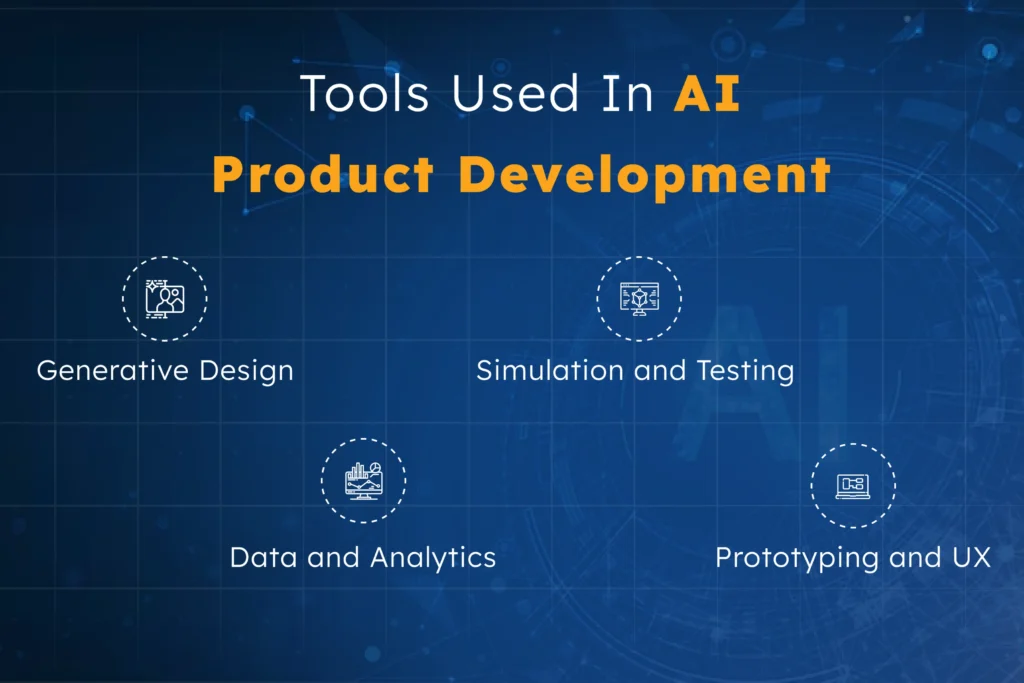
Visual breakdown of essential AI tools in product development—generative design, simulation and testing, data and analytics, and prototyping with UX—highlighting how businesses leverage AI for faster, smarter, and more customer-focused product creation.

Tools Used In AI Product Development

AI is no longer an idea. It comes to life through real tools that are used by product teams every day. These tools make the process of product development faster, smarter, and even cost-friendly. Let’s look at some of the main tools: 

 1. Generative Design

AI tools can help you create dozens of designs within minutes. These designs can be tested by the designers, and they may find creative solutions that they may not have thought of. 

Example: 

Autodesk Fusion 360: A tool used to generate designs within minutes. Such tools are often supported by our custom AI solutions and AI development company expertise, helping businesses design smarter and faster.

2.  Simulation and Testing 

Building physical prototypes can turn out to be expensive and slow. AI-powered tools let businesses complete the testing process first. This helps to spot down issues first and reduce costs. 

Example: 

Ansys: A Tool that is used to run virtual simulations to test products before they’re built. 

Siemens Simcenter: A tool that helps engineers predict product performance under real-world conditions.

Many U.S. companies also rely on software testing services and IT outsourcing company support to enhance these simulations and ensure product reliability.

3.  Data and Analytics

Good products can be built if there is a proper knowledge of what the customer actually needs. AI analytics tools read large sets of data and turn them into insights. Teams can predict demand and plan better.

Example: 

Google Cloud AI:  A tool that helps in analyzing huge datasets to uncover trends and customer needs.

Microsoft Azure AI: This is an AI tool that provides machine learning models for demand forecasting and insights.

At Samyak, our machine learning development services and AI agent development services help businesses unlock the full power of these analytics tools.

4.  Prototyping and UX

AI helps to design and test faster, which turns out to be particularly useful for products that rely on customer experience. Teams can easily create quick prototypes, get feedback, and improve in less time. 

Example: 

Figma with AI add-ons: This is a tool that assists in quick prototyping and user interface design.

Adobe XD: A tool that uses AI to enhance design workflows and test user experiences faster.

Combined with our UI/UX design and development services and user research, these tools help create products that truly connect with customers.


Future Trends In AI-Powered Product Development 

AI in product development is still growing, and the future of this looks even more promising. As technology is improving, businesses are finding new ways to design and launch products in the market. 

One big trend that has emerged with AI product development is personalisation at scale. AI makes it possible to create products that are tailored to individual customer needs, whether it is a pair of sneakers, a medical device, or even a car. Another area where AI is evolving is faster virtual testing. Instead of building physical prototypes, companies can directly use advanced AI simulations that can help to test products within seconds. This means fewer delays and lower costs. 

In the future, a stronger use of generative AI is also being predicted. Tools that can design, code, or create 3D models will help teams move way faster from idea to product. 

And finally, sustainability will take up the centre stage. AI will play a central role in developing eco-friendly materials that help in reducing waste, and make supply chains way more efficient. For U.S companies, this could also mean staying ahead of the regulations and customer expectations. 

The message is clear: AI-driven product development isn’t just about keeping up today. It’s about preparing for the future of innovation

What These Future Trends Mean For Businesses: 

  • Products will be designed faster and with fewer risks involved. 
  • Customers will expect more personalised experiences. 
  • Development costs will shrink, as virtual testing will grow. 
  • Sustainable practices, which are now considered “nice to have,” will move towards “must have”. 
  • Companies using AI will set the pace, while the ones using traditional methods will find it difficult to keep up. 
Illustration of a professional analyzing product dashboards with charts and graphs—representing how Samyak Infotech uses AI-powered development, data-driven design, and ethical practices to create faster, smarter, market-ready products.

Build Better Products with Samyak Infotech 

Choosing the right partner for your product development services can make all the difference. Samyak Infotech is a leading custom software development company helping U.S. businesses turn ideas into market-ready products.

  • We combine data-driven strategies with creative design to build products that truly resonate with customers.
  • Our team leverages advanced AI tools to speed up prototyping, testing, and market readiness.
  • We follow ethical AI practices to ensure responsible, fair, and secure product development.
  • With experience across industries, we help U.S. businesses stay ahead in fast-moving markets.

Partnering with Samyak Infotech means not just building a product, but creating one that is smarter, faster, and more aligned with market needs.

Transform Your Product Journey with AI

AI is transforming the way products are developed. From faster design cycles to smarter decision-making, AI-powered product development is no longer optional; it’s essential for staying competitive.

For U.S. businesses, the future belongs to those who embrace AI responsibly. By leveraging the right tools, following ethical practices, and partnering with experts like Laxmi Group, companies can create products that customers love and markets recognize.

The message is clear: AI in product development isn’t just the future;  it’s today’s competitive advantage.

Top Questions About AI in Product Development

Is AI in product development suitable for small businesses?

Yes, AI tools are increasingly accessible and scalable. Small businesses can utilize AI to automate tasks, gain customer insights, and enhance product offerings without significant upfront investment.

Like any technology, AI has risks: data privacy issues, bias in models, and over-reliance on automation. The key is using AI responsibly and keeping humans in the loop.

No. AI supports creativity; it doesn’t replace it. It suggests ideas, predicts trends, and tests options, but humans still make the final decisions. 

Yes. Using AI without care can lead to biased results, privacy concerns, or over-reliance on automation. The key is to combine AI insights with human judgment.

AI is powerful but complex. Samyak Infotech brings expertise, reduces risks, and helps launch smarter products faster.


Latest News from our end!

Wait! Don’t Leave Without This !!

Get 1 Week of Free Custom AI Development

Our AI experts will help you prototype, automate, or build AI-powered solutions — risk-free.
⚡ Limited-time offer for new users.