How fast can you really validate your product idea?
For years, startups have relied on traditional MVP development to test new ideas. It helped teams launch quickly. But it often depended on assumptions. Feedback came late. Iterations were slow.
AI-powered MVPs are changing this approach. They use data from day one. They learn from user behaviour. They help teams validate ideas faster and at a lower cost.
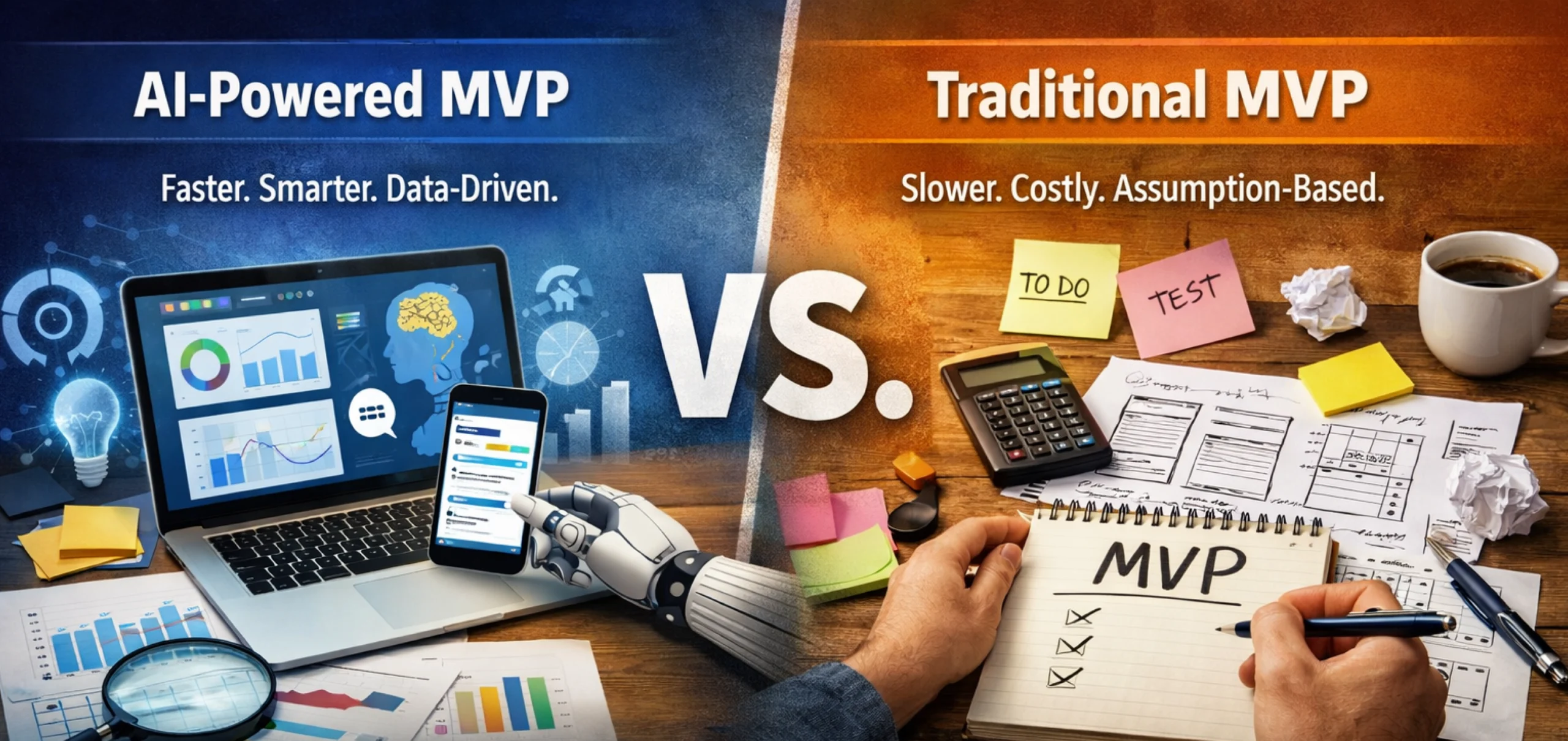
This blog compares an AI-powered MVP vs a traditional MVP. The focus is clear. Cost. Speed. And real results.
What Is a Traditional MVP?
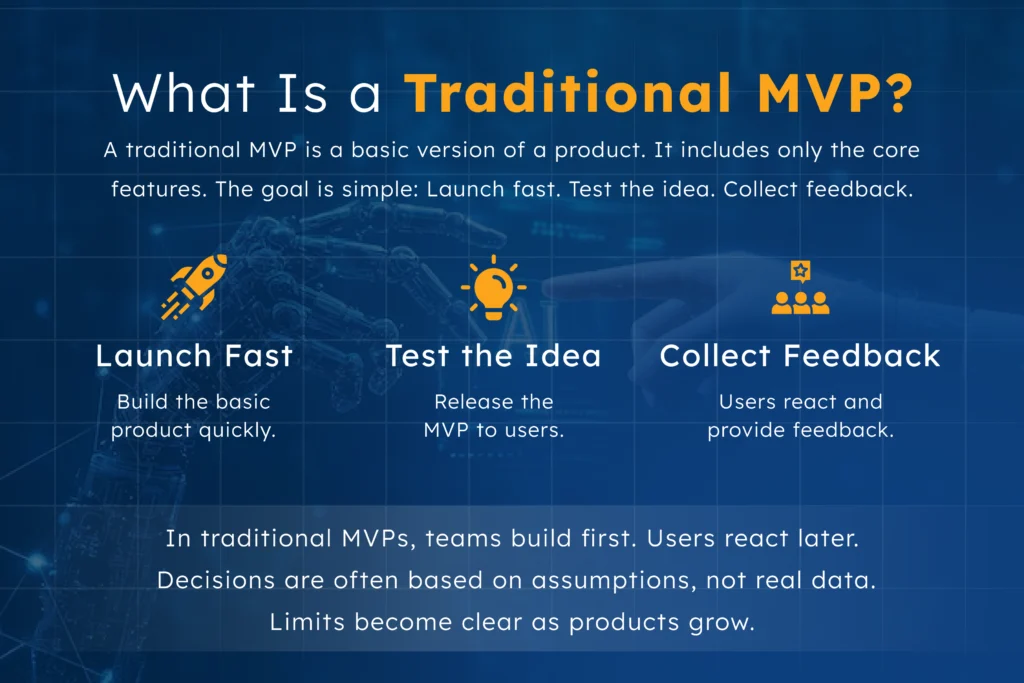
A traditional MVP is a basic version of a product. It includes only the core features. The goal is simple. Launch fast. Test the idea. Collect feedback.
In traditional MVP development, teams build first. Users react later. Decisions are often based on assumptions. Not real data.
This approach works well for simple products. Especially when user behavior is predictable. Or when the idea does not rely on complex data.
But traditional MVPs have limits. As products grow, these limits become clear.
How Traditional MVP Development Works
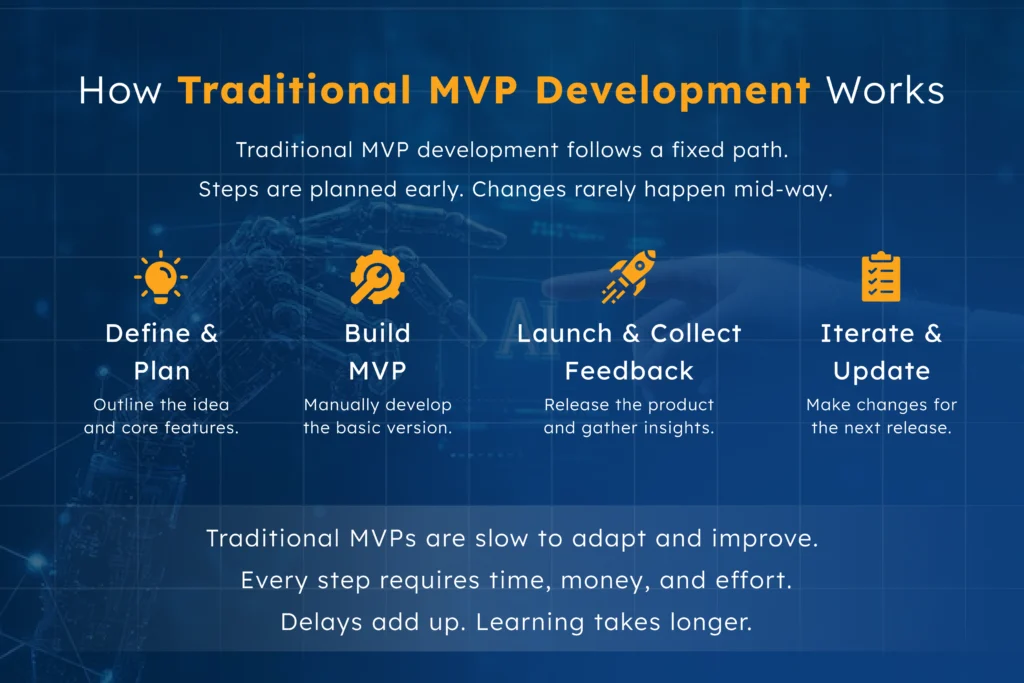
Traditional MVP development usually follows a fixed path. The steps are planned early. And they rarely change mid-way.
First, the product idea is defined. Assumptions are made about user needs. Market research is often limited at this stage. Next, core features are selected. Only what seems essential is included. But these decisions are still based on guesses.
The MVP is then built manually. Design. Development. Testing. Each phase runs one after another. This slows down delivery.
Once the product is live, users begin testing it. Feedback is collected through surveys or reviews. Sometimes through direct conversations. But useful insights take time to surface.
Changes are made in the next release. Not immediately. Each update needs new development work. New testing cycles. And new deployment efforts. Every step takes time. Every iteration costs money. Delays add up quickly. And learning slows down.
This is why traditional MVPs struggle with speed. And why product validation often takes longer than expected.
But traditional MVPs have limits. As products grow, these limits become clear. This is often discussed alongside comparisons like MVP vs. MMP, where teams evaluate how much functionality is truly needed at early stages.
Limitations of Traditional MVP
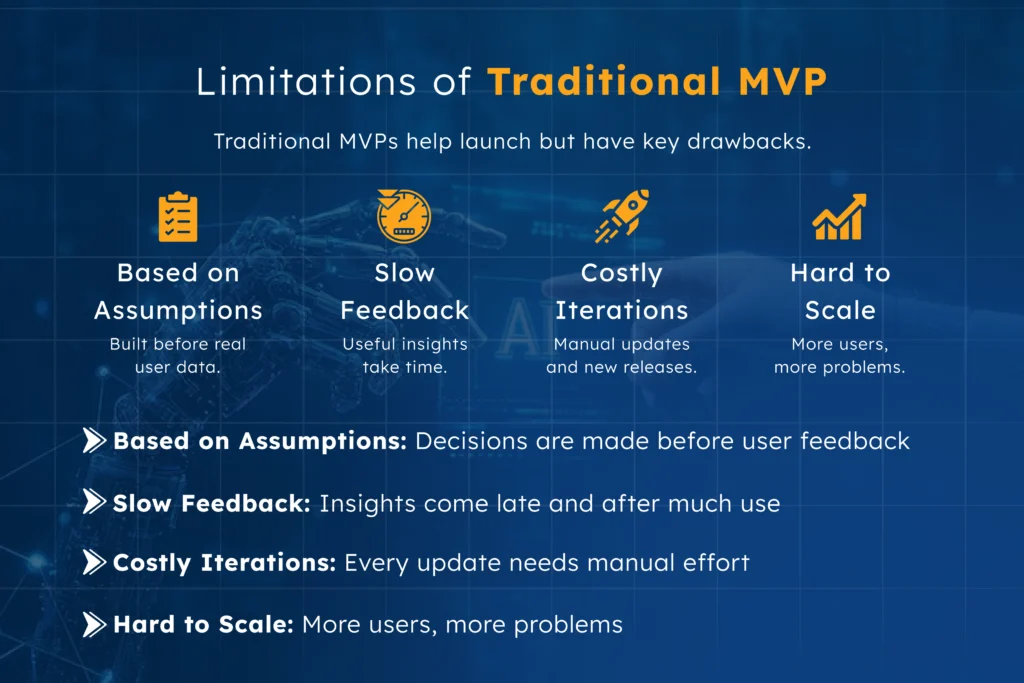
A traditional MVP helps teams get started. But it comes with clear limitations. Most traditional MVPs are built on assumptions. Teams decide features before real users interact with the product. This increases the risk of building the wrong thing.
Feedback also takes time. Users first need to discover the product. Then they need to use it long enough. Only after that does useful feedback arrive. Iteration is slow. Each change requires manual effort. Design updates. Development cycles. New releases. This makes traditional MVP development expensive over time.
Decision-making becomes difficult. Insights are based on small sample sizes. Or subjective opinions. Not real behavioral data. Scaling is another challenge. Traditional MVPs are not designed to learn or adapt. As user numbers grow, performance issues appear. Personalization becomes hard to manage.
Because of this, product validation takes longer. Mistakes become costly. And many startups lose time before reaching product-market fit.
This is where traditional MVPs fall short. And why many teams now look at AI-powered MVP development as a better alternative.
What Is an AI-Powered MVP?
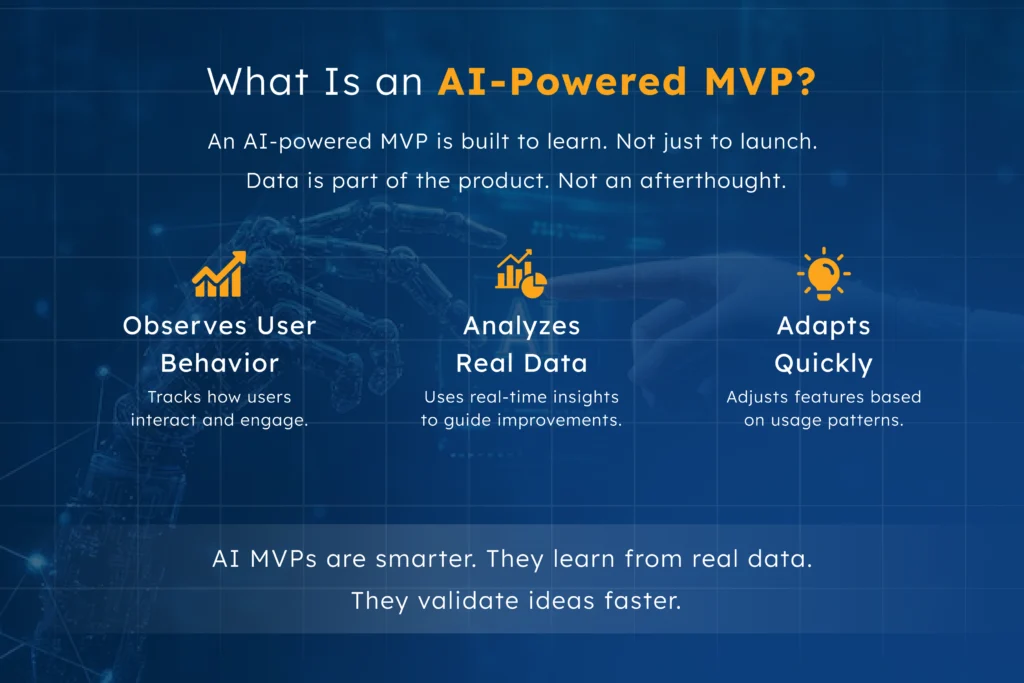
An AI-powered MVP is built to learn. Not just to launch. It uses artificial intelligence from the start. Data is part of the product. Not an afterthought.
Unlike traditional MVP development, an AI MVP does not rely only on assumptions. It observes how users behave. It tracks patterns. It adjusts based on real usage.
This makes product validation faster. And more accurate. AI-powered MVP development focuses on smarter decisions. No more features. No longer roadmaps.
How AI-Powered MVP Development Works
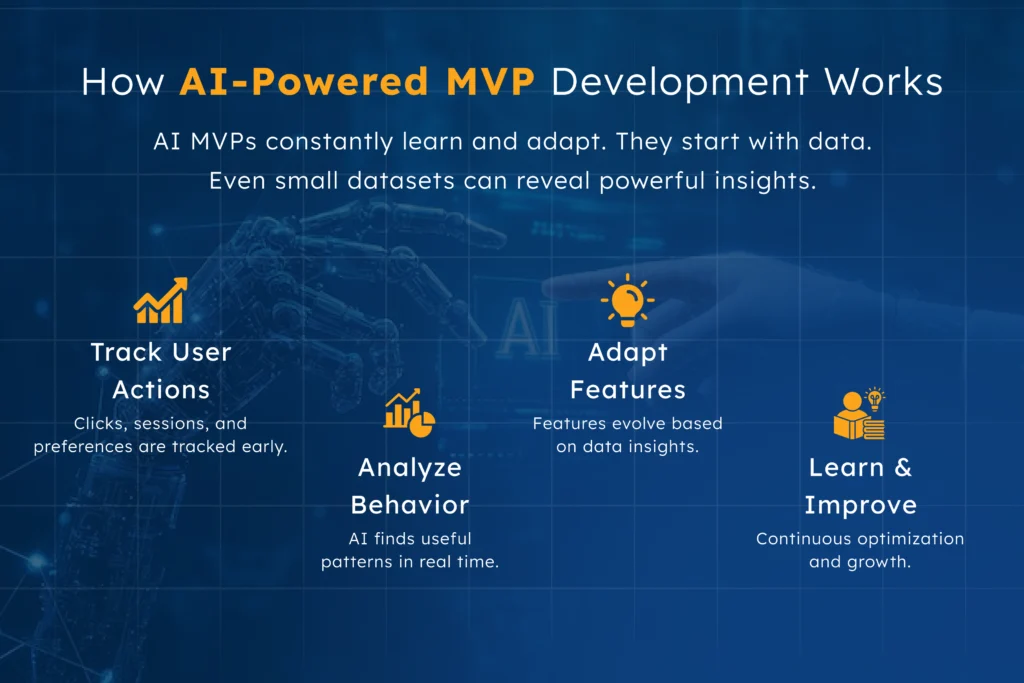
The process starts with data. Even if the dataset is small. User actions are tracked early. Clicks. Time spent. Drop-offs. Preferences.
AI models analyze this behavior. They identify patterns humans often miss. They highlight what works. And what doesn’t?
Instead of waiting for feedback cycles, learning happens in real time. Features evolve based on usage. Not opinions. Iterations become faster. Updates are informed by data. Not guesswork.
Key Capabilities of an AI-Powered MVP
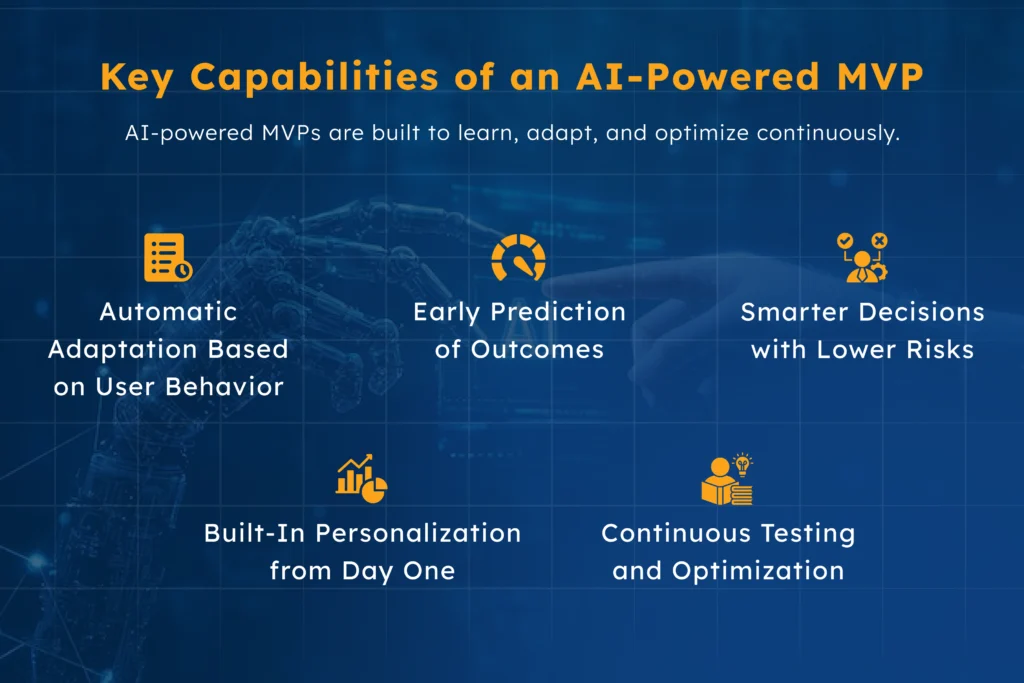
AI-powered MVPs are built to do more than launch. They are built to learn. And improve continuously.
Automatic Adaptation Based on User Behavior
An AI-powered MVP adapts on its own. It observes how users interact with the product. Then it adjusts features and flows. This reduces manual intervention. And speeds up product validation.
Built-In Personalization from Day One
Personalization is not added later. It is part of the MVP. AI-powered MVPs tailor experiences based on user data. Content changes. Recommendations improve. Journeys become smoother. This leads to better engagement early.
Early Prediction of Outcomes
AI models identify patterns quickly. Even with limited data. They help predict what users want. And what they might ignore. This supports better product decisions.
Continuous Testing and Optimization
Testing never stops in an AI-powered MVP. Experiments run in the background. Insights update in real time. There is no need to wait for long feedback cycles. Learning happens continuously.
Smarter Decisions with Lower Risks
Every interaction improves the system. Every data point adds clarity. This leads to better insights. Lower risk. And faster movement toward product-market fit.
AI-Powered MVP vs Traditional MVP: Cost Comparison
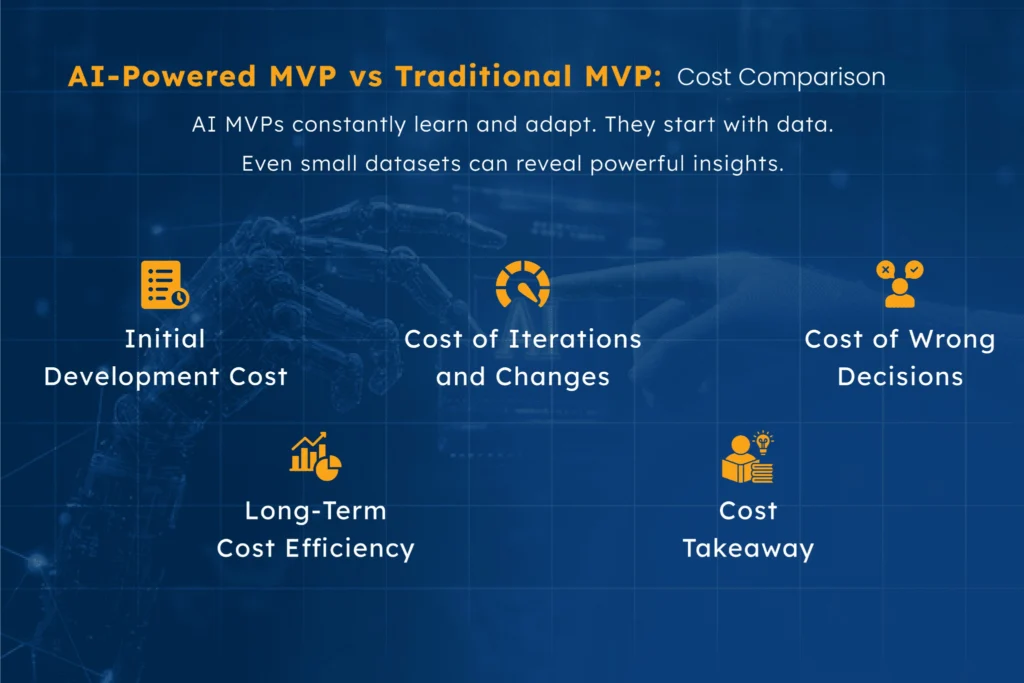
Cost plays a major role in MVP decisions. Not just the build cost. But the cost of learning. And the cost of mistakes.
Initial Development Cost
A traditional MVP often looks cheaper at first. The scope is limited. Features are basic. But most decisions are manual. Design changes take time. Development cycles repeat.
An AI-powered MVP may have a higher starting cost. Data setup. Model selection. AI integration.
But this cost supports smarter learning early.
Cost of Iterations and Changes
Traditional MVP development depends on manual updates. Each change requires new code. New testing. New deployment.
These costs add up fast. AI-powered MVPs reduce repeated work. Insights come automatically. Features evolve based on data.
This lowers the cost of frequent iterations.
Cost of Wrong Decisions
Wrong decisions are expensive. Especially early ones. Traditional MVPs rely on assumptions. If those assumptions are wrong, rework is needed.
AI-powered MVPs reduce this risk. They use real user behavior. Not opinions.
Fewer wrong decisions mean lower overall cost.
Long-Term Cost Efficiency
Traditional MVPs become expensive as they scale. More users mean more manual effort. More fixes. More resources.
AI-powered MVPs scale more efficiently. Learning improves with usage. Automation reduces overhead.
Over time, this makes AI-powered MVP development more cost-effective.
Cost Takeaway
Traditional MVPs may seem cheaper early on. But hidden costs appear later. AI-powered MVPs invest upfront. And save more over time.
AI-Powered MVP vs Traditional MVP: Cost Comparison Table
Cost Factor
Traditional MVP
AI-Powered MVP
Initial Development Cost
Lower at first due to basic features
Slightly higher due to AI and data setup
Cost of Iterations
High, as every change needs manual development
Lower, as models adapt using data
Cost of Wrong Decisions
High, due to assumption-based planning
Lower, decisions are data-driven
Feedback Collection Cost
Requires surveys, interviews, and analysis
Automated through user behavior tracking
Long-Term Development Cost
Increases with repeated rebuilds
Decreases as learning improves
Scalability Cost
High, manual processes grow with users
Lower, automation handles growth
Overall Cost Efficiency
Appears cheaper early, expensive over time
Higher upfront, cost-effective long-term
AI-Powered MVP vs Traditional MVP: Speed Comparison
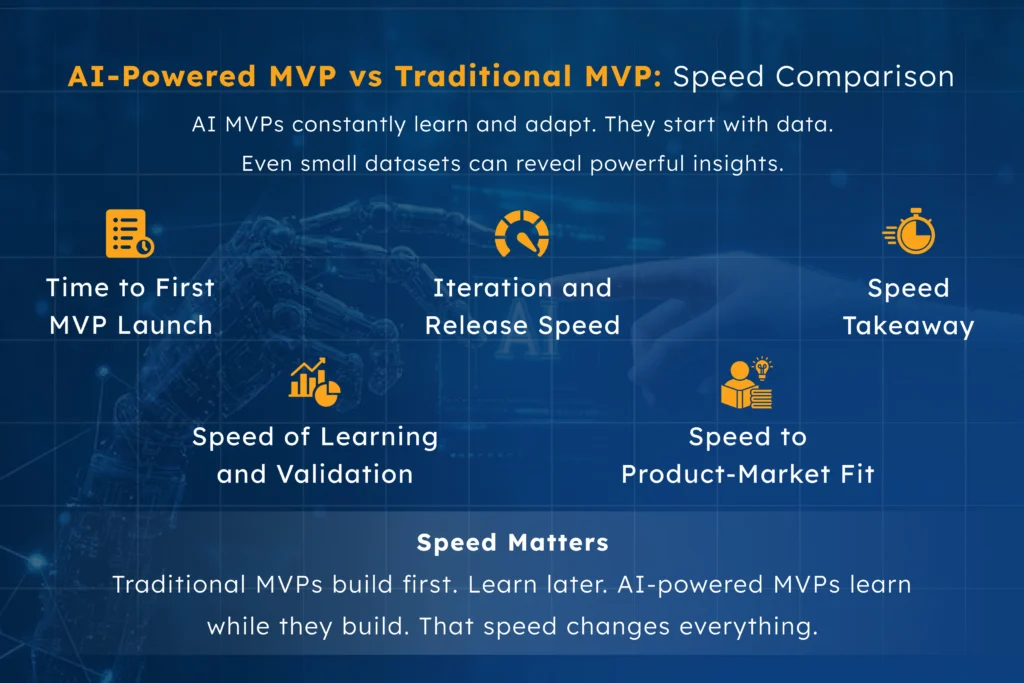
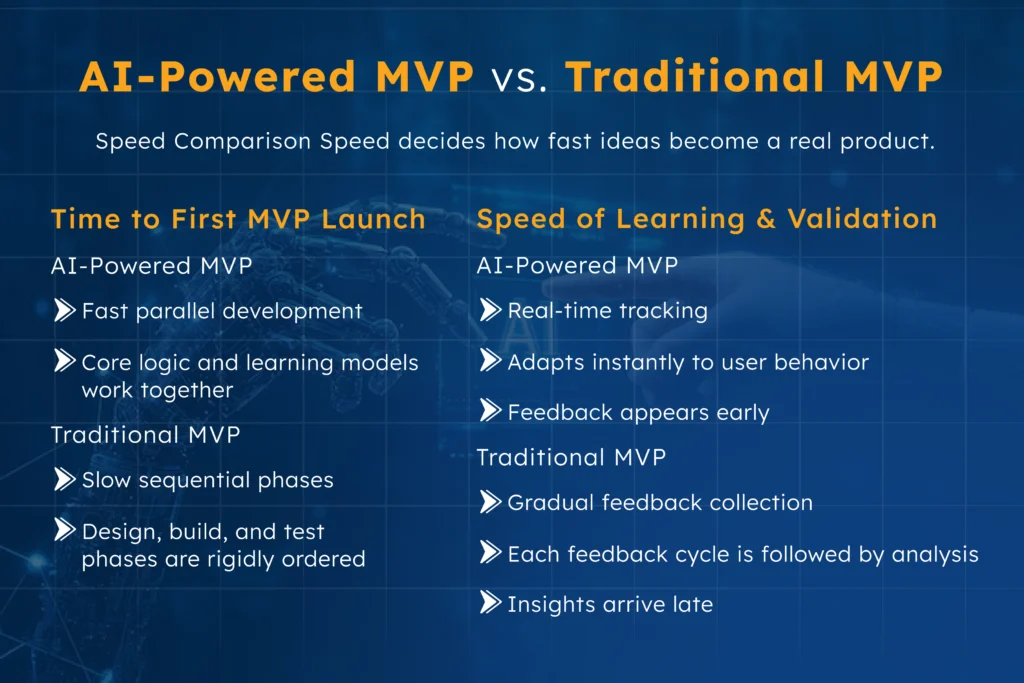
Speed decides how fast an idea becomes a real product. And how fast teams learn what works.
Time to First MVP Launch
Traditional MVP development follows a step-by-step flow. Design first. Build next. Test later.
Each phase waits for the previous one to finish. This slows down the initial launch. AI-powered MVPs move faster. Core logic and learning models run together. The product launches early. And starts learning immediately.
Speed of Learning and Validation
Traditional MVPs need time to collect feedback. Users must use the product. Then share opinions. Then, teams analyze responses. This delays product validation.
AI-powered MVPs learn in real time. User behavior is tracked instantly. Patterns appear early. Insights update continuously. Learning happens faster. Decisions improve sooner.
Iteration and Release Speed
Every change in a traditional MVP takes effort. New features require new development. Testing cycles repeat. This slows down iteration speed.
AI-powered MVPs iterate faster. Many improvements happen automatically. Models adjust without full rebuilds. Updates are smaller. And more frequent.
Speed to Product-Market Fit
Reaching product-market fit takes time. Slow learning increases risk. Traditional MVPs move carefully. But often slowly. AI-powered MVPs shorten the journey. They highlight what users want early. They reduce unnecessary features. This helps teams reach clarity faster.
Speed Takeaway
Traditional MVPs focus on building first. Learning comes later. AI-powered MVPs learn while building. And while users interact. That difference changes everything.
AI-Powered MVP vs Traditional MVP: Speed Comparison Table
Speed Factor
Traditional MVP
AI-Powered MVP
Time to First Launch
Slower due to sequential design and development
Faster with parallel build and learning
Speed of User Feedback
Delayed and manual
Real-time and continuous
Learning Cycle
Long feedback loops
Short, data-driven loops
Iteration Speed
Slow, requires manual updates
Fast, many changes happen automatically
Testing Speed
Periodic testing phases
Continuous testing in real time
Decision-Making Speed
Slower due to limited insights
Faster with live behavioral data
Speed to Product-Market Fit
Takes longer to reach clarity
Reaches clarity much faster
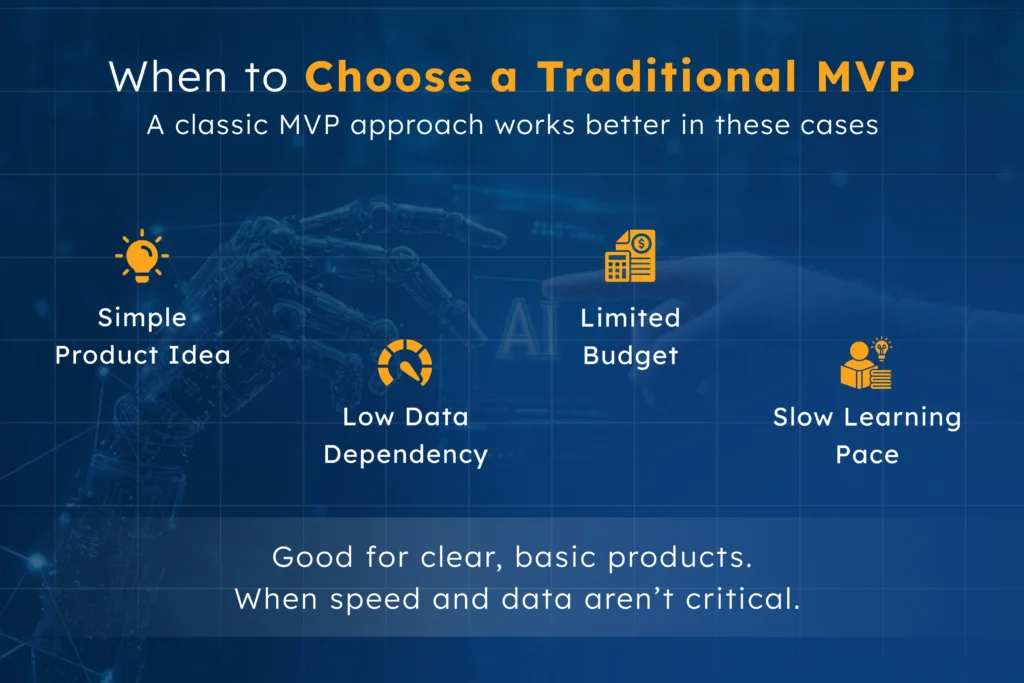
When to Choose a Traditional MVP
A traditional MVP works well when the product idea is simple. User behavior is easy to predict. And the problem is already well understood.
It is a good choice when there is no strong dependency on data. Or when AI does not add real value to the product. In such cases, traditional MVP development helps teams launch with minimal effort.
Budget can also be a deciding factor. If resources are limited and the goal is only to test basic demand, a traditional MVP can make sense. Especially for early-stage validation.
Traditional MVPs are also useful when speed is not critical. When learning can happen gradually. And when the cost of wrong decisions is low.
When to Choose an AI-Powered MVP
An AI-powered MVP is a better choice when decisions need to be backed by data. Especially when user behavior is complex. Or when outcomes are hard to predict.
It works best for products that improve with usage. Personalized platforms. Recommendation systems. Automation tools.
AI-powered MVP development is also ideal when speed matters. When teams need real insights early. And when fast validation reduces business risk.
In competitive markets, an AI MVP offers an advantage. It learns faster. It adapts quicker. And it helps teams avoid costly mistakes.
If the goal is to reach product-market fit sooner, an AI-powered MVP is often the smarter path.
Final Verdict: AI-Powered MVP or Traditional MVP?
There is no one-size-fits-all answer. The right MVP depends on the problem you are solving.
A traditional MVP works when ideas are simple. And when assumptions are low risk. It helps test demand. But learning is slow.
An AI-powered MVP is built for speed and clarity. It learns from real user behavior. It reduces guesswork. And it delivers better insights early.
If the goal is faster validation, smarter decisions, and lower long-term cost, an AI-powered MVP is the better choice. Especially in data-driven and competitive markets.
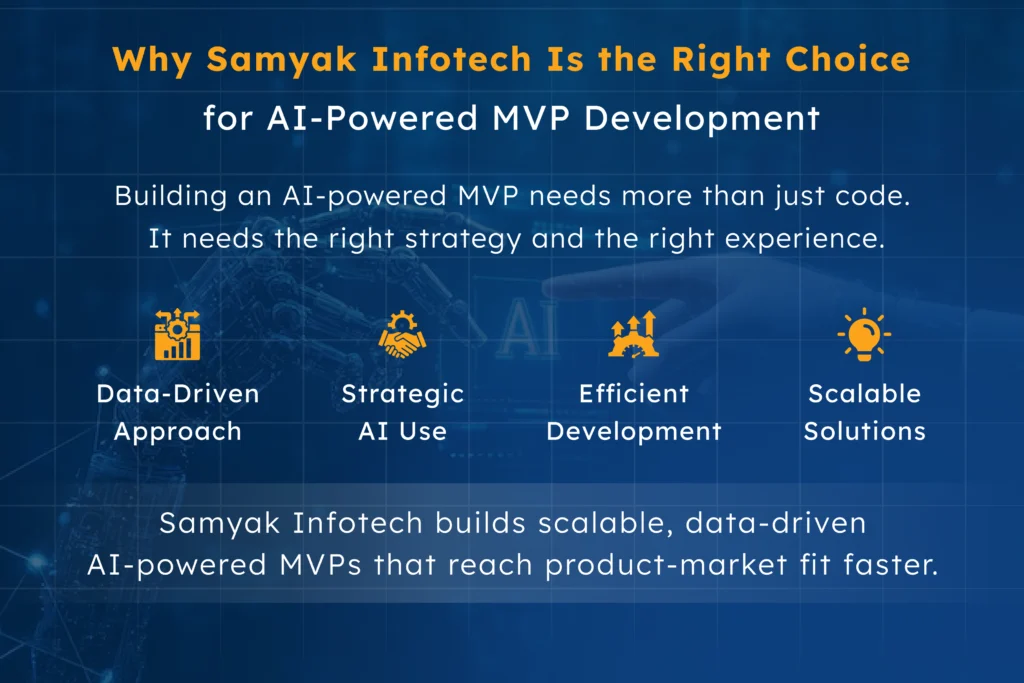
Why Samyak Infotech Is the Right Choice for AI-Powered MVP Development
Building an AI-powered MVP needs more than just code. It needs the right strategy. And the right experience.
Samyak Infotech focuses on building MVPs that learn early. Every decision is backed by data. Not assumptions. The approach starts with understanding the idea. Then, identifying where AI adds real value. Not complexity.
AI models are chosen carefully. Only what the product needs. Nothing extra.
The development process is fast. But structured. Learning begins from the first user interaction. This helps reduce risk. Lower costs over time. And reach product-market fit sooner.
For teams looking to build a scalable, data-driven product, Samyak Infotech becomes a reliable partner for AI-powered MVP development.
Frequently Asked Questions About AI-Powered MVPs
What is the difference between an AI-powered MVP and a traditional MVP?
A traditional MVP tests an idea with basic features. An AI-powered MVP learns from user data. It adapts and improves automatically.
Is an AI-powered MVP more expensive than a traditional MVP?
The initial cost can be higher. But long-term costs are often lower. Fewer wrong decisions reduce rework.
How long does it take to build an AI-powered MVP?
Most AI-powered MVPs take 8 to 12 weeks. Timelines depend on complexity and data needs.
Do AI-powered MVPs require large datasets?
No. Many AI models work with small datasets. Learning improves as usage grows.
Can a traditional MVP be converted into an AI-powered MVP later?
Yes. AI can be added in phases. But early data integration saves time.
Which startups should choose AI-powered MVP development?
Startups building data-driven products benefit the most. Especially in competitive markets.
Does AI-powered MVP development reduce failure risk?
Yes. Decisions are backed by real user behavior. This lowers uncertainty early.
Is an AI-powered MVP suitable for non-technical founders?
Yes. The right development partner handles the complexity. Founders focus on the vision.
Why choose Samyak Infotech for AI-powered MVP development?
Samyak Infotech builds MVPs that learn early. The focus is on speed, clarity, and scalability. Not unnecessary complexity.





 explore more