How to Choose the Right LLM That Fits Your Business

ON 14 February , 2026

Are you even confused about whether your business needs an LLM and how to choose one? 

With so many options available in the market today, choosing the right LLM is no longer simple. Each model works differently and has its own costs, limits, and risks involved. 

Choosing the right LLM is not just about selecting the most popular model. Rather, it is about picking the one that fits your use case, data, and long-term goals. 

This guide explains how to choose the right LLM using clear, practical factors that actually matter for businesses. 

A Large Language Model (LLM) is a type of AI designed to understand and generate text that resembles human language. It learns from large datasets of written content and predicts the next word based on the context, enabling it to respond to queries like a human would. For example, when a customer asks, “What services do you offer?” an LLM reads the question, comprehends the intent, and generates a relevant and clear answer in seconds. Businesses use LLMs in a variety of applications: Support teams leverage LLMs to answer customer inquiries quickly and accurately. HR teams use them to search through internal documents and find information faster. Marketing teams use LLMs to draft content more efficiently. However, not all LLMs are the same. Some models are designed for simple, quick responses and are cost-effective, while others are better equipped to handle more complex tasks like analyzing long-form texts but come at higher costs and require more setup. This makes choosing the right LLM for your specific needs a critical decision.

What is an LLM? 

A large language model is a type of AI that understands and generates texts. It learns from a large amount of written data and predicts the next word based on the context. In simple terms, an LLM reads a question and replies like a human. 

For example, if a customer asks, “What services do you offer?” an LLM can read that question, understand the intent, and generate a clear answer in seconds. 

Businesses use LLM in many different ways: 

  • A support team may use LLM to answer customer queries. 
  • An HR team may use it to search internal documents faster. 
  • A marketing team can use it to draft content faster. 

Also, not every LLM works the same way. Some models are good for simple questions; they are fast and cost less. While the others can handle complex tasks and analyze long texts but are available at higher costs and need more setup. This is the reason why choosing the right LLM model matters. 

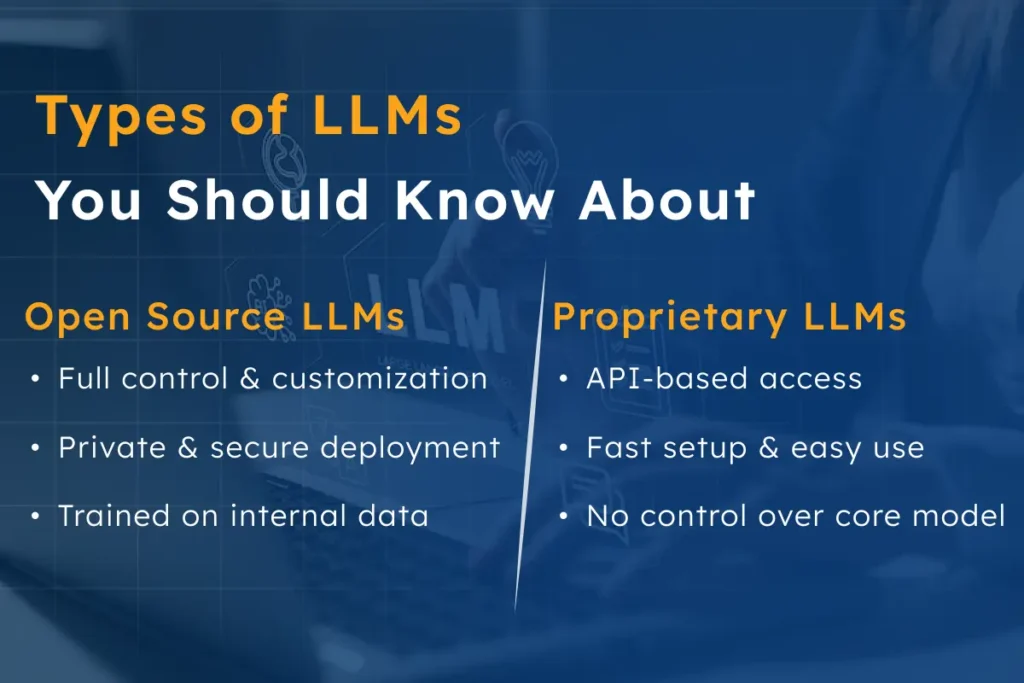
Types of LLMs You Should Know About

Not all LLMs work the same way. They are mainly divided into two types. Understanding the difference makes the rest of the decision easier. 

Open Source LLMs 

Open source LLMs are the ones that are publicly available. Businesses can access the core model. They can modify it and train it on their own data, which gives them full control. 

Example: 

A healthcare company wants an internal assistant who should be trained on private patient data. Data privacy turns out to be important. An open-source LLM can be deployed on private servers and customized for this use. 

Open-source LLMs are often used for: 

  • Industry business tools 
  • Industry-specific solutions 
  • Secure deployments 

Proprietary LLMs 

Proprietary LLMs are owned by vendors. Businesses can access them through APIs. The core model cannot be changed, which allows fast setup. 

Example: 

Tools like ChatGPT are proprietary LLMs. They are easy to use and quick to get started with. But users cannot handle how the LLM is trained or deployed. 

Another example: 

A startup wants to test a customer support chatbot quickly. A proprietary LLM helps to launch a pilot quickly in a short time. 

Proprietary LLMs are often used for: 

  • Quick testing 
  • Short-term pilots 
  • General-purpose use 

Does Your Business Need an LLM?

Not every business requires an LLM model and that is okay. A large language model only makes sense when data is a big part of your work. This includes questions, documents, or conversations. 

You might need an LLM if: 

  • Customers frequently ask similar questions 
  • Teams spend time searching for documents 
  • The content creation process is slow 
  • Text data is growing every single day 

But in cases where the workflow of the businesses is very simple, an LLM may not add value. In such cases, basic automation can work. This step turns out to be important. Choosing the right LLM model can only help when an LLM is truly needed.

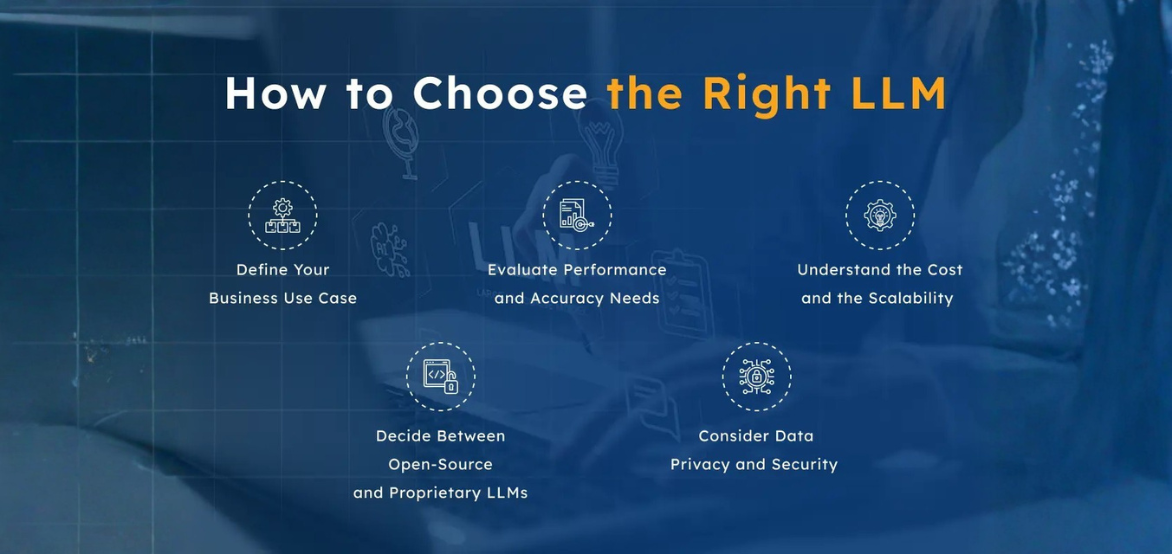
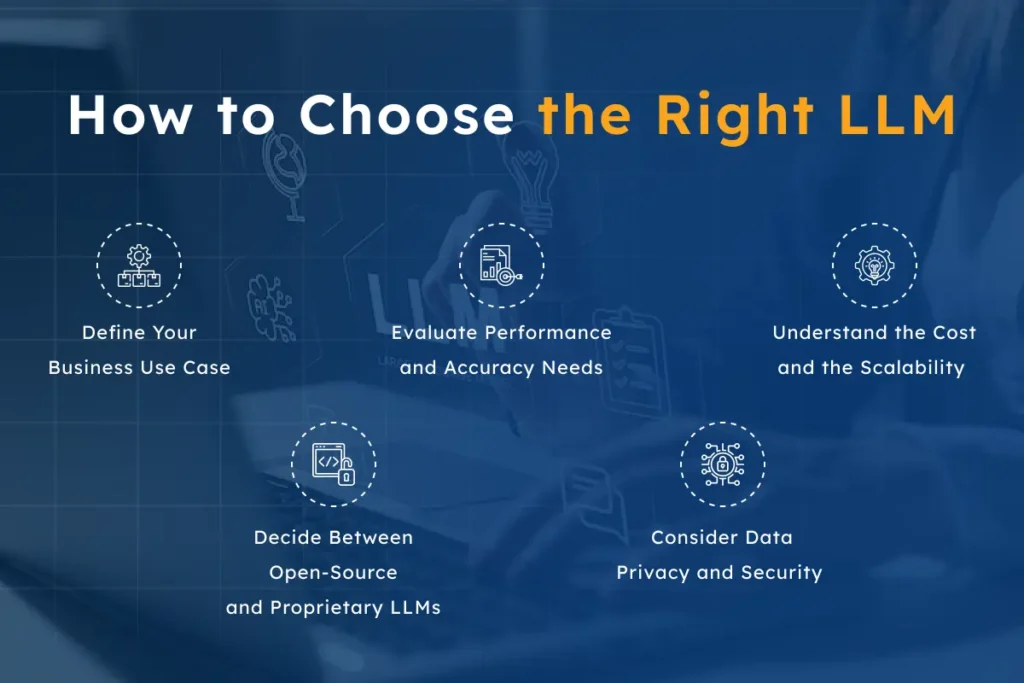
Once you know your business needs an LLM, the next step is choosing the right one. The perfect model depends on your use case, data, budget, and scale. Here are the key steps to follow: Step 1: Define Your Business Use Case Start by defining the task at hand. Understand what the LLM needs to do, who will use it, and how frequently. Different use cases require different LLMs, and having clarity will make the decision easier. Step 2: Decide Between Open-Source and Proprietary LLMs Choose between control and speed. Open-source LLMs offer more customization and private deployment, making them ideal for long-term use. Proprietary LLMs are faster and better for quick testing and pilots. Step 3: Evaluate Performance and Accuracy Needs Consider the complexity of the task. Some tasks require speed, while others need deep reasoning or context awareness. Balance the performance needed with the cost to avoid unnecessary expenses. Step 4: Consider Data Privacy and Security Understand what data the LLM will handle and assess the privacy risks. For sensitive data, control over data is essential. If the LLM processes public data, privacy concerns are lower, but they should still be addressed. Step 5: Understand the Cost and the Scalability Consider both the initial cost and future scalability. Think about the number of users, frequency of use, and potential growth. The LLM should be able to scale as your business grows without compromising performance.

How to Choose the Right LLM 

Once you know your business needs an LLM, the next step involves choosing the right one. There is no single best model for every business. The right choice depends on the use case, data, budget, and scale. If you choose a clear approach, it will help you to avoid wasted costs. 

Below are the key steps to follow when choosing the right LLM model for your business.

Step 1: Define Your Business Use Case

Before choosing an LLM model, define the problem. Do not start with the technology; start with the task. 

Take into consideration simple questions like: 

  • What should the LLM do? 
  • Who will use it? 
  • How often will it be used?

Different use cases need different LLMs. Choosing the wrong LLM can increase the cost and reduce quality. Clarity makes choosing the right LLM easier.

Step 2: Decide Between Open-Source and Proprietary LLMs

Once the use case is clear, the next step involves choosing the type of LLM. This decision shapes everything that follows. 

This involves choosing between control and speed. Open-source LLMs give more control and allow customization. Also, along with this, they support private deployment, which turns out to work well for long-term use. 

On the other hand, proprietary LLMs offer speed. They are easy to access and help with quick testing and early pilots. 

In case you are looking for an LLM to handle sensitive business data, control is something that matters most, while if you are testing an idea, speed matters more. Choosing the right type of LLM can reduce risk. It also avoids unnecessary costs later. 

This step is critical when choosing the right LLM for your business. 

Step 3: Evaluate Performance and Accuracy Needs 

Not every LLM needs the same level of performance. Some tasks are simple, while a few are complex. The next step involves understanding what the LLM must handle. 

For example: 

Answering common customer questions needs speed. Summarizing long documents needs context awareness. Analyzing reports needs strong reasoning. Choosing a powerful LLM for a basic task can waste money, and at the same time, choosing a weak one for complex tasks leads to poor results.  

This is the reason why performance matters when choosing the right LLM. The goal is balance, not excess. 

Step 4: Consider Data Privacy and Security 

Data is the key aspect of every LLM project. This makes privacy a serious concern. Start the process by asking what type of data the LLM will access—customer data, internal documents, or business-sensitive data. 

There are some LLMs that process data on external servers. Others can be deployed in private environments. 

For example: 

If the LLM will read internal reports, data control turns out to be important. And in the case if it handles public information, the risk is lower. Ignoring privacy can lead to compliance issues and also it reduces the user’s trust. 

Step 5: Understand the Cost and the Scalability 

Cost is not just about the starting price. It grows as the usage increases. There are a few LLMs that require infrastructure and maintenance.

While choosing a particular LLM start with basic questions like: 

  • How many users will be able to access the LLM 
  • How often it will be used 
  • Will the usage increase in future 

For example, an LLM that is used by one team may cost little while the same that is used across multiple departments can turn out to be expensive. 

Scalability is important as much as the cost. The LLM you choose should handle growth without breaking performance. 

This step helps to make sure that you are choosing the right LLM for today and tomorrow. 

Choosing the right LLM is just the first step. Building it the right way matters even more. Samyak Infotech is an LLM development company that focuses on real business use cases. We design LLM solutions that are tailored to your data, workflows, and scale. Our approach begins with understanding your specific needs. At Samyak Infotech, we don’t rely on ready-made tools; instead, we build custom LLMs that are optimized for your business. We help with: Use case evaluation Open-source LLM development Domain-specific fine-tuning Private and secure deployment Cost and performance optimization Our LLM development process emphasizes ownership and control, allowing businesses to avoid long-term dependency and escalating costs. If you are serious about adopting AI, getting the right foundation is crucial. That's where Samyak Infotech adds real value.

How Samyak Infotech Helps You Choose and Build the Right LLM 

Choosing the right LLM is just the first step. Building it the right way matters even more.

Samyak Infotech is an LLM development company that is focused on real business use cases. We design LLM solutions that fit your data, workflows, and scale. Our approach starts with understanding your needs. At Samyak Infotech, we do not push ready-made tools; we build custom LLMs that work for your business. 

We help with: 

  • Use case evaluation 
  • Open source LLM development 
  • Domain-specific fine-tuning 
  • Private and secure deployment 
  • Cost and performance optimization 

Our LLM development process focuses on ownership and control. This helps businesses avoid long-term dependency and rising costs. In case you are serious about adopting AI, the right foundation matters. That is where Samyak Infotech helps in adding real value. 

Choosing the right LLM is more than just a technical step—it's a crucial business decision. The right LLM improves efficiency, reduces manual work, and scales with your business growth. In contrast, the wrong choice can increase costs, create dependency, and limit future flexibility. Clarity is key to making the right choice. When you understand your use case, data, and goals, the decision becomes easier. This clarity helps you avoid chasing trends and instead focus on building long-term value. This is where having the right development partner, like Samyak Infotech, makes a difference. We help businesses move beyond mere experimentation, delivering LLM solutions that are customized, secure, and scalable. With the right development approach, your LLM becomes a long-term asset rather than a risk or a short-term fix. Choosing the right LLM today sets the foundation for smarter systems tomorrow.

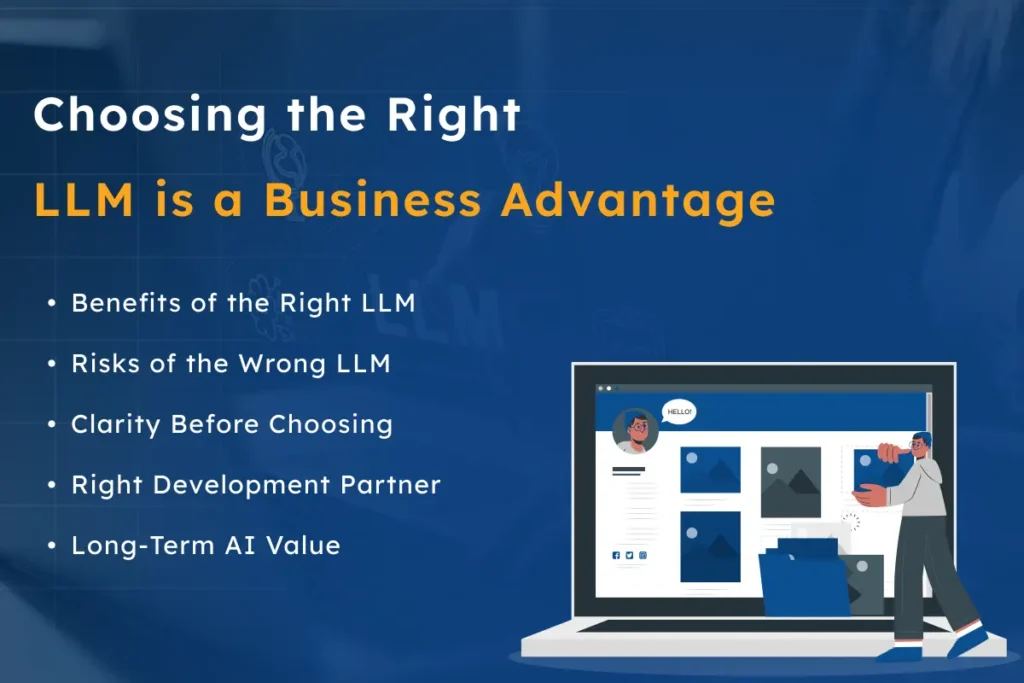
Choosing the Right LLM is a Business Advantage 

Choosing the right LLM is not just one technical step; it is a business decision. The right LLM helps in improving efficiency, reducing manual work, and scales with your growth. And at the same time, choosing the wrong LLM can increase cost, create dependency, and also limit future flexibility. 

That is the reason why clarity matters. When you understand your use case, data, and goals, the decision becomes easier. You stop chasing trends and start building value. 

This is where the right development partner makes a difference. Samyak Infotech helps businesses move beyond experimentation. We focus on building LLM solutions that are customized, secure, and scalable. 

With the right development approach, an LLM becomes a long-term asset and not a risk or a short-term fix. 

Choosing the right LLM today sets the foundation for smarter systems tomorrow.

Frequently Asked Questions About Choosing the Right LLM

How do I choose the right LLM for my business?

Start by defining your use case. Understand what tasks the LLM should handle. Then evaluate performance, data privacy, and cost. This approach helps in choosing the right LLM without overcomplicating the decision.

There is no single best LLM for every business. The right choice depends on your data, scale, and customization needs. Businesses with long-term goals often prefer open-source LLMs.

Open-source LLMs allow customization and private deployment. Proprietary LLMs are accessed through APIs and offer faster setup. Choosing the right LLM depends on control versus speed.

No. Using ChatGPT means accessing a proprietary LLM. Building an LLM involves customizing and deploying models for specific business needs.

Yes, when deployed correctly. Open-source LLMs can be hosted in private environments. This makes them suitable for handling sensitive business data.

The cost depends on usage, infrastructure, and scale. Some LLMs have usage-based costs. Others require upfront development and hosting investment.

Yes. LLMs can be fine-tuned using industry-specific data. This improves accuracy and relevance for business use cases.

LLM development requires expertise in data, infrastructure, and scalability. An LLM development company helps avoid costly mistakes. It also ensures long-term performance and control.

Latest News from our end!

Wait! Don’t Leave Without This !!

Get 1 Week of Free Custom AI Development

Our AI experts will help you prototype, automate, or build AI-powered solutions — risk-free.
⚡ Limited-time offer for new users.