Are businesses ready to work with intelligent systems? Many leaders are now looking at AI agents in business. These systems help with daily tasks across teams. They reduce manual work and cut down delays. This leads to faster and more consistent results.
Interest in agentic AI in business is growing. Organizations want smarter and more flexible tools. These tools can plan tasks, take action, and respond to changing business needs. This makes operations more flexible and efficient.
Leaders are studying real agentic AI use cases in businesses. They want to see where value appears. Common areas include sales, service, and logistics.
Early results show strong productivity improvements. Businesses now view AI as operational support.
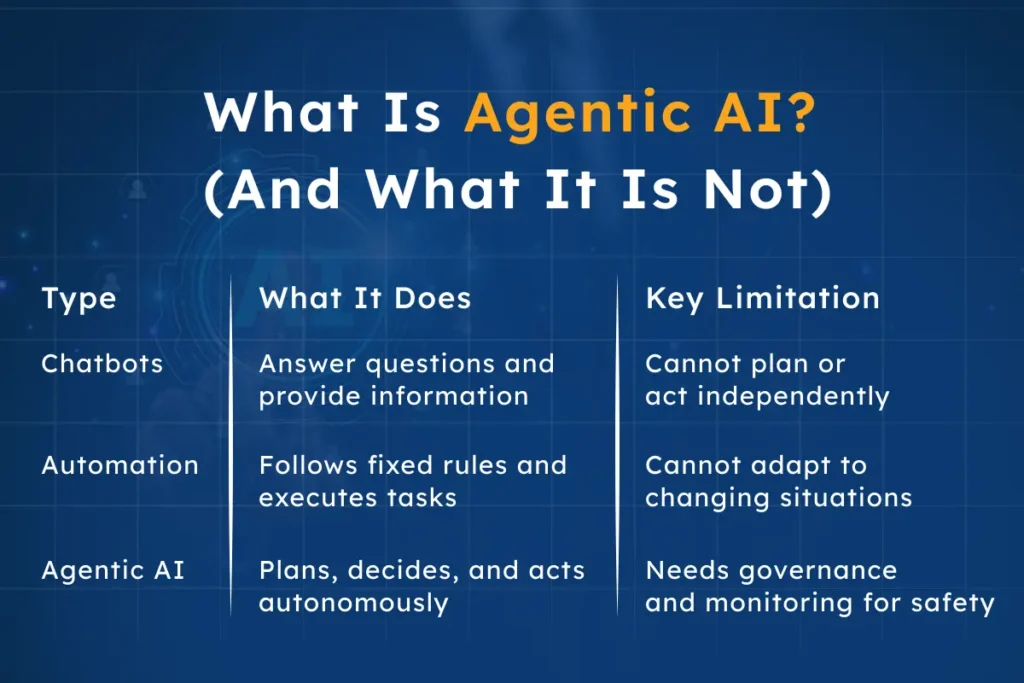
What Is Agentic AI? (And What It Is Not)
Agentic AI refers to systems that plan, decide, and take action, going beyond simple tools like chatbots by independently managing tasks across teams.
Traditional tools differ in function and purpose: chatbots answer questions and provide information, while automation follows fixed rules to complete assigned tasks. Both lack flexibility and cannot adapt to changes.
Here’s a clear comparison:
Type
What It Does
Key Limitation
Chatbots
Answer questions and provide information
Cannot plan or act independently
Automation
Follows fixed rules and executes tasks
Cannot adapt to changing situations
Agentic AI
Plans, decides, and acts autonomously
Needs governance and monitoring for safety
Agentic AI in business can observe situations. It decides next steps and coordinates actions. This makes it far more dynamic than automation.
Why Governance Is Non-Negotiable
Implementing autonomous systems requires strong governance, as unclear rules can lead to unintended actions, operational errors, and reputational risks. Strong oversight ensures AI contributes safely to business goals.
Proper frameworks help manage risk effectively while allowing innovation.
Decision Boundaries
AI systems need clear limits. They define what actions are allowed. Boundaries prevent mistakes while maintaining flexibility. Companies can set rules for:
What AI can do
When human approval is required
Which tasks are fully autonomous
Human Oversight
Even autonomous AI requires supervision. Supervisors review important decisions and step in when needed. Oversight ensures accountability and prevents costly errors. Combining human judgment with AI autonomy makes systems reliable.
Risk Management and Compliance
Governance includes risk and regulatory readiness. Businesses must track operational, financial, and legal risks. Audit trails and reporting maintain transparency. Following laws and standards keeps AI adoption safe and trusted.
Many organizations partner with AI consulting services to design these frameworks. Experts help define boundaries, oversight, and risk controls. This approach makes implementing agentic AI in business structured and secure.
Technical Safeguards That Make Autonomy Safe
Even advanced AI agents in business need strong safeguards. Autonomous systems without proper protection can make costly mistakes. This prompts companies to use technical measures to ensure safe operation.
These safeguards protect operations while letting AI perform effectively.
Permissions and access levels define what AI can do. Restricting sensitive tasks prevents errors or misuse. Companies assign roles and approval requirements to each agent. This ensures AI acts only where it is authorized.
Observability and monitoring create transparency in AI actions. Teams track decisions using dashboards and logs. Monitoring allows quick detection of issues and corrective steps. It ensures AI behaves as intended over time.
Accountability and escalation systems add extra safety. Every action links to the responsible team. Unusual or high-risk decisions automatically trigger human review. This combination of oversight and escalation reduces operational risks.
Many organizations use AI consulting services to implement these safeguards. Experts guide the setup of permissions, monitoring, and escalation. This approach makes autonomous AI systems secure and reliable.
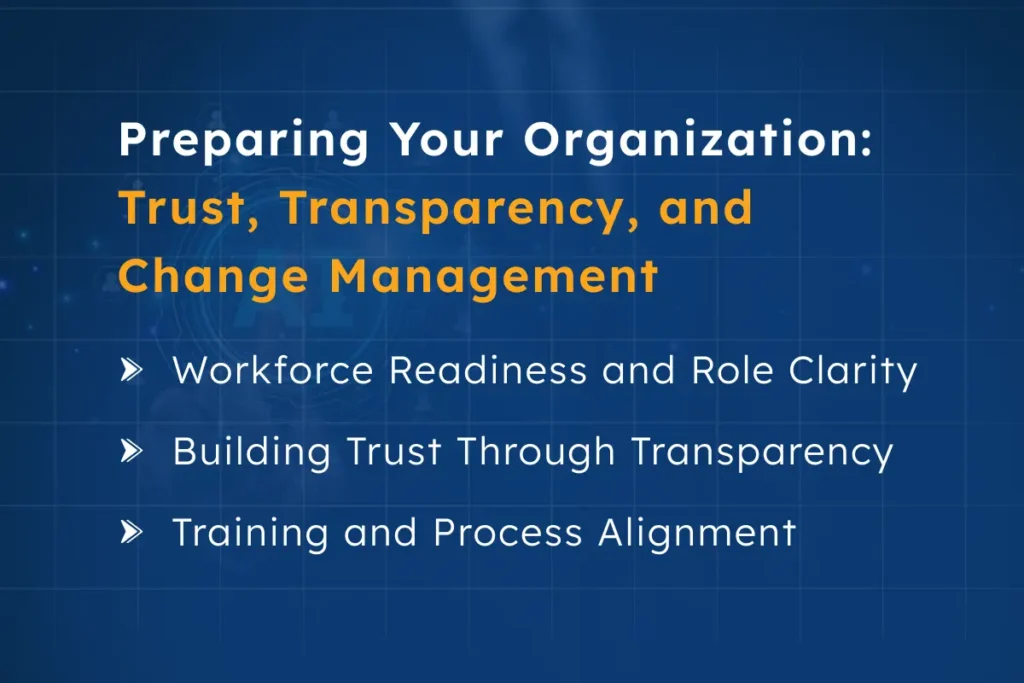
Preparing Your Organization: Trust, Transparency, and Change Management
Workforce Readiness and Role Clarity
Employees must understand how AI supports their work rather than replaces it
Routine tasks can shift to AI, allowing teams to focus on strategic and high-value activities
Clear communication reduces resistance and builds confidence
Building Trust Through Transparency
Employees should understand how AI systems make recommendations
Explainable outcomes increase confidence in AI-driven decisions
Transparent processes encourage collaboration between humans and AI
Training and Process Alignment
Teams should be trained to supervise and interact with AI agents
Workflows may need adjustment to align with AI capabilities
Proper implementation ensures security, reliability, and alignment with business goals
Agent Design Models to Know Before You Build
Choosing the right design model is crucial. Different approaches suit different workflows and tasks. Understanding these models helps implement AI agents in business effectively. Proper selection ensures agents are efficient, scalable, and aligned with goals.
Common agent design models include:
Single-Agent Systems—One AI handles a specific task. Simple to deploy and efficient for narrow functions.
Multi-Agent Systems—Multiple agents collaborate to achieve shared goals. Ideal for complex operations requiring coordination.
Supervisor–Worker Structures—A principal agent oversees others’ tasks. Ensures accountability and better decision-making across workflows.
Human-in-the-Loop Models—Humans review critical decisions. Combines autonomy with human judgment for safety and reliability.
Task-Based vs. Goal-Based Agents—Task-based agents follow predefined steps. Goal-based agents focus on achieving outcomes, adapting along the way.
Many companies rely on AI agent development services for these implementations. Experts help with custom AI agent development and building AI agents for business workflows. This ensures the right model is chosen for maximum impact.
Data and Infrastructure Readiness
Firm foundations are critical for AI agents in business. Without clean data and reliable systems, AI cannot perform effectively. Proper infrastructure ensures agents act accurately and support real-time decisions.
Planning for readiness reduces errors and operational risk.
Clean and Connected Data
Data must be accurate, complete, and connected across systems. AI agents rely on quality inputs to make decisions. Disconnected or messy data reduces performance and trust. Ensuring data hygiene is the first step in readiness.
Systems Integration
AI works best when systems are integrated. Agents need access to enterprise tools, workflows, and databases. Smooth integration allows seamless coordination across departments. This reduces manual intervention and improves operational efficiency.
APIs and Tools
APIs and tools enable AI to interact with other software. They provide flexibility for agents to execute complex tasks. Selecting the right tools ensures long-term scalability. Proper design allows agents to leverage existing systems effectively.
Real-Time Decision Support
Agents must act on data in real time. Immediate insights improve the speed and accuracy of decisions. This capability is essential for dynamic business environments. Monitoring and analytics help maintain consistent performance.
Many organizations leverage AI consulting services for readiness planning. Experts assist with AI infrastructure planning and AI implementation consulting. This ensures agentic AI in business operates safely and efficiently.
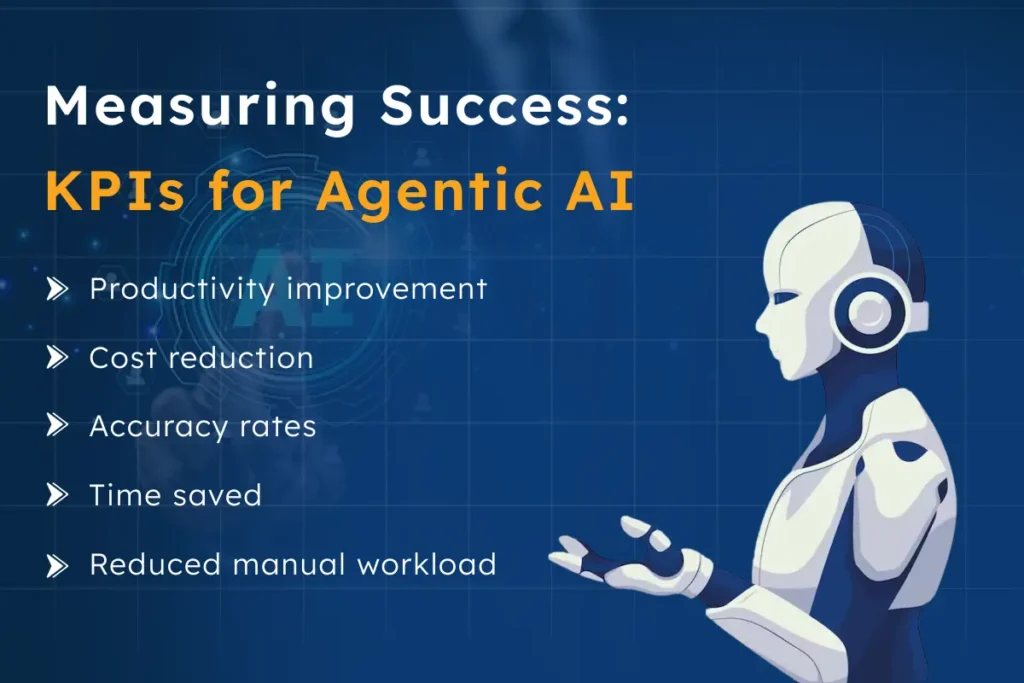
Measuring Success: KPIs for Agentic AI
Tracking performance is essential for AI agents in business. Organizations need clear metrics to evaluate impact and ROI. Proper KPIs show where agents improve efficiency, reduce errors, and support decision-making.
Measuring results helps refine strategies and scale AI effectively.
Key performance indicators often include:
Productivity improvement—Faster completion of tasks across teams.
Cost reduction—Lower operational and labor costs.
Accuracy rates—Correct decisions and fewer errors.
Time saved—Less manual effort and faster execution.
Reduced manual workload—Teams focus on higher-value activities.
By tracking these KPIs, businesses can measure real value from AI. They also identify areas for improvement and future scaling. Understanding metrics ensures agentic AI in business delivers meaningful outcomes.
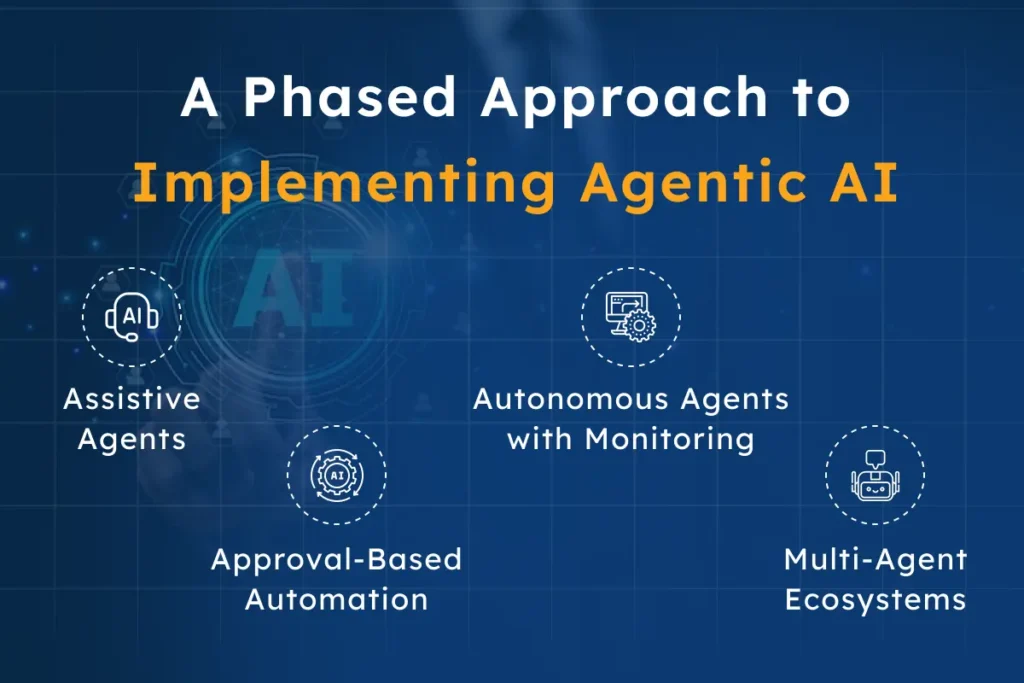
A Phased Approach to Implementing Agentic AI
Implementing autonomous systems works best in stages. A phased approach reduces risk and ensures success. Businesses can scale safely while improving performance. Proper planning allows AI to deliver real value gradually.
Stage 1: Assistive Agents
The first stage introduces AI as an assistant. Agents support tasks while humans remain in control. Teams learn to work alongside AI effectively. This stage builds familiarity and confidence in automation.
Stage 2: Approval-Based Automation
AI performs tasks but requires human approval for critical actions. This reduces mistakes and increases trust. It allows businesses to test workflows safely. Oversight ensures AI decisions align with organizational goals.
Stage 3: Autonomous Agents with Monitoring
Autonomous AI agents act independently while being monitored continuously. Humans review exceptions or unusual decisions. This stage unlocks efficiency while maintaining safety. Proper monitoring balances autonomy with accountability.
Stage 4: Multi-Agent Ecosystems
Multiple agents coordinate to achieve complex goals. They communicate and collaborate across departments. This stage enables fully integrated AI workflows. Teams benefit from higher productivity and smarter operations.
Many organizations partner with an AI agent development company. Experts act as an experienced AI implementation partner, guiding roadmap execution and scaling. This ensures a structured, reliable, and safe adoption of agentic AI in business.
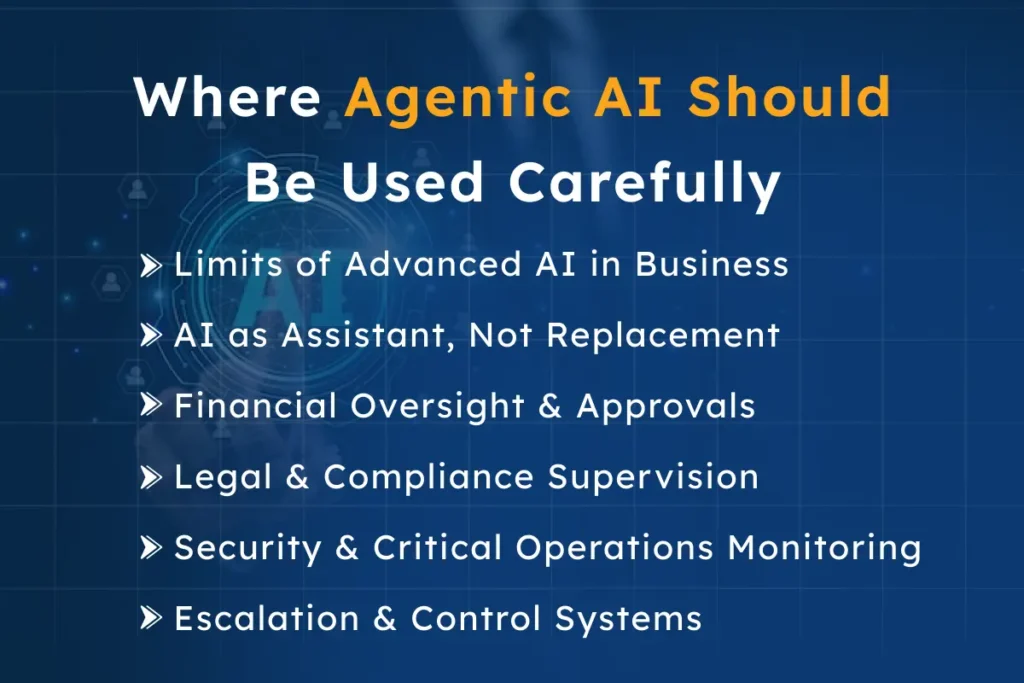
Where Agentic AI Should Be Used Carefully
Even advanced AI agents in business have limits. High-risk decisions require human judgment to avoid costly errors. AI should assist, not replace, humans in sensitive areas.
Financial approvals need careful oversight. Human checks prevent losses and ensure accountability. Legal and compliance tasks also require supervision. Humans interpret rules that AI cannot always understand.
Critical operations, like security or infrastructure, demand continuous monitoring. Escalation systems keep control while AI supports tasks. Balanced adoption combines autonomy with human expertise for safe operations.
Build vs. Buy: Choosing the Right Strategy
Businesses must buy off-the-shelf AI or build custom agents. Ready-made tools are fast but less flexible. Custom agents fit complex workflows and unique needs. Choosing the right path balances cost, speed, and impact.
Custom development works when processes are highly specific. AI aligns with internal systems and business goals. Building ensures scalability but needs skilled talent. Not all companies have in-house AI expertise.
Many turn to AI outsourcing for support. Experts deliver custom AI agent solutions and enterprise AI agent development. This reduces risk while providing tailored, high-quality AI.
Final Thoughts: Implementing Agentic AI the Right Way
Agentic AI can change how businesses work safely. Responsible use balances AI independence with human control. This helps teams build trust while processes get better over time.
A strategic rollout reduces risks and maximizes impact. Start small, test workflows, and scale gradually. This approach builds confidence and efficiency.
Thoughtful AI adoption drives long-term transformation. Decisions are faster, errors are reduced, and operations improve. Organizations gain a competitive advantage in efficiency and speed.
For businesses ready to explore AI safely, Samyak Infotech provides guidance and expertise. They help unlock the full potential of agentic AI in business.






 explore more