What is White-Label Software?

Person Analyzing White-Label Software Dashboard
ON 13 April , 2026

What is White-Label Software? 

What is white-label software, and why are businesses using it to launch products faster? Many companies want quick market entry. Building software from scratch takes time, investment, and technical expertise.

In today’s SaaS-driven market, speed matters, especially for businesses that rely on custom software development services. Companies want to offer digital products without managing full development cycles.

Many businesses ask, What is white-label software? It refers to software built by one company and sold by another under the other company’s brand.

White-label software makes it easier to launch products. It reduces development pressure. It helps businesses focus on growth, sales, and customer relationships rather than on product development.

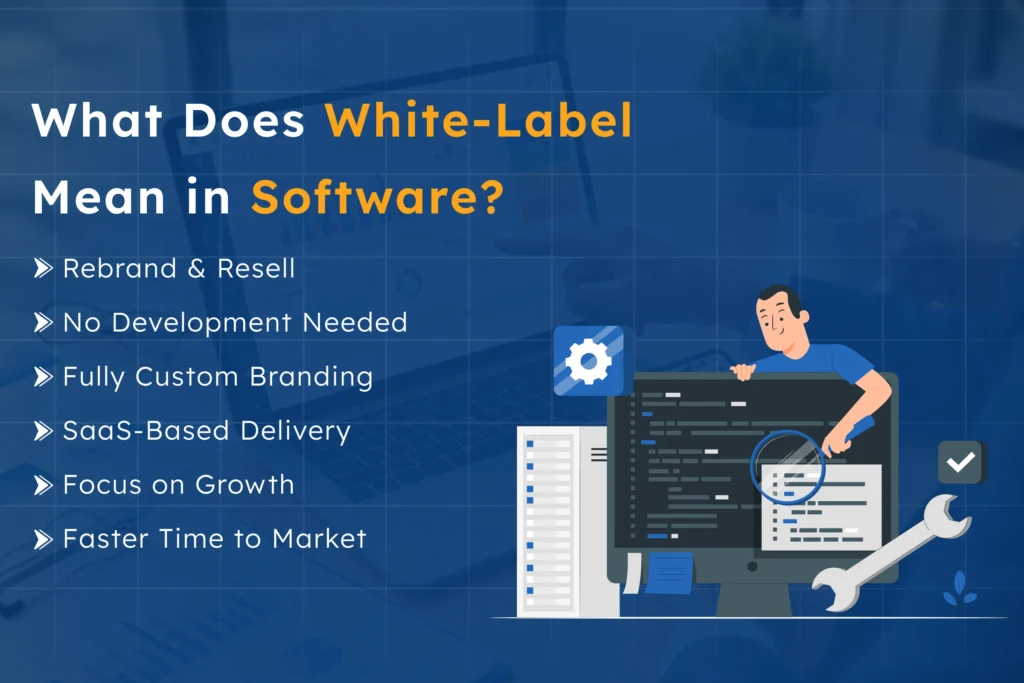
An infographic explaining what is white-label software, highlighting its benefits such as rebranding and reselling, no development needed, custom branding, SaaS-based delivery, growth focus, and faster time to market. It features illustrations of a developer and computer code alongside key points.

What Does White-Label Mean in Software?

White-label software is developed by one company and rebranded by another for sale under the rebranding company’s name. The end customers see only the reseller’s brand.

What is white labelling in software? It refers to customizing an existing product’s branding. This includes logos, domain names, interface elements, and brand identity.

The original provider builds and maintains the software. The reseller does not develop the product from scratch. Instead, it focuses on sales, marketing, and customer acquisition.

Most white-label software is delivered through the SaaS model. Clients access it through subscriptions. The provider manages updates, security, and infrastructure in the background.

Brand ownership stays with the reseller. Development ownership stays with the provider. This structure allows businesses to launch products quickly without building internal engineering teams.

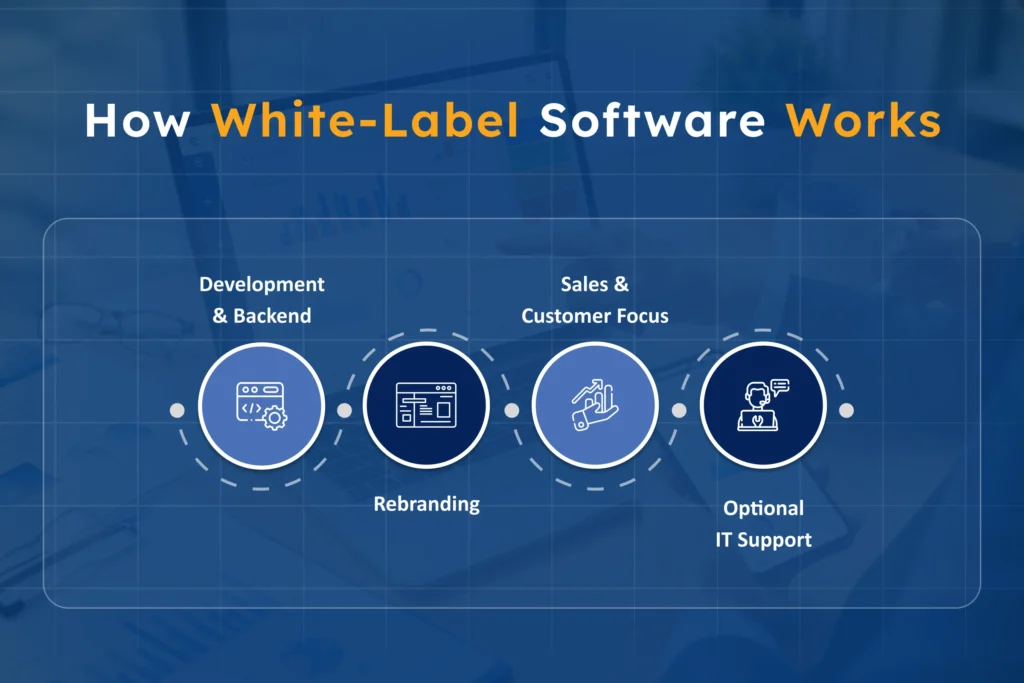
An infographic showing how white-label software works, from development and backend management by the provider to rebranding by the reseller, focusing on sales and customer acquisition, and offering optional IT support. The process is visualized through icons and key steps.

How White-Label Software Works

White-label software lets businesses sell products under their own brand. The provider builds and maintains the software. The reseller focuses on branding, sales, and growth.

  • Development and Backend: The provider builds the software. They handle updates, security, and backend development.
  • Rebranding: The reseller adds logos, colors, the domain, and interface elements. This creates a unique brand identity.
  • Sales and Customer Focus: The reseller manages marketing and client acquisition. They do not handle technical tasks.
  • Optional IT Support: Companies can use IT outsourcing services. This speeds up setup and reduces workload.
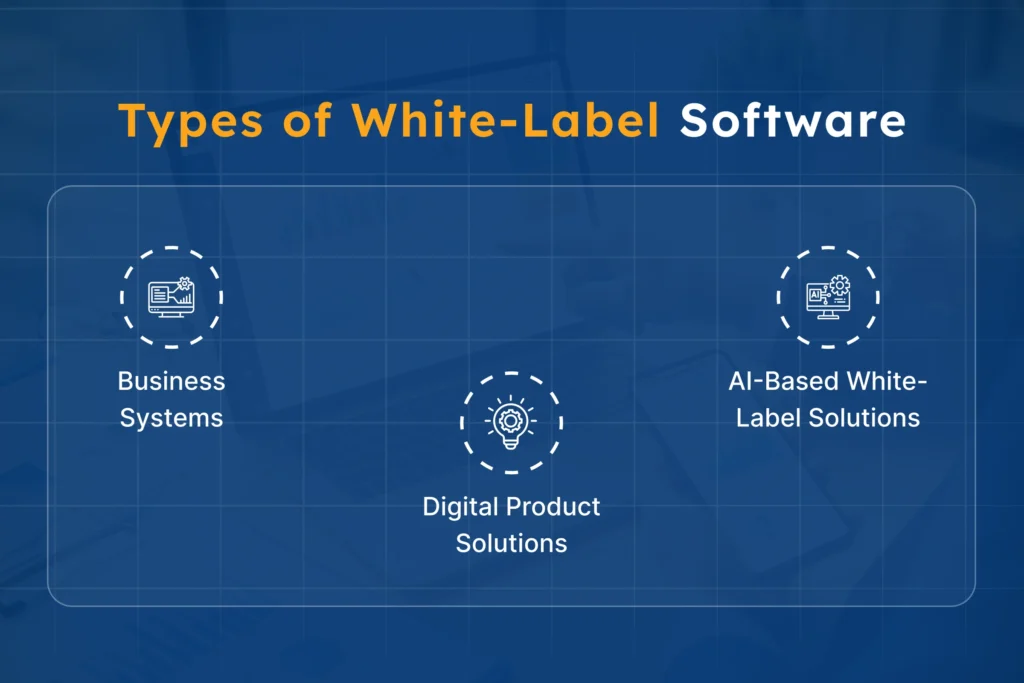
An infographic outlining different types of white-label software, including business systems (CRM, automation tools, analytics dashboards), digital product solutions (SaaS platforms, web and mobile applications), and AI-based solutions (chatbots, automation systems, predictive analytics). Icons represent each type to illustrate their use cases.

Types of White-Label Software

White-label software comes in many forms. Businesses choose solutions based on their goals and needs. It can help manage operations, improve efficiency, or deliver new digital products quickly.

Business Systems

  • CRM platforms: Help companies track and manage customer relationships. They organize leads, contacts, and sales pipelines.
  • Automation tools: Reduce repetitive tasks. They streamline workflows and save time for teams.
  • Analytics dashboards: Provide insights into performance. They track metrics, KPIs, and business trends.

Digital Product Solutions

  • SaaS platforms: Offer ready-to-use online services. Businesses can sell software without building it from scratch. Many rely on custom software development services to add tailored features.
  • Web applications: Interactive tools that run in browsers. They support many business functions.

AI-Based White-Label Solutions

  • Chatbots: Provide automated customer interactions. They handle FAQs, lead capture, and support without human intervention.
  • Automation systems: Streamline business processes using AI. They reduce manual work and increase efficiency.
  • Analytics platforms: Deliver actionable insights using AI. They track trends, predict outcomes, and improve decision-making.
  • Predictive Analytics Tools: Use AI to forecast trends, sales, or customer behavior. They help businesses make data-driven decisions.

Natural Language Processing (NLP) Tools: Analyze text, chat, or voice data. They power chatbots, sentiment analysis, and document automation.

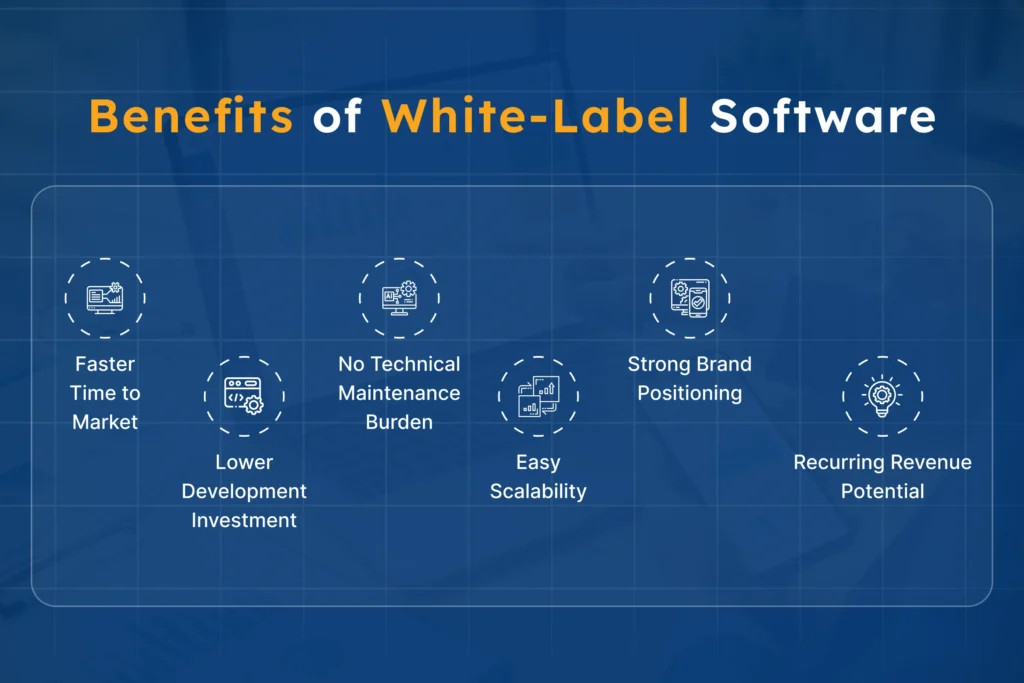
An infographic displaying the benefits of white-label software, including faster time to market, lower development investment, no technical maintenance burden, easy scalability, strong brand positioning, and recurring revenue potential. Icons represent each benefit with a brief description.

Benefits of White-Label Software

White-label software provides many advantages for businesses and agencies. It allows companies to launch products faster. This is important in competitive markets. You can enter the market without full product development.

Faster Time to Market

White-label software lets you go live quickly. You avoid long development cycles. You can focus on marketing and sales.

Lower Development Investment

Costs are lower than in-house development. You avoid hiring large engineering teams. You also save on infrastructure and ongoing maintenance.

No Technical Maintenance Burden

The provider manages updates, security, and infrastructure. Your team can focus on clients and growth instead of technical tasks.

Easy Scalability

You can easily expand features or add users. The software grows as your business grows. There’s no need for additional development teams.

Strong Brand Positioning

Sell software under your own brand. Clients see your company as the provider. This builds recognition and credibility in the market.

Recurring Revenue Potential

Subscription models create a steady income. Agencies and businesses can build long-term client relationships. Recurring revenue supports sustainable growth.

An infographic illustrating why companies use white-label software, including benefits like gaining a competitive advantage, reducing operational overhead, accessing technical expertise, focusing on strategic growth, and expanding into new revenue streams. The image includes icons and illustrations representing each benefit.

Why Companies Use White-Label Software?

Many companies choose white-label software to save time, reduce costs, and grow their business. It helps them focus on their strengths while outsourcing the technical work.

Competitive Advantage

Companies don’t want to spend months or years building software. This model helps them launch quickly. They can start selling sooner. It allows them to enter competitive markets faster.

Reduced Operational Overhead

Building software in-house is expensive. It requires hiring developers, managing infrastructure, and maintaining updates. This approach removes this burden. A specialized provider handles the technical side. 

Access to Technical Expertise

Not every company has a product team or engineering leadership. Many lack backend infrastructure and technical experience. This model solves this. Providers offer ready products, proven systems, and technical know-how. 

Business Focus and Strategic Growth

Companies want to focus on sales, marketing, client relationships, and strategy. They don’t want to spend time on product development, maintenance, or bug fixing. It allows them to sell software without becoming a software company.

Expansion into New Revenue Streams

White-label software opens new revenue streams. Agencies can expand their service portfolio. Startups can launch SaaS products faster. Businesses can create recurring income. Companies can test new product ideas with less risk.

White-Label SaaS for Agencies

White-label SaaS creates strong growth opportunities for agencies. It allows them to offer software without building products from scratch. They can expand services and increase revenue with less technical effort.

Resell Software Under Your Brand

Agencies can sell software under their own brand name. Clients see the agency as the product provider. This builds trust and brand value. It also strengthens long-term client relationships.

Bundle Software With Services

Agencies can combine software with their existing services. They can offer it with marketing, consulting, or development support. This creates more value for clients. It also helps agencies stand out in competitive markets.

Build Subscription-Based Revenue

White-label SaaS supports recurring income. Agencies can charge monthly or yearly fees. This creates predictable revenue. It also improves business stability over time.

Scale Without Hiring Large Tech Teams

Agencies do not need to build large development teams. The provider manages the product and handles updates. This reduces technical responsibility. It allows agencies to grow faster without increasing operational pressure.

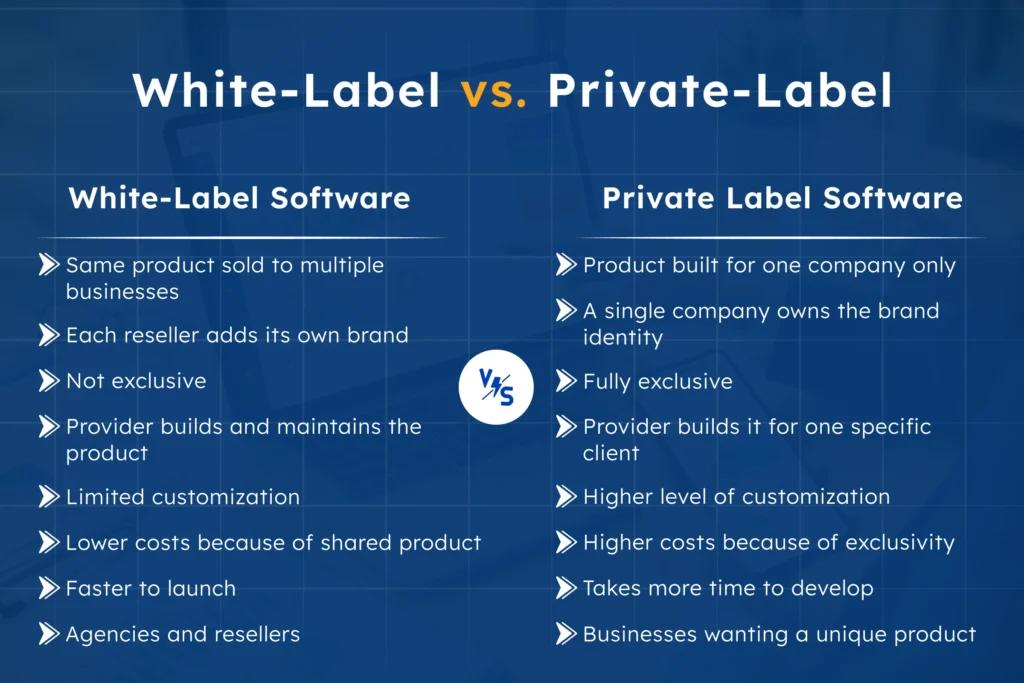
An infographic comparing white-label and private-label software, highlighting differences in product access, branding, exclusivity, development ownership, customization, costs, time to launch, and the best fit for each. It shows the advantages of speed and lower costs for white-label software, versus the exclusivity and customization of private-label software.

White-Label vs. Private-Label Software

White-label and private-label software are often confused. Both allow businesses to sell products under their own brand. However, the ownership model and level of exclusivity are different.

Basis White-Label Software Private Label Software
Product Access Same product sold to multiple businesses Product built for one company only
Branding Each reseller adds its own brand A single company owns the brand identity
Exclusivity Not exclusive Fully exclusive
Development Ownership Provider builds and maintains the product Provider builds it for one specific client
Customization Limited customization Higher level of customization
Cost Lower costs because of shared product Higher costs because of exclusivity
Time to Launch Faster to launch Takes more time to develop
Best For Agencies and resellers Businesses wanting a unique product

Private labels offer more control and uniqueness. White-label offers speed and lower investment. Businesses choose based on their goals, budget, and long-term strategy.

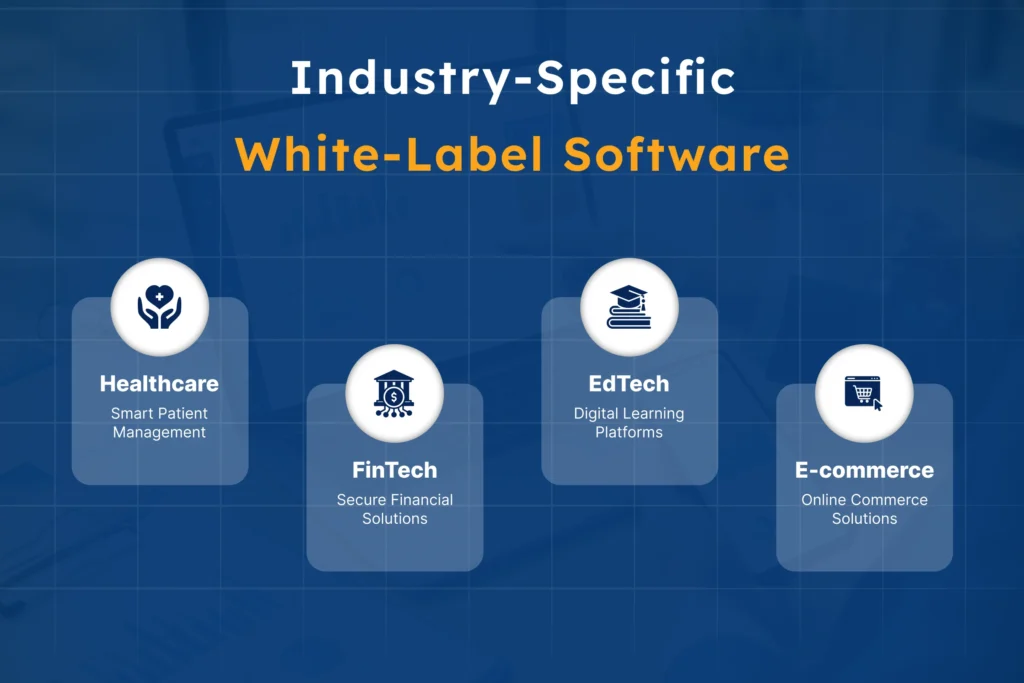
An infographic showcasing industry-specific white-label software, including healthcare (smart patient management), FinTech (secure financial solutions), EdTech (digital learning platforms), E-commerce (online commerce solutions), and real estate (property listing platforms and CRM systems). Each industry is represented with an icon and brief description.

Industry-Specific White-Label Software

White-label software is used across many industries. This enables faster solution launches. It reduces development effort. It also supports quick digital transformation. Many businesses adopt it to stay competitive.

  • Healthcare: Used for patient portals and telemedicine platforms. It supports appointment booking systems. Hospitals use it for digital records and management tools. Many providers use AI software development services to improve diagnosis and automate processes. 
  • FinTech: Used for payment apps and digital wallets. It supports lending platforms and financial dashboards. Companies use custom AI solutions to detect fraud and analyze risks. It improves security and decision-making. 
  • EdTech: Used for online learning platforms and virtual classrooms. It supports student management systems. Institutions use it to deliver courses and track performance. It helps launch education products quickly.
  • E-commerce: Used for online stores and marketplace platforms. It supports inventory and order management tools. Businesses use it to sell products under their brand. It helps them enter the market faster. 
  • Real Estate: Used for property listing platforms and CRM systems. It supports lead management and client tracking. Agencies use it to showcase properties online. It improves customers’ experience.
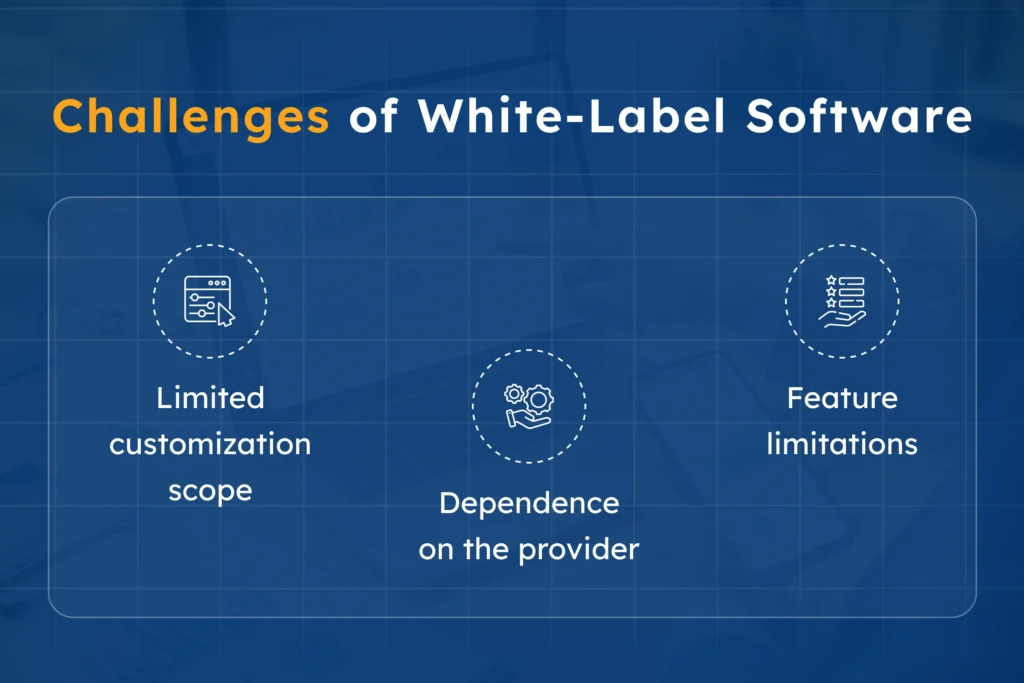
An infographic highlighting the challenges of white-label software, including limited customization scope, dependence on the provider for updates and fixes, feature limitations, and potential integration complexity with existing systems. Each challenge is represented with an icon and brief explanation.

Challenges of White-Label Software

White-label software offers many benefits. It also comes with a few limitations. Businesses should understand these before making a decision. This creates realistic expectations and builds long-term success.

  • Limited customization scope: Customization options can be restricted. The core product stays the same for all resellers. Some features cannot be changed. This can limit uniqueness in some cases.
  • Dependence on the provider: The provider controls development and updates. Businesses rely on them for fixes and improvements. Any delays can affect service delivery. Long-term dependence is a key factor to consider.
  • Feature limitations: The product may not include every feature a business needs. Adding new features may take time. Some requests may not be supported. This can impact specific business requirements.
  • Integration complexity: Connecting with existing systems can be challenging. Some tools may not integrate easily. Extra setup may be required. This can increase time and effort during implementation.
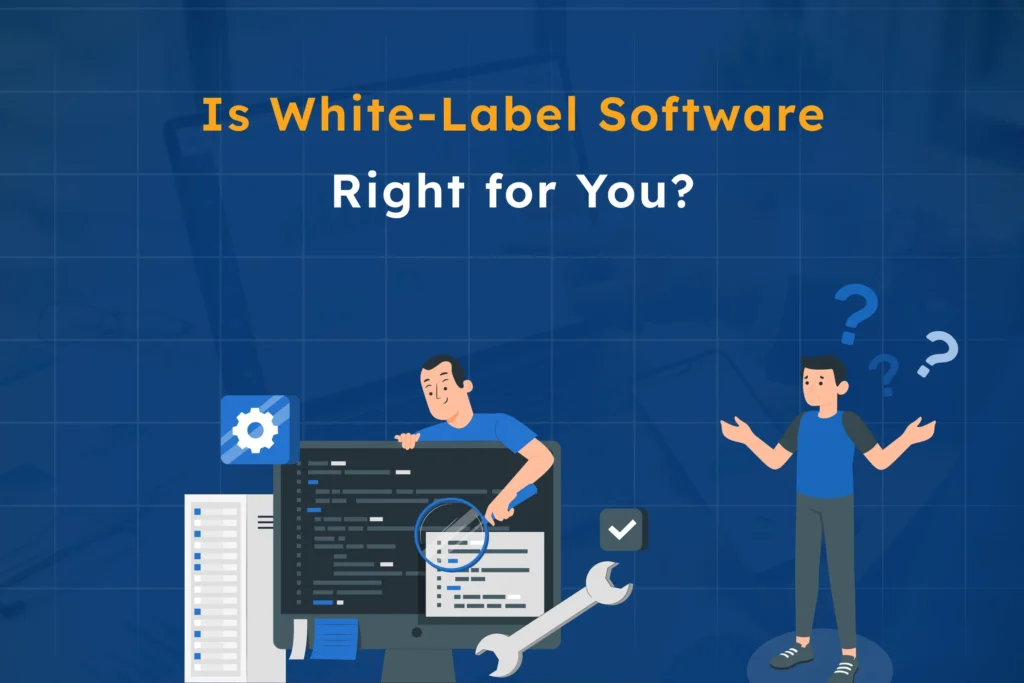
An infographic asking if white-label software is the right choice, emphasizing its benefits like faster launches, cost savings, and scalability. The image includes an illustration of a person considering the decision, with icons representing development and growth.

Is White-Label Software Right for You?

White-label software is a practical and scalable model. It allows businesses to sell ready-made products under their own brand. There is no need to build from scratch. This reduces time, cost, and technical effort.

It supports faster launches and steady growth. Companies can focus on sales and strategy instead of development. This makes scaling easier and more predictable.

With the right development partner, the model becomes even more powerful. Samyak Infotech helps businesses launch and expand digital products with confidence. White-label software offers a smart way to grow in today’s competitive market.

Frequently Asked Questions

Is white-label software legal?

Yes, white-label software is legal. The provider grants resellers the right to rebrand and sell the software under a licensing agreement

White-label software can be profitable because businesses avoid development costs and generate recurring revenue through subscriptions.

Startups, agencies, SaaS entrepreneurs, and established businesses can use white-label software to launch branded digital products without building from scratch.

White-label software allows full rebranding. Reseller software is usually sold under the original provider’s brand.

Branding can be customized, but core features are typically shared across multiple resellers.

Latest News from our end!