

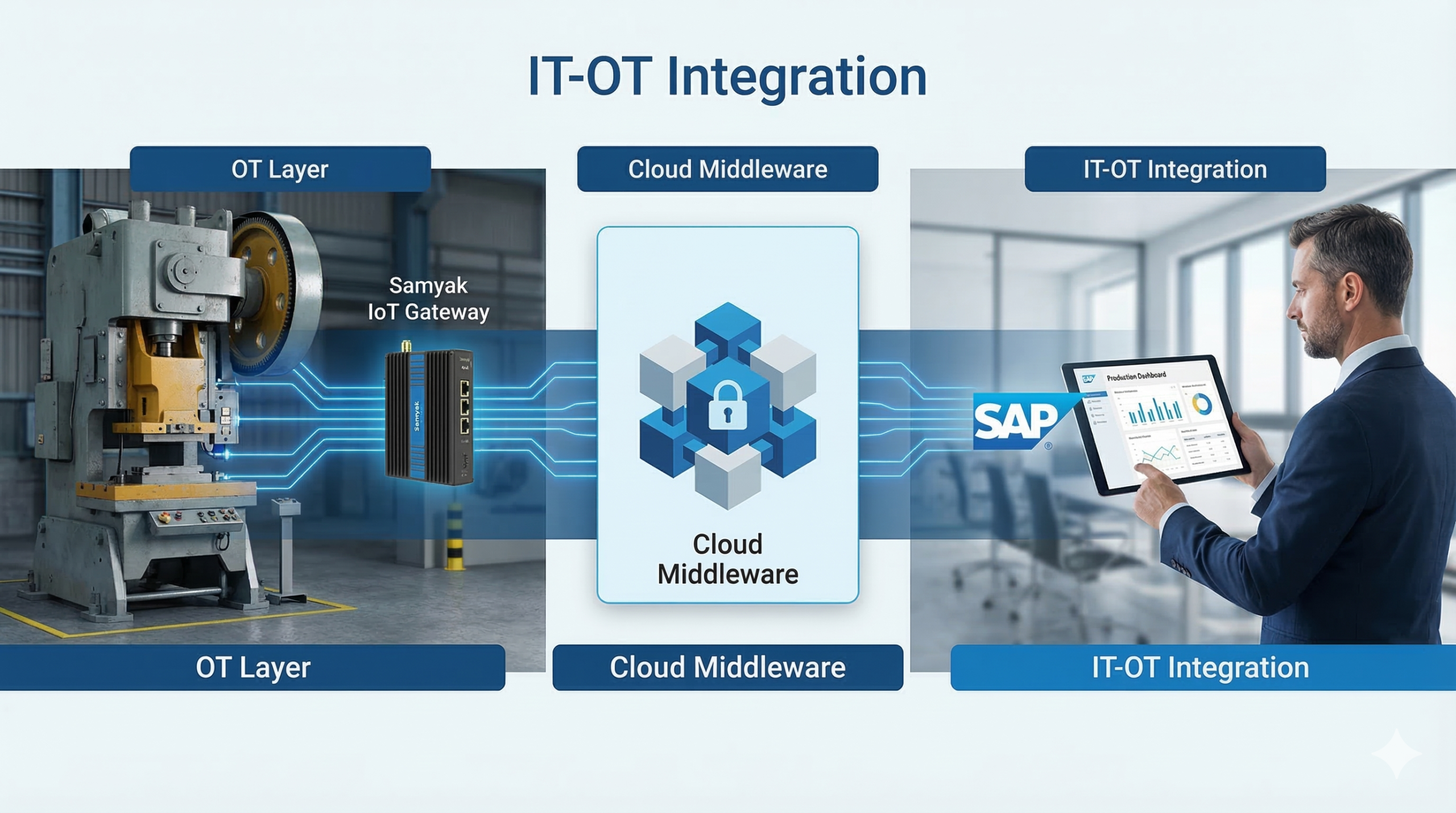
For any manufacturing Chief Information Officer (CIO), the ultimate dream is the “Real-Time Enterprise.” Achieving true IT-OT Integration is the only way to reach this state, ensuring that the financial data on the boardroom dashboard perfectly matches the physical reality of the factory floor at any given second.
However, achieving this is notoriously difficult. In most industrial setups, two entirely different worlds exist in parallel. On one side, you have Information Technology (IT): the pristine, highly structured, and disciplined world of your ERP systems. On the other side, you have Operational Technology (OT): the chaotic, fast-paced, noisy world of PLCs, SCADA systems, and physical machinery.
Bridging the gap between these two worlds is the essence of IT-OT Integration. Yet, in over 80% of Indian manufacturing plants, this “bridge” is still a human being holding a clipboard, writing down production counts, and handing them to a data entry operator the next morning.
This manual process creates a massive “Air Gap” that results in delayed inventory tracking, inaccurate yield calculations, and poor production planning. At Samyak Infotech, we specialize in eliminating this gap. We build the intelligent software middleware that acts as the digital spine for true IT-OT integration, seamlessly connecting shop floor realities with ERPs.
You cannot have a robust software platform without a bulletproof hardware layer. Many software companies fail at IT-OT integration because they do not understand how to physically extract data from a 20-year-old hydraulic press or a dusty utility pipeline.
Because we work hand-in-hand with our sister company, Samyak Instrumentation, we offer a completely turnkey digital transformation. Before our software even touches your data, our instrumentation team builds the physical foundation:
The Sensor Layer: We deploy rugged field instruments to capture primary data. Whether it is measuring water consumption with our Flow Indicator Totalizer or tracking machine cycles with proximity sensors, we ensure the physical data is captured accurately.
The Automation Layer (PLC & HMI): For legacy machines that lack a digital brain, we retrofit modern PLCs and HMIs. This gives the machine operator local control and digital visibility, transforming a “dumb” machine into a smart node.
The Data Acquisition Layer: To gather this data securely, we install our proprietary IoT Data Loggers. These devices act as the secure data vaults on the factory floor, capable of storing weeks of data locally.
The Edge Connectivity: Finally, our rugged Industrial IoT Gateways translate the raw industrial protocols (Modbus, Profinet) into IT-friendly JSON payloads, pushing the data securely to the Samyak Infotech middleware.
By owning the entire hardware stack, we eliminate the “blame game” between IT and OT vendors, ensuring a flawless flow of data from the sensor to ERP.
When companies first decide to pursue IT-OT integration, they often make a critical architectural mistake: they try to connect their factory floor sensors directly to their ERP system.
They assume that because an IoT device has an internet connection, it should simply push data straight into ERP. This is a recipe for disaster, for three main reasons:
The “Garbage In, Garbage Out” Problem: The shop floor is physically noisy. A sensor might vibrate and register 10 false counts in a millisecond. If that raw sensor is wired directly to ERP, it will immediately inflate your production numbers and corrupt your inventory valuations.
Linguistic Incompatibility: ERP speaks standard IT languages—OData, REST APIs, SOAP, and RFC (Remote Function Call). Factory machines speak industrial protocols like Modbus, Profinet, or OPC-UA. They fundamentally do not understand each other.
Security Vulnerabilities: Directly exposing your core financial ERP to hundreds of internet-connected endpoints on a factory floor is a massive cybersecurity risk.
To achieve successful IT-OT integration, you do not need a longer wire; you need a translator, a buffer, and a firewall. You need Middleware.
At Samyak Infotech, we do not just move data; we validate, buffer, and synchronize it. Our proprietary Remote Monitoring System (RMS) and SFI Middleware sits securely between the factory floor and your ERP, ensuring that only clean, actionable business intelligence reaches SAP.
Once the data from the Industrial Gateways hits the Samyak Middleware, it undergoes rigorous sanitization. Before a single piece of data is allowed to touch SAP, our software asks a series of logical questions:
Is the Machine ID valid?
Is the reported production count physically possible within a 5-minute window?
Is the “Production Order” currently active and released in ERP?
If the data fails these checks, our software flags it as an anomaly and quarantines it for human review. This ensures that your ERP remains a single source of absolute truth.
Once the data is validated, our middleware performs the actual IT-OT integration. We utilize standard, ERP-approved integration methods like Business Application Programming Interfaces (BAPIs) to automate complex transactions:
Automated CO11N: When a machine finishes a batch, our middleware automatically posts the production confirmation in Production Planning.
Automated MIGO: As raw materials are consumed by the machine, the system automatically posts goods issues in Material Management, updating your raw material inventory in real-time.
Manufacturing plants run 24/7. IT servers do not.
One of the most common challenges in IT-OT integration is handling network downtime. What happens when your ERP server goes offline for scheduled Sunday maintenance, but the factory floor keeps producing goods?
Standard point-to-point connections will drop the data, resulting in missing inventory on Monday morning.
The Samyak Infotech Middleware is built with advanced Store and Forward queuing architecture. If the connection to ERP is interrupted, our middleware automatically buffers the incoming production data in a secure local database. The second the ERP server comes back online, our system automatically processes the backlog in strict FIFO (First In, First Out) order. This guarantees zero data loss and ensures your financial ledgers are perfectly reconciled.
True IT-OT integration is not a one-way street. While pushing production data up to ERP is critical, pushing business context down to the factory floor is where digital transformation truly accelerates.
Using our middleware, we enable bi-directional data flow:
Downloading Orders: When a Production Planner releases an order in ERP, our middleware pulls that order data (Target Quantity, SKU, Recipe) and pushes it directly to the local HMI screens installed on the shop floor machines.
Live Operator Feedback: The machine operator no longer needs a printed sheet of paper. They see their exact target on the screen. As the machine runs, the screen updates their “Remaining Quantity” in real-time, matching the data being sent back to ERP.
Many organizations attempt to build these middleware bridges in-house using generic IT tools, only to realize that understanding ERP logic is entirely different from understanding factory floor PLC logic. This fragmented approach is the single biggest cause of failed IT-OT integration in India.
At Samyak Infotech, we speak both languages natively.
We understand the intricacies of ERP modules (PP, MM, PM, QM) just as deeply as we understand Siemens and Allen-Bradley automation architectures. By acting as the sole architect of your IT-OT integration, we eliminate the friction between your IT department and your plant managers.
In the highly competitive manufacturing landscape of 2026, running your supply chain on 24-hour-old data is a massive liability. By implementing robust middleware, you remove the human bottleneck, ensure pristine data integrity, and unlock the true potential of your ERP investment.
Ready to connect your shop floor to your top floor?
Schedule a technical consultation with Samyak Infotech today to discuss your IT-OT integration roadmap.


©2026 Samyak Infotech Pvt Ltd. | All trademarks, images and logos are the property of their respective owners.
 explore more