AI-Powered MVP Development: Key Strategies, Tools, and Services for Startups

ON 20 December , 2025

How Startups Can Build Smarter MVPs with AI

Most of the startups these days don’t fail because the idea is bad. They fail because they build too much, too early, without even having an understanding of what the users actually want. That is the reason why the way MVPs are built is changing. 

Today, startups are expected to move really fast. But the speed without any sort of insight can lead to wasted efforts. This is where the role of AI-powered MVP development comes in. It helps the founders to test their ideas with intelligence, not just with speed. 

Instead of just launching a basic product and waiting for feedback, AI-powered MVPs learn as users interact with them. They help to reveal patterns early. They help to highlight what works and what doesn’t. Also, this helps teams to make decisions backed by data and not just through assumptions. 

This blog will help founders and startup teams to explore AI-powered MVP development practically. This guide is just clear thinking on when to use AI, how to build a meaningful MVP, and how to avoid the common mistakes that make startups slow down. 

Understanding MVP Development in the AI Era

An MVP always had one purpose. Learn quickly with minimum effort. This principle has not changed. What has changed is how startups can learn. 

Earlier, MVPs were just static. You launched a basic product. You waited for users to react. Feedback came in slowly. And decisions took time. AI shifts this model. 

Today, an MVP can observe, learn, and adapt while the users are still interacting with it. This does not mean adding complex AI everywhere. It means using intelligence where it can help to create real clarity. 

How Traditional MVPs Usually Work

  • Build a small set of core features
  • Launch to early users
  • Collect feedback manually
  • Iterate based on assumptions and patterns

This type of approach still works, but it slows down when the data grows. Also, it leaves room for guesswork, which can lead to problems at later stages. 

How AI-Powered MVPs Work Differently

  • User behavior is tracked in real time
  • Patterns are identified automatically
  • Feedback is supported by data, not opinions
  • Decisions improve with every interaction

This type of MVP turns out to be less of a prototype and more of a learning system. The checklist to build an MVP can help to understand the strategy to build a minimum viable product in a better way. 

A Simple Example 

Think of a startup that is working on building a hiring platform. A traditional MVP might just show job listings and track applications. Useful, but still limited. At the same time, an AI-powered MVP can help to go one step further. It can help to analyse candidate behavior, suggest better matches, and also highlight drop-off points early. Even when the data is limited, the product starts learning. 

The difference is not just complexity. It is insight. 

What This Means for Startups 

AI does not replace lean MVP thinking. It strengthens it. 

  • You still build small. 
  • You still validate early. 
  • You still avoid overbuilding. 

The difference is in the speed and clarity. You learn faster, decide with confidence, and reduce the risk of building the wrong thing. 

This is the reason why AI-powered MVP development is becoming relevant for early-stage startups. Not just because AI is trendy, but because learning faster can help in deciding whether a startup survives. 

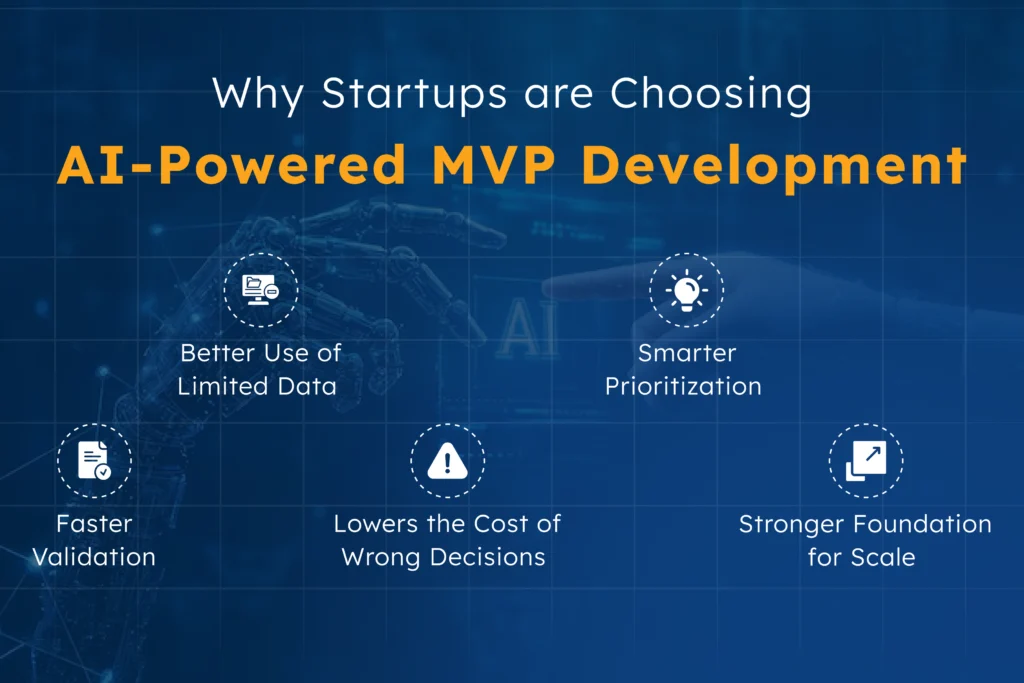
A graphic explaining why startups are increasingly adopting AI-powered MVP development. It highlights five key benefits: faster validation, better use of limited data, lower cost of wrong decisions, smarter prioritization, and stronger foundation for scale. A robotic hand and AI-themed visuals emphasize the role of intelligent learning in modern product development.

Why Startups are Choosing AI-Powered MVP Development

Startups do not just adopt AI because it sounds impressive. They adopt it because early decisions are risky. And getting those decisions wrong can turn out to be expensive. An AI-powered MVP helps in reducing those risks. 

Instead of relying only on the opinions and limited feedback, founders can see how users actually behave. What they click, pause, and what makes them leave. That clarity matters early. 

Here is the reason why more startups are moving in this direction: 

Faster Validation 

AI helps surface patterns early. You don’t have to wait weeks to understand what’s working.

Better Use of Limited Data 

Even small datasets can provide useful insights when they are used correctly. 

Lowers the Cost of Wrong Decisions 

It’s cheaper to adjust an MVP than rebuild a full product later.

Smarter Prioritization 

Teams know what to fix, improve, or remove. This helps in reducing the guesswork. 

Stronger Foundation for Scale 

AI systems learn and adapt over time. That learning turns compounds as the product grows. 

There is a mindset shift happening. Founders now no longer see MVPs as disposable prototypes. Rather, they see them as the first version of the real product. One that should already be learning, even if it is simple. 

That is one of the major reasons that AI-powered MVP development makes sense for startups today. Not just because the AI is advanced, but because clarity can decide whether a startup moves forward or stalls. 

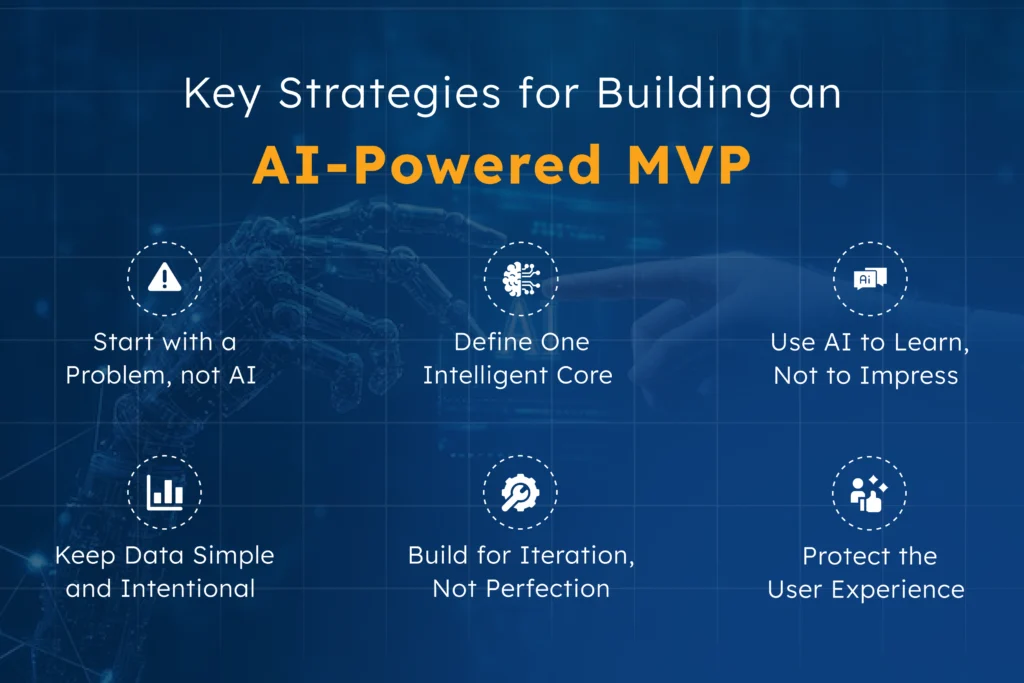
Infographic listing six core strategies for building AI-powered MVPs, including: start with a problem, define one intelligent core, use AI to learn, keep data simple, build for iteration, and protect the user experience—highlighting practical guidance for startups focused on impactful, data-driven product development.

Key Strategies for Building an AI-Powered MVP 

An AI-powered MVP can work best when the strategy comes before the technology part. Many startups make the mistake of starting with the tools. The smarter approach is to start with clarity. 

Here are the key strategies that matter the most when it comes to building an AI-powered MVP. 

1. Start with a Problem, not AI 

AI should solve a clear problem and nothing more than that. Ask yourself one simple question: what decisions, tasks, or insights turn out to be better with AI? If the answer to this is not clear, AI probably does not belong in the MVP yet. 

2. Define One Intelligent Core 

A strong MVP is something that does not try to do everything. Pick down any one AI-driven capability that creates visible value. It could be: 

  • Smarter Recommendations 
  • Faster Automation 
  • Better predictions 
  • Clearer insights from the user data

Everything else that is needed can wait. 

3. Use AI to Learn, Not to Impress 

Early-stage users care more about the outcomes rather than the algorithms. Give your major on what the product learns: 

  • What users prefer. 
  • Where they struggle 
  • What keeps them engaged 

If AI helps answer these questions faster, it’s doing its job.

4. Keep Data Simple and Intentional 

While building an AI-powered MVP, you do not need massive datasets to start. What you need is: 

  • Relevant data 
  • Clean inputs 
  • A clear idea of what you are measuring 

Design the MVP in a way so that data collection improves naturally as users grow. 

5. Build for Iteration, Not Perfection 

AI-powered MVPs are never finished. Models improve, insights evolve, and assumptions change. That is why the product should support: 

  • Quick Experimentation 
  • Easy model updates
  • Continuous feedback loops 

Progress matters more than precision early on.

6. Protect the User Experience 

AI should work quietly in the background. If the users have to think too much about how AI works, something is off. The experience should feel simple, predictable, and helpful, even when the technology behind it is complex. 

These strategies keep AI-powered MVP development focused and practical. They help startups move fast without losing direction. And they reduce the risk of building something impressive but unnecessary.

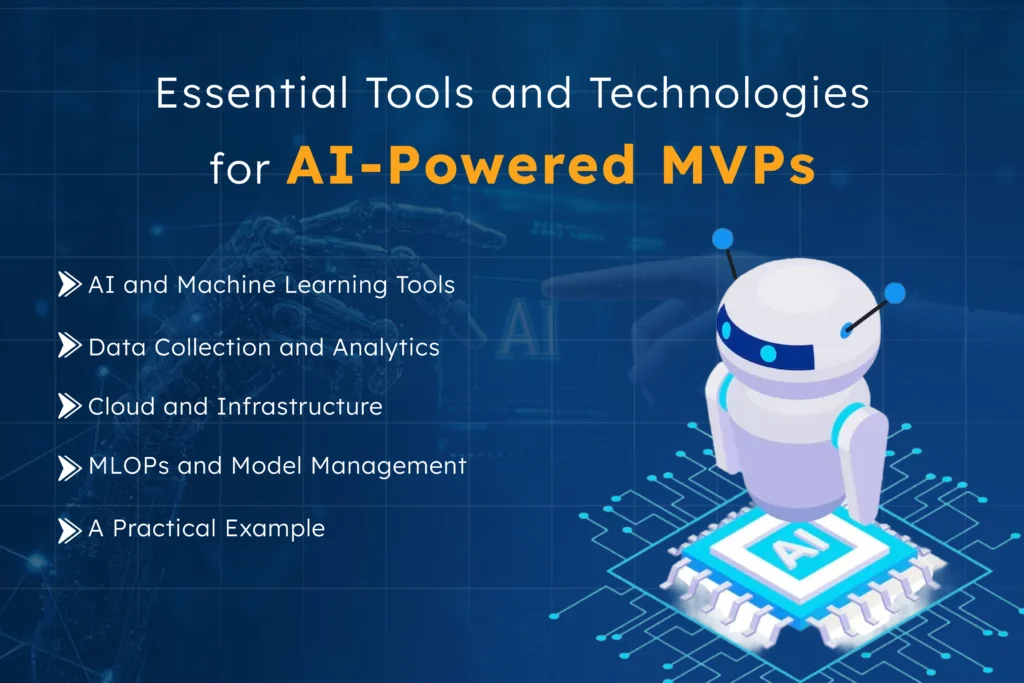
A visual overview of core tech components for building AI-powered MVPs, featuring a robot on a microchip labeled “AI.” Topics listed include AI/ML tools, data collection, cloud infrastructure, MLOps, and a practical use case—highlighting the importance of choosing simple, outcome-focused technologies to accelerate learning and product validation.

Essential Tools and Technologies for AI-Powered MVPs

Tools do not make an AI successful, it is the choice that you make that does. The goal at this stage is not to build a perfect AI stack. It is to move fast, learn quickly, and stay flexible. That is the reason why most of the startups benefit from using simple, proven tools instead of custom-heavy setups. 

Below are a few core technology areas that matter when building an AI-powered MVP. 

AI and Machine Learning Tools 

This is where intelligence comes in. Most startups do not need to train complex models from scratch. APIs and lightweight frameworks are often enough. 

Some of the common approaches to this include: 

  • Pretrained AI APIs for text, chat, or recommendations
  • Lightweight ML frameworks for basic predictions
  • Rule-based logic combined with AI for early validation. 

This is often where machine learning development is becoming more popular. The focus should be on outcomes, not model depth. 

Data Collection and Analytics 

AI only turns out to be useful if the data behind it is. At the MVP stage, the priority is visibility. 

You need to know: 

  • How users interact with the product. 
  • Where they get stuck 
  • What actions lead to value

Simple analytics tools and clean data pipelines usually work better than complex setups at the early stages. 

Cloud and Infrastructure 

Scalability is important, but not at the cost of speed. 

Cloud platforms can help startups to: 

  • Deploy quickly 
  • Control the infrastructure costs 
  • Scale only when needed 

Severless and managed services are often the perfect ones for MVPs. They help in reducing the operational overhead and keep the teams focused on the product. 

MLOPs and Model Management 

MVPs that are at early stages do not require full MLOps pipelines. 

What they do need is the: 

  • Version control for models 
  • Basic performance monitoring 
  • The ability to update models without breaking the product. 

Simple workflows turn out to be enough in the beginning. MLOps consulting at this time can help in making an MVP successful.  

A Practical Example

Consider an example of a startup building an AI-powered customer support tool. Instead of creating a custom NLP model, the team focuses on creating an existing AI API for intent detection. User queries are logged. Responses are tracked. Over time, patterns emerge. 

The MVP delivers value early. And the team learns what needs improvement before investing deeper. That is the right use of tools at this stage. The best AI-powered MVPs use technology like an enabler, and not as a distraction. Tools should support learning, not slow it down.

Promotional graphic for AI-powered MVP development services tailored to startups, featuring a glowing lightbulb, a computer screen with code, and icons representing decision-making. Emphasizes the importance of strategic support, AI integration, and iterative development in building scalable, user-focused MVPs.

AI-Powered MVP Development Services for Startups 

Building an AI-powered MVP is not just one technical task. It is a sequence of decisions. What to build, to skip, and validate first. This is where the right development support can make all the difference. 

For most of the startups, AI-powered MVP development services are less about outsourcing work and more about reducing uncertainty. A good partner can help the founders move with clarity instead of trial and error. 

What Startups Actually Need at the MVP Stage 

Startups at the MVP stage do not need everything, but just the right things. 

Typically, this includes: 

  • AI consulting and MVP understanding to validate whether AI fits in the use case. 
  • Product and UX design that is focused on simplicity and adoption. 
  • AI model integration using practical, lightweight approaches
  • End-to-end MVP development that can support fast iteration. 
  • Post-launch optimization based on real user data. 

Each of the services exists for a reason: to help startups learn faster without overbuilding. An MVP development checklist can be the best for startups at this stage. 

Why Services Matter More than Tools

Tools can be replaced, but in case there is a strategy mistake, it turns out harder to fix. Startups mostly struggle not because they choose the wrong framework, but because they build the wrong feature first. AI-powered MCP development services help in avoiding that by aligning technology with business goals from day one. 

Instead of asking, “What AI can we build?” the focus shifts to “What insight do we need next?”

That’s why guidance from an AI agent development company or exploring AI agent use cases can clarify what intelligence actually belongs in the MVP.

A Realistic Startup Scenario 

Imagine you are a founder working on building an AI-driven SaaS product. They know AI is required. However, at the same time, they are unsure how much to make initially. The MVP launches faster. Feedback comes in sooner, and the product evolves with direction, not guesswork. 

Where Samyak Infotech Fits In 

At Samyak Infotech, an AI-powered MVP development is approached with a startup-first mindset. 

The focus stays on: 

  • Clarity before complexity 
  • Learning before scaling 
  • Value before features 

From early validation to deployment-ready MVPs, the goal is to help startups build practical and intelligent products that are practical, scalable, and grounded in real user needs. AI-powered MVP development services work out the best when they feel like an extension of the founding team. That is when the ideas move faster. And when MVPs turn into real products. 

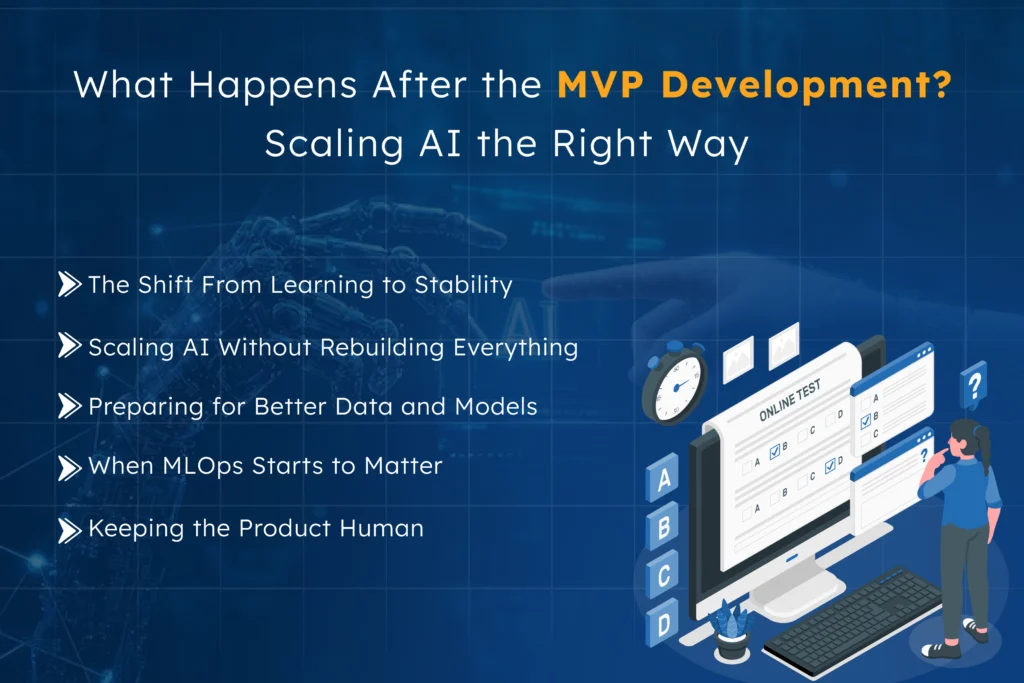
Illustration showing the next steps after MVP development for AI-powered products, with a checklist of strategies like moving from learning to stability, scaling AI without rebuilding, improving data models, adopting MLOps, and maintaining a human-centered user experience. Includes a computer screen with a multiple-choice test and a user analyzing results.

What Happens After the MVP Development? Scaling AI the Right Way 

Launching an AI-powered MVP is an important milestone. But it is not the finish line. For many startups, it is where new challenges begin. 

Once the users start to adopt the product, expectations change. What worked well for a small group now needs to work at a scale. And this is where many AI-driven products struggle. 

The Shift From Learning to Stability

During the MVP phase, the focus is on learning. Speed matters more than precision. 

After the MVP, priorities start to shift: 

  • AI outputs need to be more consistent
  • Performance needs to stay reliable
  • Errors become more visible and costly

This transition requires structure, not reinvention.

Scaling AI Without Rebuilding Everything 

One of the common mistakes that startups make is starting all over. If the MVP is designed well, scaling becomes an extension of what already exists. Models improve gradually. Data pipelines mature, and infrastructure grows only where needed. The goal is evolution and not replacement. 

Preparing for Better Data and Models 

As the usage grows, so does the quality of the data. 

This allows startups to: 

  • Improve the model accuracy 
  • Introduce personalization at a deeper level 
  • Replace the temporary solutions with refined logic. 

What mattered less during the MVP has now become valuable. 

When MLOps Starts to Matter

Not on day one. But not too late either.

As AI becomes central to the product, startups need basic systems for:

  • Model monitoring
  • Performance tracking
  • Controlled updates

This doesn’t mean enterprise-level complexity. It means having just enough structure to stay in control.

Keeping the Product Human 

As the AI scales, it is easy to lose sight of the user. More automation should not mean less transparency. Users should understand outcomes, trust decisions, and feel in control. The best AI-driven products scale quietly. They get smarter without getting harder to use. 

Why This Stage Defines Long-term Success 

Many startups build an MVP, but there are only a few startups that scale it well. Those who succeed treat AI as a long-term capability, and not as a one-time feature. They plan for growth early, without slowing down the MVP.  That balance is what turns an AI-powered MVP into a sustainable product.

Conclusion graphic showing a startup launch concept with a rocket emerging from a laptop screen labeled "START UP," and a person holding a phone, representing innovation and progress. Highlights the importance of building practical, insight-driven MVPs with AI to help startups move forward efficiently.

Conclusion: Key Takeaways for Startups

AI-powered MVP development is not about building something that is very complex. It is about making something useful. For startups, the goal with an MVP is simple: learn early, fast, and avoid wasting time on assumptions that do not hold up in the real world. 

If you are considering an AI-powered MVP development, the question is not how advanced your AI should be. It is how clearly it should help you to move forward. 

With the right thinking, the right tools, and the right support, an AI-powered MVP can do exactly what it is meant to do. Help your startup build better, smarter, and not bigger. 


Latest News from our end!

Wait! Don’t Leave Without This !!

Get 1 Week of Free Custom AI Development

Our AI experts will help you prototype, automate, or build AI-powered solutions — risk-free.
⚡ Limited-time offer for new users.