


7 AI Tools Every Product Manager Should Use in 2025

Best AI Tools for Product Managers in 2025
ON 10 December , 2025

Are you a product manager struggling to keep up with endless tasks and data? You’re not alone. Managing research, roadmaps, meetings, and stakeholder updates can feel overwhelming. That’s where AI tools for product managers 2025 are becoming important to help you with your workflow.. Our AI development company builds solutions that take care of repetitive work, turn data into insights, and help you focus on what really matters, which is building better products. 

In this blog, we’ll explore the 7 best AI tools for product managers in 2025. You’ll see their pros and cons, learn how they fit into your daily workflow, and get tips on choosing the right tool for your team, backed by our AI product development services

How to Choose the Right AI Tool as a Product Manager

Not every AI tool can fit well into the workflow. Picking the right tool can help save hours, while choosing the wrong ones can waste time and budget. 


Here is a simple framework that can help the product managers find the best AI tools for product management in 2025: 

  • Integration with Your Stack 

The AI tool you choose should work seamlessly with what you already use, like Jira, Slack, Notion, or Trello. Smooth integration means less friction and faster adoption. 

  • Ease of Use 

The tools that are best for product managers are very easy to learn. Your team should be able to start using the tool with minimal training.

  • Scalability

The tools you choose should work well when your team grows. Look for tools that can handle more projects, data, and users as you scale. 

  • Cost vs. ROI 

Compare the price with the value it brings. A tool can help you save 10 hours a month and can justify a higher pricing tag. 

  • Collaboration Features

Product management is something that can work well with the team. Choose the tools that make it easy to share insights, roadmaps, and updates across teams. 

  • Security and Compliance

In 2025, data privacy has turned out to be very important. Choose the tools that follow strong security practices and comply with regulations like SOC 2 or GDPR. 


Keeping all of these points in mind, one can easily select an AI tool that can make the work easier, not harder. 

Best AI Tools for Product Managers in 2025 (Reviewed) 

There are dozens of tools in the market, but not all of those tools are worth your time. Listed below are some of the best AI tools for product managers in 2025 that we have handpicked and reviewed in detail to make your work easier with AI product development services. 

For each of the tools mentioned below, you will see: 

  • What is the tool, and why does it actually matter? 
  • Which stages of product development can it help with 
  • Key strengths and things to keep in mind. 

This way, you can easily decide which tools work the best for your team and workflow. 
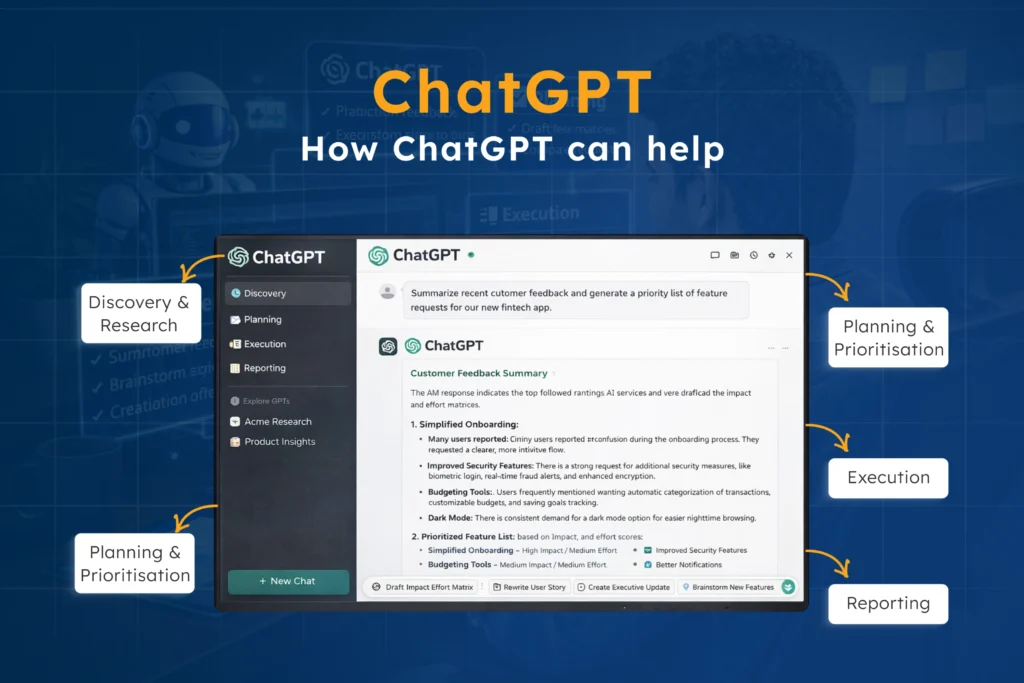
Illustration showing ChatGPT’s interface with labeled use cases such as discovery, planning, execution, and reporting—demonstrating how ai tools for product managers can use this AI tool in 2025 to streamline research, prioritize tasks, and improve productivity.

1.ChatGPT

ChatGPT is an AI chatbot from OpenAI that writes, summarizes, and analyzes information in seconds. It’s one of the most versatile AI tools for product managers in 2025

How ChatGPT can help

  • Discovery and Research: ChatGPT can help to summarise customer feedback, brainstorm feature ideas, and create quick user personas. 
  • Planning and Prioritisation: This tool can be used to draft impact or effort matrices, compare feature requests, and also write problem statements. 
  • Execution: ChatGPT can be used to generate PRDS, rewrite user stories, and also polish Jira tickets for clarity. 
  • Reporting: Data can be easily converted into executive summaries or used to prepare stakeholder updates using this tool. 

Positive sides of using ChatGPT

  • Extremely flexible: Useful across multiple product management stages.
  • Saves Time: Using ChatGPT can save hours on brainstorming, writing, and summarizing.
  • Constantly improving: The tool has features like custom GPTs and integrations, which can make your work even easier by providing custom AI solutions. 

Things to Keep in Mind While Using ChatGPT

  • May generate incorrect information if prompts are vague. Thus, it turns out to be important to always review outputs. 
  • This tool can work best with clear and detailed prompts. 

Built-in integrations are limited unless connected with third-party tools
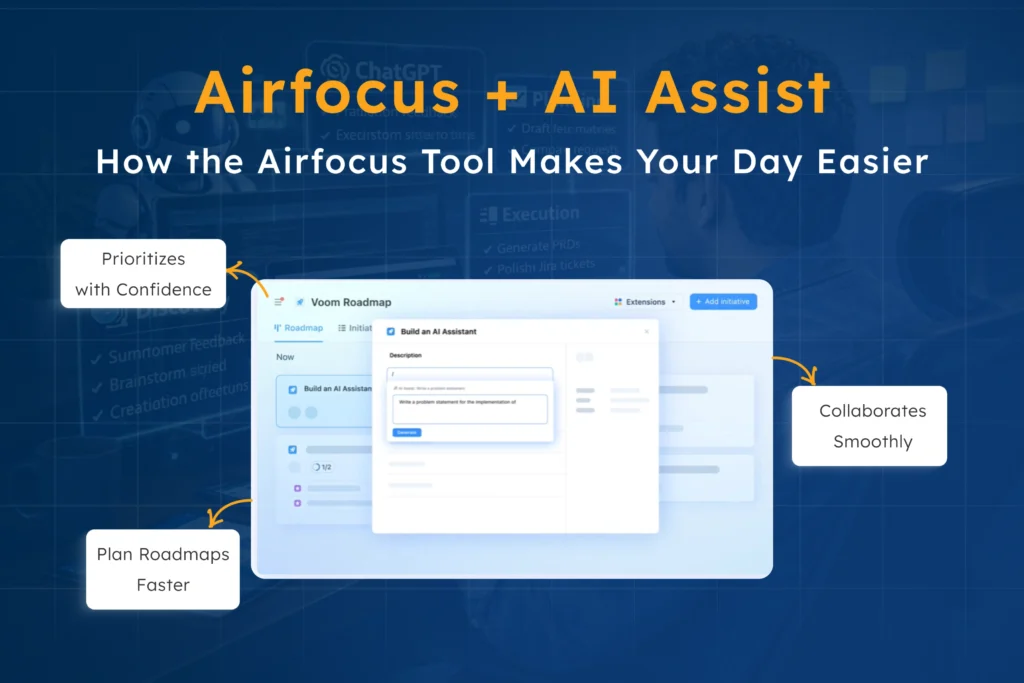
Screenshot of the Airfocus AI Assist interface highlighting features like roadmap planning, prioritization scoring, and team collaboration—showcasing how this AI tool supports product managers in 2025 with efficient decision-making and planning.

2. Airfocus + AI Assist

Airfocus is a product management platform that helps teams prioritize features and plan roadmaps efficiently. Its AI Assist feature adds smart recommendations based on your data, making decision-making faster and more objective.
How the Airfocus Tool Makes Your Day Easier

  • Prioritizes with Confidence: Unsure which features to build first? AI Assist scores each feature by impact and effort, so you can focus on what truly matters.
  • Plan Roadmaps Faster: This tool can help you turn your ideas and requests into a clear roadmap in minutes, with AI suggesting the most logical order.
  • Collaborates Smoothly: You can easily share prioritization frameworks and roadmaps with your team, keeping everyone on the same page.

Positive Sides of Using Airfocus for AI Assistance 

  • Helps make data-driven decisions rather than relying on gut feeling.
  • Saves hours of manual scoring and roadmap planning.
  • Supports collaboration across teams. 

Things to Keep in Mind while using Airfocus for AI Assistance

  • Works best with clean, well-organized input data. 
  • May require some initial setup to match your team’s workflow. 
  • AI recommendations should complement, not replace, human judgment.
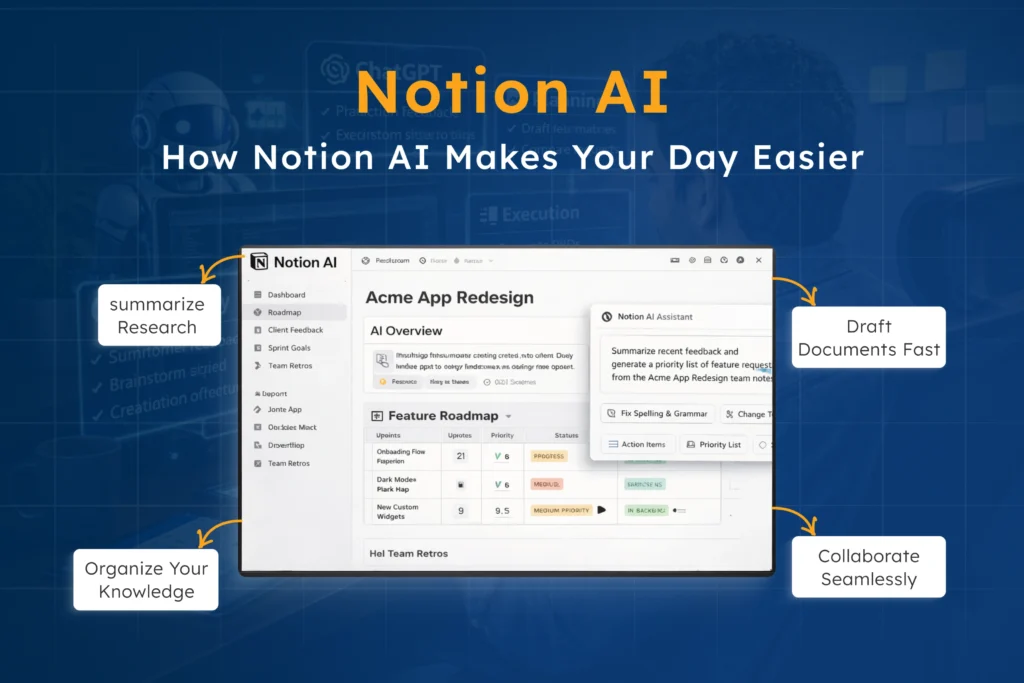
Interface of Notion AI showcasing features like drafting documents, summarizing research, organizing knowledge, and seamless team collaboration—highlighting how this AI tool boosts productivity for product managers in 2025.

3.Notion AI

Notion AI is an AI-powered assistant built into Notion, the popular productivity and collaboration platform. It helps product managers draft documents, summarize notes, and organize information quickly.
How Notion AI Makes Your Day Easier

  • Draft Documents Fast: This tool can be used to turn messy notes into clean PRDs, specifications, or meeting notes in minutes. This is a process that can also be enhanced with our custom AI solutions.
  • Summarize Research: Notion AI helps to quickly pull insights from customer feedback, competitor analysis, or internal reports.
  • Organize Your Knowledge: Using this tool, you can keep all project information, updates, and ideas in one searchable workspace.
  • Collaborate Seamlessly: Team members can access AI-generated summaries or updates, reducing back-and-forth emails.

Positive Sides of Using Notion AI

  • Speeds up writing and documentation tasks significantly.
  • Keeps all team knowledge organized in one place.
  • Helps to turn raw information into actionable insights. 

Things to Keep in Mind while Using Notion AI

  • Works best when notes and data are structured. 
  • AI-generated content in this tool may need minor edits for clarity or context. 
  • Some features may require a paid plan for full functionality. 
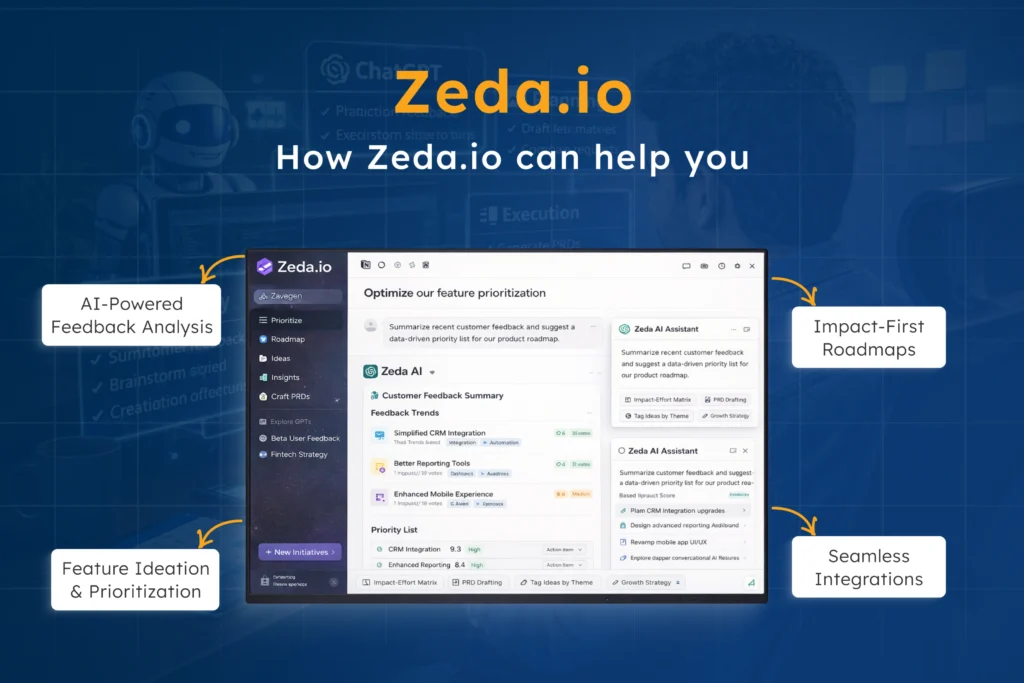
Screenshot of Zeda.io platform displaying AI-generated customer feedback summaries, prioritized feature lists, and roadmap planning—illustrating how this AI tool helps product managers in 2025 with feedback analysis, prioritization, and strategic product development.

4.Zeda.io

Zeda.io is an AI-powered product discovery and strategy platform that assists product teams in uncovering customer problems, deciding what to build next, and creating strategies to drive outcomes. It turns the Voice of Customer (VoC) into actionable product insights, enabling teams to build exactly what customers want and the business needs. 
How Zeda.io can help you

  • AI-Powered Feedback Analysis: Zeda.io analyzes customer feedback from various sources like Slack, Intercom, and Teams, providing actionable insights to understand customer sentiments and identify areas for improvement.
  • Feature Ideation and Prioritization: The platform helps in brainstorming feature ideas and prioritizing them based on customer impact, ensuring that the team focuses on what matters most.
  • Impact-First Roadmaps: Zeda.io enables the creation of roadmaps that align with business outcomes, ensuring that the product development efforts are strategically directed.
  • Seamless Integrations: The platform integrates with tools like Jira, Slack, and CRM systems, streamlining workflows and enhancing collaboration across teams. 

Positive Sides of Using Zeda.io 

  • Customer-Centric Approach: Zeda.io emphasizes understanding and addressing customer needs, leading to products that truly resonate with users.
  • AI-Driven Insights: The platform leverages AI to provide deep insights from customer feedback, which helps in informed decision-making. 
  • Enhanced Collaboration: Integrations with various tools facilitate seamless collaboration among product, engineering, and other teams.

Things to keep in mind while using Zeda.io 

  • Learning Curve: As with any comprehensive platform, there might be a learning curve for new users to fully leverage all features.

  • Data Quality: The effectiveness of AI insights depends on the quality and consistency of the data fed into the system.

  • Customization Needs: Depending on the organization’s specific requirements, some customization might be needed to align the platform with existing workflows.
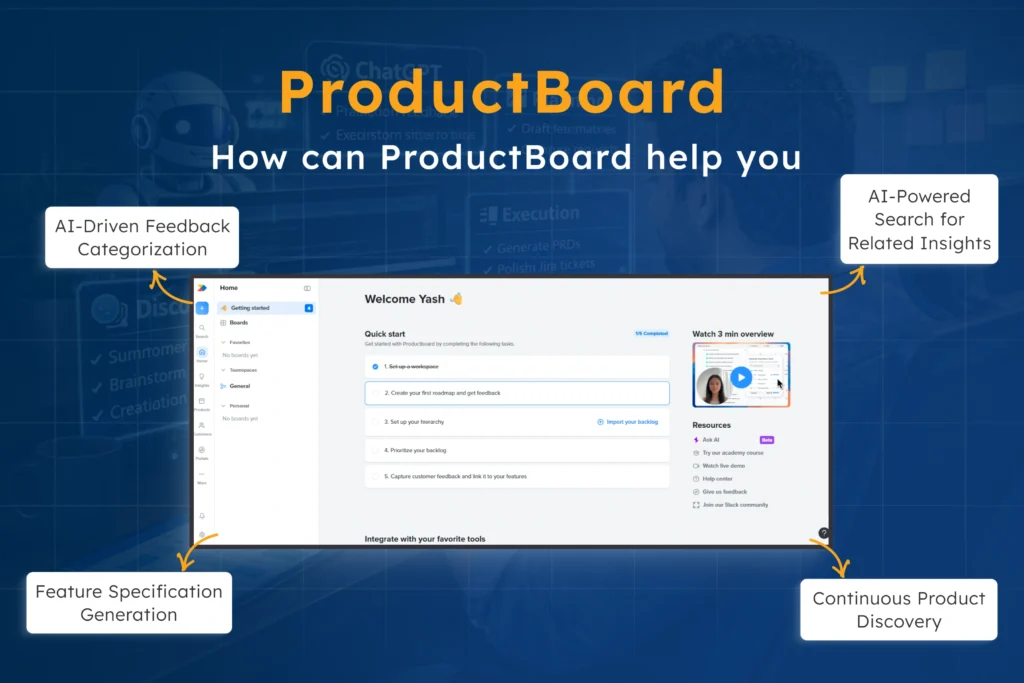
Screenshot of Productboard’s AI-powered interface highlighting features like automated feedback categorization, insight search, feature specification generation, and product discovery—showcasing its role as an essential AI tool for product managers in 2025.

5. ProductBoard 

Productboard is a comprehensive product management platform that centralizes customer feedback, streamlines feature prioritization, and facilitates roadmap planning. With its AI-powered capabilities, it enables product teams to make data-driven decisions and align their product strategies with customer needs.
How can ProductBoard help you 

  • AI-Driven Feedback Categorization: Productboard AI automatically categorizes and links customer feedback to relevant feature ideas, ensuring that every piece of feedback is considered in the decision-making process. This is something we can also help to enhance with our AI agent development services.
  • Feature Specification Generation: The platform assists in drafting feature specifications by summarizing pain points and identifying common themes from user insights, accelerating the documentation process.
  • AI-Powered Search for Related Insights: Productboard AI allows you to describe a feature and retrieve related customer feedback, aiding in validation and refinement of feature ideas. This is something similar to the capabilities we offer as an AI agent development company
  • Continuous Product Discovery: With automated feedback trend monitoring, Productboard AI helps in identifying emerging customer needs, enabling proactive product development. 

Positive Sides of Using ProductBoard

  • Seamless Integration:  Productboard integrates with various tools, creating a unified product management ecosystem.
  • Enhanced Collaboration: Facilitates cross-functional collaboration by providing a shared platform for all stakeholders.
  • Scalability: Suitable for teams of all sizes, from startups to large enterprises.

Things to keep in mind while using ProductBoard

  • Learning Curve: New users may experience a learning curve due to the platform’s comprehensive features.


  • Pricing: Advanced AI features may require higher-tier subscriptions, which could be a consideration for budget-conscious teams.
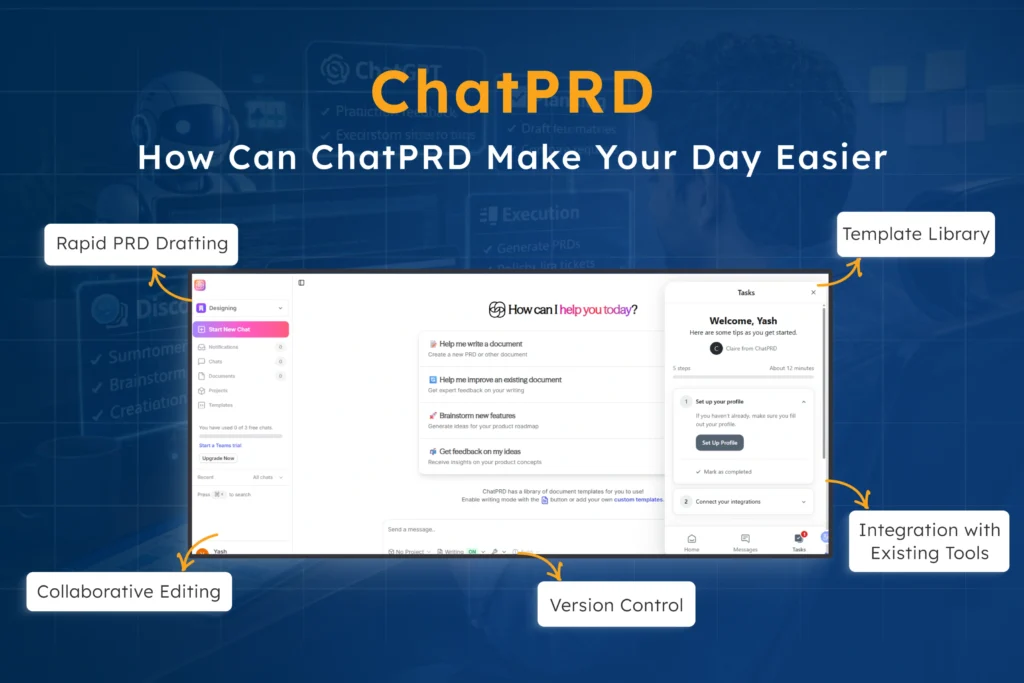
Interface of ChatPRD showing features like rapid PRD drafting, collaborative editing, version control, and integration with tools—highlighting how this AI tool helps product managers in 2025 create and manage product documentation efficiently.

6. ChatPRD

ChatPRD is an AI-driven platform tailored for product managers, enabling them to swiftly draft and refine PRDs, user stories, and technical specifications. By transforming minimal input into structured documents, it accelerates the documentation process, allowing teams to focus more on strategic planning and execution.
How Can ChatPRD Make Your Day Easier

  • Rapid PRD Drafting: Generate detailed PRDs from brief outlines, reducing the time spent on documentation. This is a process we also support with our MVP development services.


  • Collaborative Editing: Work seamlessly with team members, incorporating feedback and making real-time updates.


  • Integration with Existing Tools: Connect with platforms like Slack, Notion, and Google Drive to streamline workflows.


  • Template Library: Access a variety of templates to maintain consistency across documents.


  • Version Control: Track changes and maintain a history of document revisions for accountability. 

Positive Sides of Using ChatPRD 

  • Time Efficiency: Significantly reduces the time required to create comprehensive product documents.


  • Consistency: Ensures uniformity in documentation, adhering to best practices.


  • Collaboration: Facilitates teamwork through shared access and real-time editing.


  • Integration: Seamlessly fits into existing tool ecosystems, enhancing productivity.

Things to Keep in Mind While Using ChatPRD

  • Learning Curve: New users may require some time to familiarize themselves with the platform’s features.


  • Data Privacy: Ensure that sensitive information is handled appropriately, given the use of AI.


  • Customization: While templates are available, some customization may be needed to align with specific organizational needs.
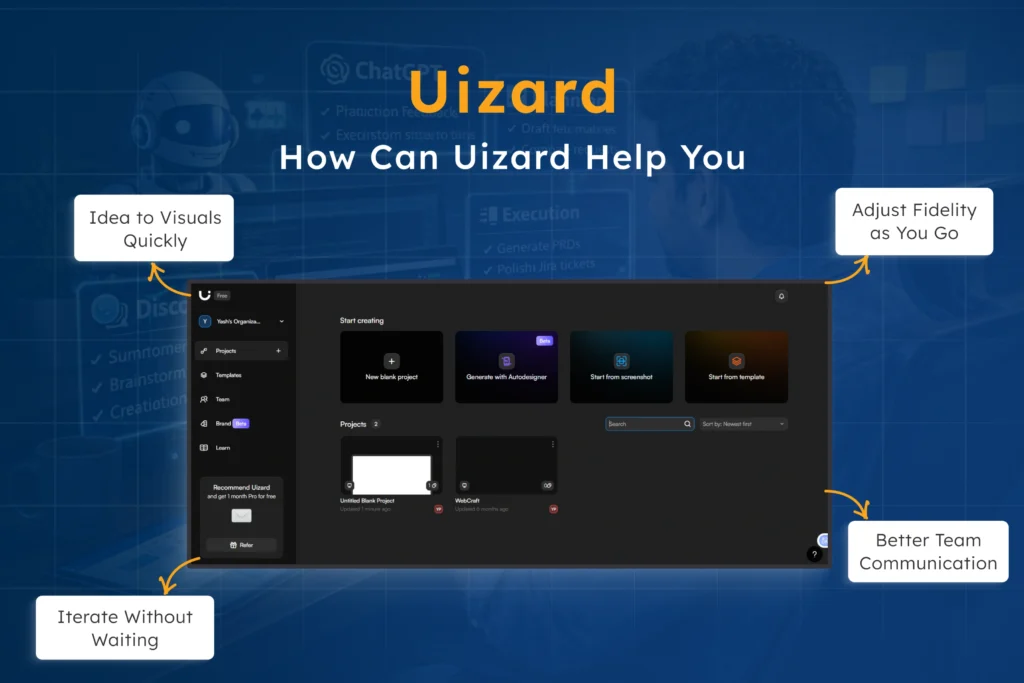
Uizard interface showcasing features like rapid idea-to-visual conversion, editable UI mockups, fidelity adjustments, and team collaboration—illustrating how this AI tool helps product managers prototype and communicate designs quickly in 2025.

7. Uizard 

Uizard is an AI tool for turning ideas into UI mockups and prototypes very fast. You can type a prompt, sketch, or use a screenshot, and Uizard helps convert that into editable designs.

How Can Uizard Help You

  • Idea to Visuals Quickly: Need to show something fast to stakeholders? Type a description or upload a sketch. Uizard gives you mockups in seconds.
  • Iterate Without Waiting: You don’t need a designer for every change. Screenshot Scanner or Wireframe Mode lets you turn existing designs into editable versions. Then tweak, update, iterate. 
  • Adjust Fidelity as You Go: Start in low fidelity (just layout/flow), then switch to high fidelity later. Good for early feedback vs polished presentations. 
  • Better Team Communication: Visual mockups help non-designers, stakeholders, and devs see what you mean. They reduce misunderstanding and make product discussions more concrete.

Positive Sides of Using Uizard  

  • Let PMs express ideas visually even without design tools + design skills.
  • Speeds up early prototyping and mockup creation.
  • Real-time collaboration features help align teams.
  • Helps bridge the gap between concept and handoff.

Things to Keep in Mind while Using Uizard 

  • AI output may be generic, especially for complex UI needs. You might need to refine heavily.
  • Design tools still need human judgment for usability, aesthetics, and brand consistency.
  • Some features are better on paid plans; access to templates or advanced modes may be limited.
  • Not always perfect converting screenshots/sketches, sometimes conversion needs manual tweaking.

Comparison Table: Best AI Tools for Product Managers (2025)

Tool Best For Key Benefit Things to Keep in Mind
ChatGPT Brainstorming, research, writing Quick answers, content generation, and idea validation Needs human review to avoid incorrect info
airfocus + AI Assist Roadmap planning & prioritization Data-driven feature scoring & prioritization Works best with clean input data
Notion AI Documentation & knowledge sharing Turns messy notes into clean docs fast Requires edits for context/clarity
Zeda.io Product discovery & VoC analysis AI-powered feedback insights & strategy alignment Data quality impacts insight accuracy
Productboard Customer feedback & feature prioritization Links feedback to features, helps build customer-driven roadmaps Advanced features may need a higher plan
ChatPRD Writing PRDs & user stories Generates detailed PRDs from short prompts Ensure sensitive data is handled carefully
Uizard Prototyping & wireframing Converts text or sketches into mockups fast AI output may need manual refinement

The Future of AI in Product Management (2025 and Beyond)

AI in product management is no longer just a trend; it’s happening right now. In 2025, we’re already seeing:


Smarter Insights: Tools are getting better at understanding context, not just data. They’re suggesting features, writing specs, and even predicting customer needs more accurately.


More Automation: Feedback analysis, research summaries, and roadmap updates are becoming semi-automated, letting PMs focus on strategy and vision.


Better Collaboration: From smarter insights to better collaboration, these AI tools for product managers 2025 are already shaping how teams work and transforming product workflows.


Human-Centric AI: As automation grows, product managers play a key role in keeping AI decisions aligned with real customer needs and business goals.

Why Partner with Samyak Infotech

AI tools are powerful, but using them effectively is where the real magic happens. That is where Samyak Infotech comes in. 


With years of experience in product engineering and AI adoption, we help businesses to: 


  • Integrate them seamlessly with the existing workflow. 


  • Build the custom solutions when off-the-shelf tools are not enough. 


Our goal is very simple: help you deliver better products that are faster with AI that can actually work for your team. 

Illustration of a product manager using AI tools to manage data dashboards, charts, and workflows—symbolizing how AI transforms product management in 2025 with faster decision-making, prototyping, and strategy execution.

Level Up Your Product Management in 2025

AI is already transforming product management in 2025,  and those who adopt it early will stay ahead. From ChatGPT for idea generation to Uizard for rapid prototyping, the right tools can save hours, cut confusion, and help you build products that users love.

Start experimenting with one or two AI tools for product management from this list, refine your workflow, and balance automation with human judgment.

When you’re ready to take AI adoption to the next level, Samyak Infotech can help you turn these tools into a real competitive advantage.


Ready to Bring AI into Your Product Workflow?

Let Samyak Infotech help you pick the right tools, integrate them seamlessly, and unlock real ROI from day one.

Smart Questions People Ask About AI Tools for Product Managers

Which AI tools are most beginner-friendly for product managers new to AI?

Here are a few that are easier to pick up:

  • ChatGPT: easy prompts, works in many stages.

  • Notion AI: good for documentation, summaries.

  • Uizard: when you want visual mockups without needing design skills.
    Start small, try one tool, see how it fits with your workflow before adding more.

No, not really. AI tools help with repetitive or data-heavy work, speed up writing, generate ideas, etc. But product managers still need to lead, make judgment calls, understand strategy, align teams, and bring the human touch. AI is a helper, not a replacement.

AI tools for product managers are software solutions that help with tasks like gathering user feedback, prioritizing features, drafting documentation, designing mockups, and generating reports. They use machine learning, natural language processing, or other AI techniques to make your work faster and more data-driven.

Check if it integrates with your tools, delivers quality output, saves time, and offers a trial so you can test before paying.

Many tools do, but performance varies. Some excel in discovery & research, others in prototyping or reporting. Choose based on your stage of product development. 

Absolutely. Many tools scale from small to large teams. For startups, choose tools with flexible pricing and focus on solving your biggest pain points first.

Prices vary. Many tools offer free tiers or trials. Full plans usually cost per user per month. It depends on features (AI-powered insight, integrations, etc.).

Start with versatile, beginner-friendly tools like ChatGPT (for ideas & writing), Notion AI (for documentation), or Uizard (for basic mockups). Try free trials first.

Risks include inaccurate outputs, over-reliance, data privacy issues, and loss of product vision if AI suggestions are taken without thinking.

Mostly yes, if you pick tools with strong security and compliance. Always check privacy policies, encryption, and data sharing limits.

Latest News from our end!

Wait! Don’t Leave Without This !!

Get 1 Week of Free Custom AI Development

Our AI experts will help you prototype, automate, or build AI-powered solutions — risk-free.
⚡ Limited-time offer for new users.