How to Choose the Right LLM
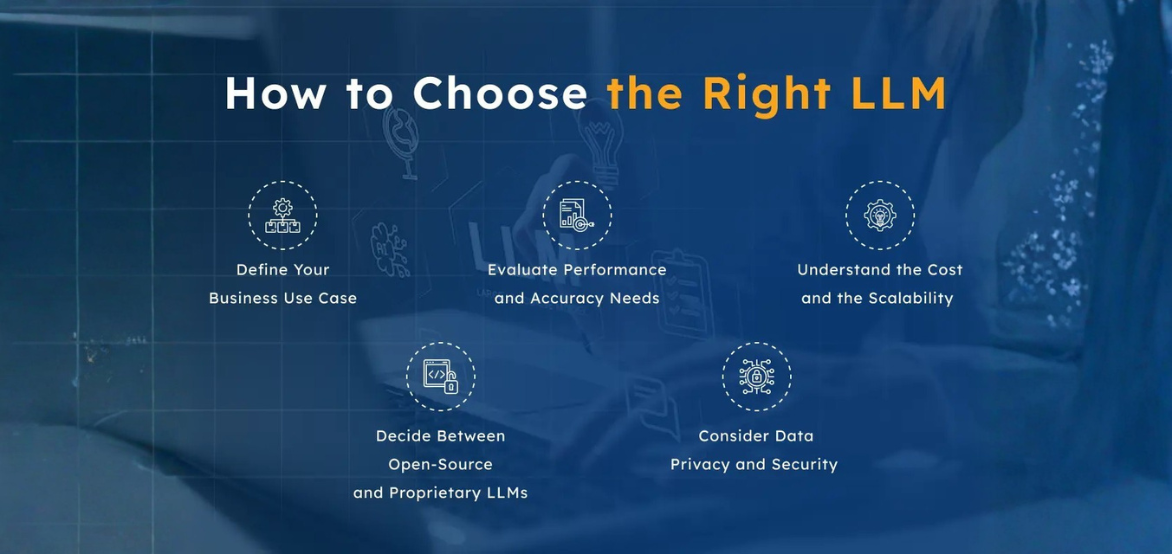
Once you know your business needs an LLM, the next step involves choosing the right one. There is no single best model for every business. The right choice depends on the use case, data, budget, and scale. If you choose a clear approach, it will help you to avoid wasted costs.
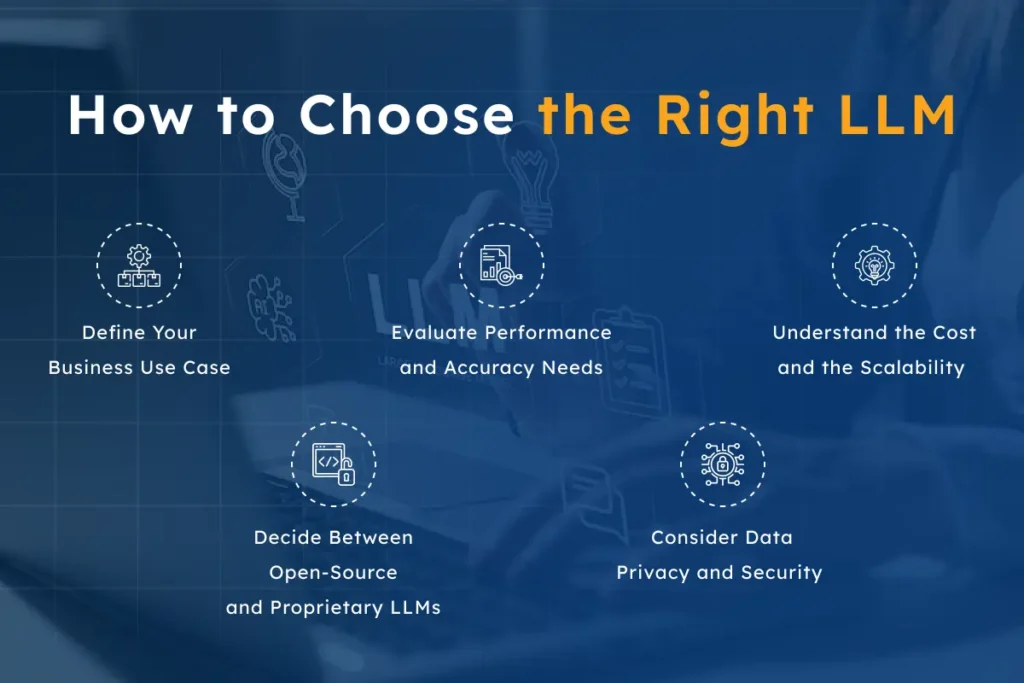
Below are the key steps to follow when choosing the right LLM model for your business.
Step 1: Define Your Business Use Case
Before choosing an LLM model, define the problem. Do not start with the technology; start with the task.
Take into consideration simple questions like:
- What should the LLM do?
- Who will use it?
- How often will it be used?
Different use cases need different LLMs. Choosing the wrong LLM can increase the cost and reduce quality. Clarity makes choosing the right LLM easier.
Step 2: Decide Between Open-Source and Proprietary LLMs
Once the use case is clear, the next step involves choosing the type of LLM. This decision shapes everything that follows.
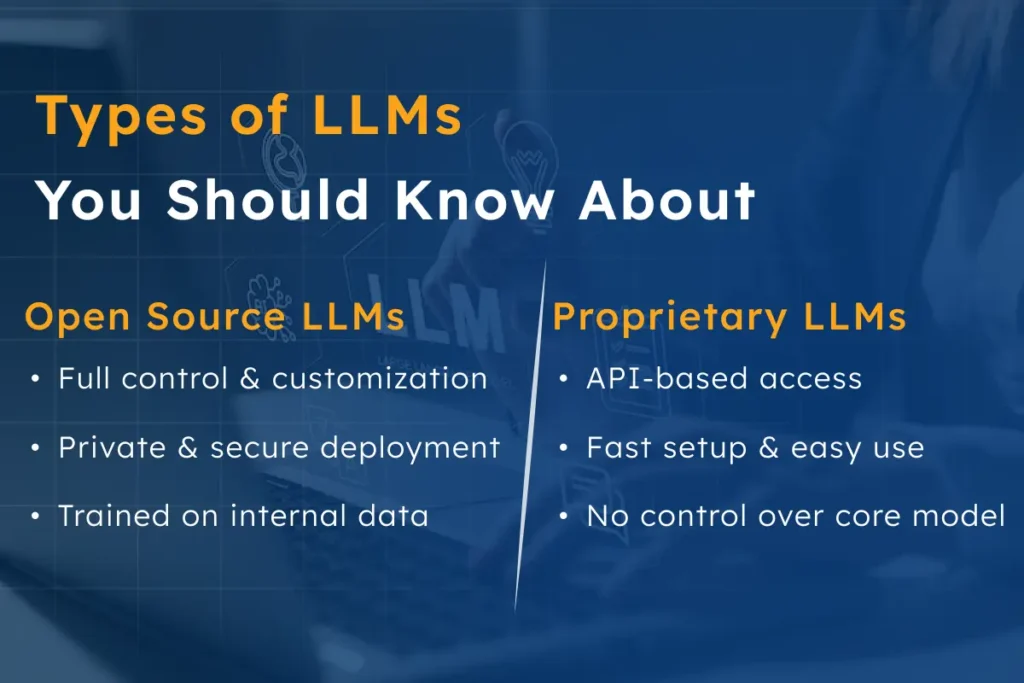
This involves choosing between control and speed. Open-source LLMs give more control and allow customization. Also, along with this, they support private deployment, which turns out to work well for long-term use.
On the other hand, proprietary LLMs offer speed. They are easy to access and help with quick testing and early pilots.
In case you are looking for an LLM to handle sensitive business data, control is something that matters most, while if you are testing an idea, speed matters more. Choosing the right type of LLM can reduce risk. It also avoids unnecessary costs later.
This step is critical when choosing the right LLM for your business.
Step 3: Evaluate Performance and Accuracy Needs
Not every LLM needs the same level of performance. Some tasks are simple, while a few are complex. The next step involves understanding what the LLM must handle.
For example:
Answering common customer questions needs speed. Summarizing long documents needs context awareness. Analyzing reports needs strong reasoning. Choosing a powerful LLM for a basic task can waste money, and at the same time, choosing a weak one for complex tasks leads to poor results.
This is the reason why performance matters when choosing the right LLM. The goal is balance, not excess.
Step 4: Consider Data Privacy and Security
Data is the key aspect of every LLM project. This makes privacy a serious concern. Start the process by asking what type of data the LLM will access—customer data, internal documents, or business-sensitive data.
There are some LLMs that process data on external servers. Others can be deployed in private environments.
For example:
If the LLM will read internal reports, data control turns out to be important. And in the case if it handles public information, the risk is lower. Ignoring privacy can lead to compliance issues and also it reduces the user’s trust.
Step 5: Understand the Cost and the Scalability
Cost is not just about the starting price. It grows as the usage increases. There are a few LLMs that require infrastructure and maintenance.
While choosing a particular LLM start with basic questions like:
- How many users will be able to access the LLM
- How often it will be used
- Will the usage increase in future
For example, an LLM that is used by one team may cost little while the same that is used across multiple departments can turn out to be expensive.
Scalability is important as much as the cost. The LLM you choose should handle growth without breaking performance.
This step helps to make sure that you are choosing the right LLM for today and tomorrow.







 explore more