Top Questions to Ask Before Outsourcing AI Development

AI Outsourcing Guide Top 10 Questions to Ask
ON 12 February , 2026

How about outsourcing AI development? Many companies want to use AI. It can automate tasks and save costs. However, AI projects often fail without proper guidance. 

Choosing the wrong partner can be costly. Poor models, slow delivery, and hidden fees hurt business.

Asking the right questions prevents mistakes later. It helps clarify expectations and avoid risks. This is why considering AI outsourcing early can make all the difference.

This blog covers the top questions to ask before outsourcing AI development. Following these helps you make smarter AI decisions.

Outsourcing AI development involves partnering with an external AI development company to plan, build, and manage AI solutions. This allows businesses to avoid the need for large internal AI teams. By outsourcing, companies can leverage specialists to handle complex tasks such as defining AI goals, evaluating feasibility, and ensuring the AI system meets business needs. An AI development company designs systems that learn from data and improve over time, making them distinct from traditional fixed-rule software. AI models continue learning even after deployment, adding complexity to the project. Due to these challenges, AI requires specialized skills, advanced infrastructure, and ongoing monitoring, making outsourcing a preferred choice for many organizations.

What Is Outsourcing AI Development?

Outsourcing AI development means working with an external AI development company. These teams plan, build, and manage AI solutions. Companies avoid creating large internal AI teams.

With AI outsourcing, businesses rely on specialists for complex work. This includes defining AI goals and evaluating feasibility. The focus stays on outcomes, not internal setup.

An AI development company designs and builds AI systems. These systems learn from data and improve over time. They differ from fixed-rule software systems.

AI development does not stop after delivery. Models continue learning after deployment. This ongoing learning makes AI projects more complex.

Because of this complexity, AI requires specialized skills. It also needs advanced infrastructure and monitoring. That is why many companies choose AI outsourcing.

Why Companies Choose AI Outsourcing

Many companies outsource AI to access specialized expertise. AI requires skills in data, models, and systems. Building this expertise internally takes time. Outsourcing provides immediate access to experienced teams through AI consulting services.

Speed is another major reason for outsourcing. External teams enable faster experimentation and delivery. They follow proven frameworks and workflows. This reduces trial-and-error during the early stages.

Cost and hiring flexibility also matter. Hiring full-time AI experts is expensive. Outsourcing converts fixed costs into flexible spending. Companies pay only for required skills.

Outsourcing also supports easy scaling. Teams can grow or shrink as needed. Businesses avoid building large internal teams. This keeps operations lean and adaptable.

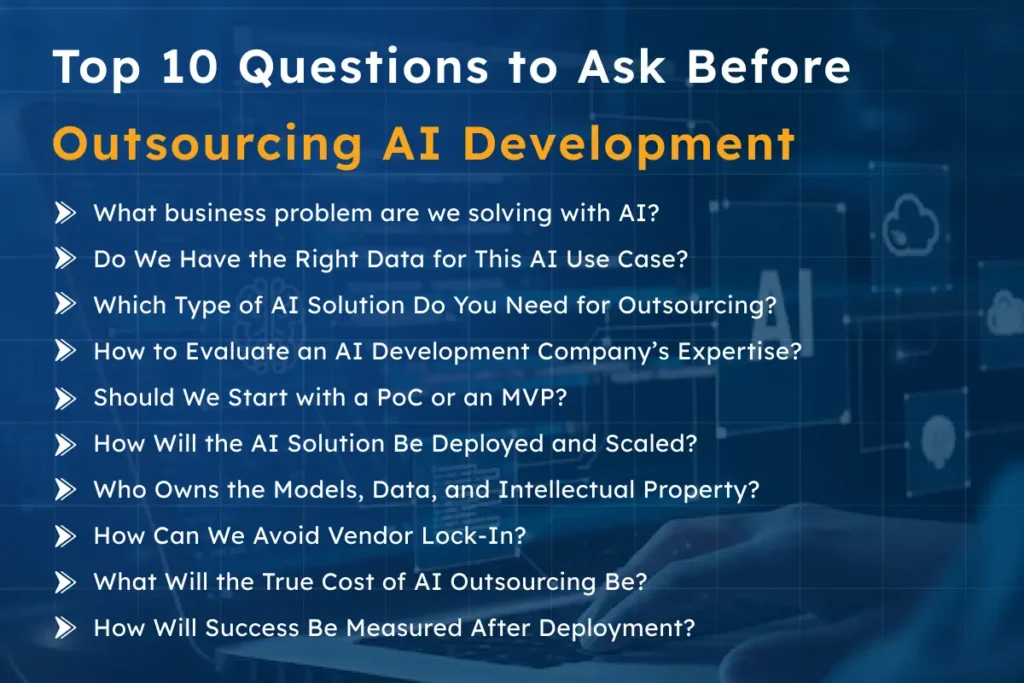
What business problem are we solving with AI? Define clear objectives to avoid wasting time and budget. Do We Have the Right Data for This AI Use Case? Ensure accurate, consistent data ownership to improve model performance. Which Type of AI Solution Do You Need for Outsourcing? Choose the right solution (ML models, AI agents, LLM-based systems) based on the task. How to Evaluate an AI Development Company's Expertise? Check past projects, team expertise, and end-to-end AI lifecycle management. Should We Start with a PoC or an MVP? Decide between testing feasibility (PoC) or validating business value (MVP). How Will the AI Solution Be Deployed and Scaled? Plan deployment (cloud or on-premises) and ensure scalability and monitoring. Who Owns the Models, Data, and Intellectual Property? Clarify ownership to avoid vendor lock-in and protect AI assets. How Can We Avoid Vendor Lock-In? Ensure portability by securing access to models, code, and documentation. What Will the True Cost of AI Outsourcing Be? Understand development and operational costs, and ensure transparency. How Will Success Be Measured After Deployment? Track business KPIs and technical metrics to ensure continued value.

Top 10 Questions to Ask Before Outsourcing AI Development

1. What business problem are we solving with AI?

AI should solve a simple business problem. Many projects fail without defined objectives. Teams build AI because it sounds innovative. This often leads to poor outcomes.

Every AI initiative needs measurable outcomes. These outcomes guide model design and success metrics. Clear goals help evaluate real business impact.

Avoid building AI without a simple use case. Undefined use cases waste time and budget. A strong problem statement ensures AI delivers value.

2. Do We Have the Right Data for This AI Use Case?

Data is the foundation of every AI solution. Without data, models cannot learn patterns. Many AI projects fail because of poor data readiness.

Businesses must assess the availability and quality of data, ensuring it is accurate and consistent. Incomplete data reduces model performance.

Data ownership is equally important. Companies must control their data sources. This avoids legal and compliance issues.

Define roles early. The client provides data and business context. The AI development company handles data processing and modeling. Clear responsibilities reduce delays and confusion.

3. Which Type of AI Solution Do You Need for Outsourcing?

Not every problem needs the same AI approach. Different use cases require different AI systems. Choosing the wrong type increases costs and complexity. The right choice depends on tasks and outcomes.

AI solutions usually fall into three categories. These include ML models, AI agents, and LLM-based systems.  

Many LLM-based systems are built using foundation models from providers like OpenAI, which power advanced language understanding and decision-making in enterprise AI solutions

Each serves a different purpose. Understanding these differences is critical when selecting AI outsourcing services.

AI Solution Types Comparison

AI Type Best Used For Key Characteristics
ML Models Predictions and classification Structured data, narrow tasks, high accuracy
AI Agents Process automation and actions Decision-making, tool usage, workflow execution
LLM-Based Systems Language and reasoning tasks Chat, documents, search, contextual understanding

Businesses must also choose how models are built. You have two main options:

  • Custom-built solutions
    • Fit unique workflows and business requirements
    • Require more data, time, and development effort
    • Offer better alignment with specific needs
  • Pre-trained solutions
    • Suitable for common, repeatable tasks
    • Deliver faster results with less effort
    • Offer lower initial cost but less customization

Choosing the right combination reduces rework and controls long-term AI costs. Rational decisions now make scaling much easier later.

4. How to Evaluate an AI Development Company’s Expertise?

Not every software provider understands AI deeply. AI engineering differs from standard app development. Traditional apps follow fixed rules.

AI systems learn continuously from data. Choosing the wrong AI development company can lead to poor model performance.

When evaluating an AI development company, start with a portfolio review. Past AI projects show real-world experience. Look for use cases similar to your business needs. This helps validate practical expertise.

The availability of skilled AI experts also matters. Strong teams include data scientists, ML engineers, and AI architects. These experts handle model selection, training, and evaluation.

Proven expertise extends beyond development. An AI development company should manage deployment, monitoring, and retraining. Experience in AI operations reduces risk and speeds up delivery.

5. Should We Start with a PoC or an MVP?

Businesses often struggle to decide between a Proof of Concept (PoC) and an MVP (Minimum Viable Product). The choice depends on technical uncertainty, business goals, and risk tolerance. Understanding the difference helps reduce wasted effort and cost.

PoC vs MVP Comparison

Aspect Proof of Concept (PoC) Minimum Viable Product (MVP)
Goal Test technical feasibility Validate real-world business value
Scope Extremely limited internal use Functional, real users can interact
Data Sample or historical Live or near-live data
Time & Cost Shorter, lower cost Longer, higher cost
Outcome Shows if the idea can work Shows if the solution is valuable
  • When to start with a PoC:
    • New or unproven AI technology
    • Uncertain data quality
    • High technical risk
  • When to move directly to an MVP:
    • Proven technology and clear use case
    • Existing high-quality data
    • Speed to market is important

Choosing the right approach saves time and cost. Starting with a PoC reduces technical risk. Starting with an MVP accelerates business validation. It also enables faster results through MVP development services. A phased approach often works best.

6. How Will the AI Solution Be Deployed and Scaled?

Deployment strategy is critical for AI success. Solutions can run on the cloud or on-premises. Cloud deployment uses external servers managed by a provider. On-premises deployment runs the AI within your own servers. 

On-premises gives full control over data and security. Cloud offers flexibility and easier scaling. The right choice depends on business needs and compliance.

Once deployed, AI systems need monitoring and retraining. Models can experience performance drift over time. Regular evaluation ensures accuracy and reliability. Vendors should provide tools to track model performance continuously.

Scaling is another key factor. The system must handle growing data and users. Proper scaling prevents slowdowns and downtime. Experienced vendors manage expansion without disrupting operations.

Working with experts ensures reliable AI deployment services. They handle infrastructure, monitoring, and scaling efficiently. This reduces risk and speeds up time-to-value.

7. Who Owns the Models, Data, and Intellectual Property?

IP clarity is crucial in AI outsourcing. Contracts must define ownership of models, data, and workflows. Without clear terms, businesses risk losing control over their AI assets.

Long-term control over AI solutions is essential. Companies should ensure access to source code, trained models, and data pipelines. This prevents vendor lock-in and supports future scaling or migration.

Clear IP agreements also protect against legal and compliance risks. All parties must agree on usage rights, modifications, and licensing. Well-defined contracts safeguard both the business and the vendor.

8. How Can We Avoid Vendor Lock-In?

Vendor lock-in happens when AI systems depend too heavily on one provider. Businesses should prioritize portability of models and infrastructure. This ensures they can move or scale systems easily.

Access to code, documentation, and deployment pipelines is essential. Companies should get copies of models, scripts, and setup guides. This avoids being tied to a single vendor in the long term.

Clear agreements on ownership and transfer rights also help. Well-documented systems make scaling, updates, or migrations much easier. Planning for portability reduces risk and protects AI investments.

9. What Will the True Cost of AI Outsourcing Be?

Understanding the true cost of AI outsourcing is essential. Costs include development and operational expenses. Development covers design, model building, and testing. Operational costs include deployment, monitoring, and maintenance.

Different vendors use different pricing models. Some charge fixed fees, others use subscription or usage-based pricing. Hidden expenses, like data preparation or extra infrastructure, can add up quickly.

Careful planning helps avoid budget overruns and ensures transparency in AI development costs. Clear agreements on scope and deliverables reduce surprises. Working with experienced partners ensures predictable AI outsourcing costs and better ROI.

10. How Will Success Be Measured After Deployment?

Measuring success is critical for AI projects. Companies should track both business KPIs and technical metrics. Business KPIs show real impact on revenue, efficiency, or customer satisfaction. 

Technical metrics monitor model accuracy, reliability, and performance over time.

AI systems require continuous optimization. Models may need retraining as data changes. Regular evaluation ensures maximum value. Tracking ROI helps justify investment and guide future projects.

Clear success measures align teams and vendors. They make performance transparent and decisions data-driven. Well-defined metrics reduce risk and support scaling.

Make Smarter AI Outsourcing Decisions

Evaluating AI vendors carefully is essential. Asking the right questions reduces risk and ensures real value. Structured evaluation prevents costly mistakes and wasted effort.

Rushed decisions often lead to poor models and delayed projects. Take the time to clarify goals, data, ownership, and deployment strategies. This approach helps you make informed choices that scale with your business.

Samyak Infotech is your partner for end-to-end AI solutions. From strategy and development to deployment and optimization, we help businesses achieve measurable results.

Ready to start your AI journey? Get in touch with Samyak Infotech today!

Latest News from our end!

Wait! Don’t Leave Without This !!

Get 1 Week of Free Custom AI Development

Our AI experts will help you prototype, automate, or build AI-powered solutions — risk-free.
⚡ Limited-time offer for new users.