

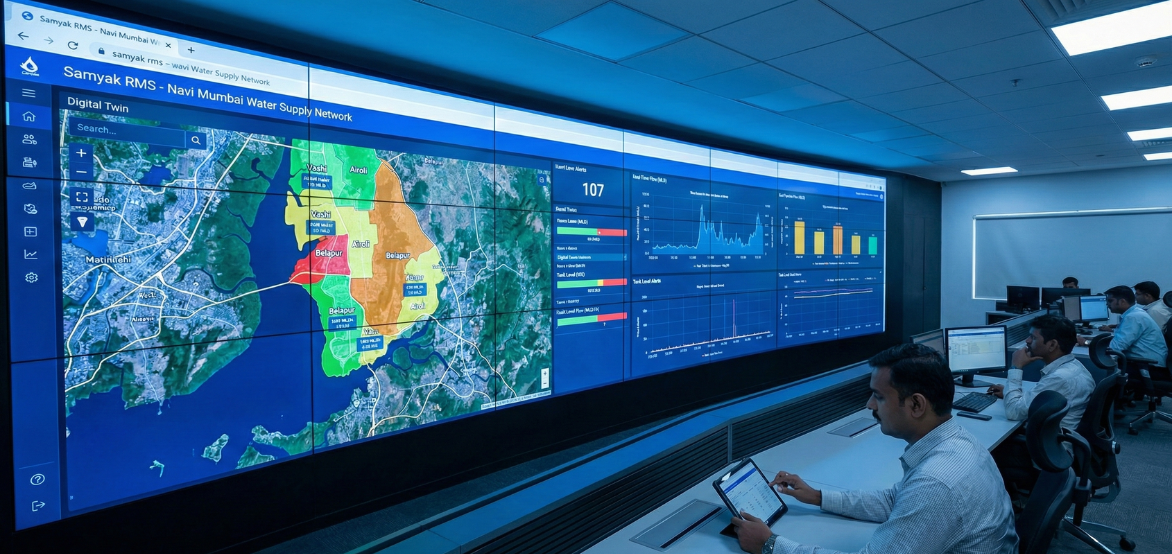
In the world of Industrial IoT, “Data” is only as good as the platform that visualizes it. For years, the Navi Mumbai Municipal Corporation (NMMC) relied on traditional SCADA systems to monitor their water distribution. While functional, these systems were “locked” in control rooms. A ward officer in Airoli had no real-time visibility into what was happening in Morbe Dam unless they made a phone call.
The mandate for Samyak Infotech was clear: Democratize the Data.
We were tasked with replacing the legacy SCADA with Samyak RMS (Remote Monitoring System)—a centralized, web-based water management software capable of handling the massive scale of Navi Mumbai’s water network.
This wasn’t just a software update; it was a complete digital transformation involving 70+ visualization screens, 67 distinct report types, and a complex database architecture.
The Architecture: A Web-Based “Digital Twin”
The core of the project was to move from “static visuals” to a “dynamic web experience.” We built a platform that allows authorized users to access critical water data—collected continuously by Samyak Instrumentation’s IoT Data Loggers—from any secure device, anywhere.
The sheer scale of the NMMC network required us to design 70 unique dashboard screens. 10
We didn’t just dump data into tables; we created a Digital Twin of the network.
Data is useless without context. The NMMC required a staggering 67 different types of automated reports.
Building this reporting engine was the most complex part of the software development.
Role-Based Access Control (RBAC) at Scale
Security is paramount in municipal software. We implemented a granular Role-Based Access Control system.
This ensures that while data is centralized, operational control remains distributed and secure.
Bridging the Gap: The “Trunkline” Integration
A major software achievement was integrating the Trunkline Data (the main arteries of the water network) onto the unified server.
Previously, the transmission data (Trunklines) and distribution data (Wards) lived in separate software worlds. By merging them into a single SQL database structure, Samyak RMS enabled Predictive Analytics. The system can now analyze trends—like a drop in Trunkline pressure—and predict which specific Sector Tanks in Airoli or Nerul will face a shortage in the next 4 hours.
Conclusion
The NMMC project is a blueprint for the future of Smart Cities in India. It demonstrates that with the right software architecture, municipalities can leapfrog from 1990s technology to 2026 standards without disrupting daily operations.
Samyak Water Management Software didn’t just replace a SCADA system; it built a nervous system for Navi Mumbai’s water infrastructure. Explore more IIoT Solutions.


©2026 Samyak Infotech Pvt Ltd. | All trademarks, images and logos are the property of their respective owners.


 explore more