What Is ClawdBot? Your Guide to the Most Viral AI Assistant.

ON 05 February , 2026

What Is ClawdBot? Your Guide to the Most Viral AI Assistant.

Why is ClawdBot suddenly popping up all over the internet? Its popularity has been swift and hard to miss. Tech groups are actively talking about it each day.

Videos on YouTube, threads on Reddit, and tweets on Twitter went viral. Tech news websites quickly caught on to the trend. Programmers started releasing demos and experiments publicly. The talk reached well beyond the tech groups.

ClawdBot represents a new trend in AI development. Users increasingly want AI systems that actually get things done. Chatbots simply talk but do not act. Action-oriented AI agents offer more real-world potential.

This guide will tell you what ClawdBot is and what it actually does. It will discuss its capabilities, its limitations, and its actual risks. You will learn why the current hype exists. You will also learn where the line of caution should be drawn.

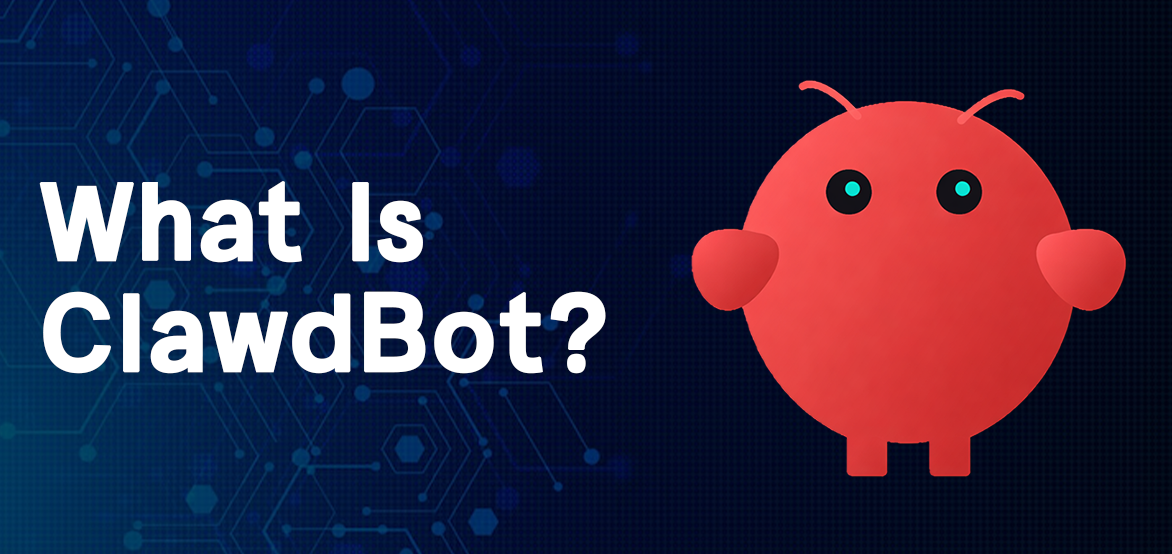
Red cartoon robot representing ClawdBot, an autonomous AI agent system, on a tech-themed blue background with the title " What is ClawdBot " displayed above.

What Is ClawdBot? 

ClawdBot is an autonomous AI agent system. It can observe, decide, and take action. Unlike chatbots, the agent runs continuously in the background. It is usually self-hosted on private systems.

Traditional AI chatbots focus on conversations only. They answer questions and generate responses. This AI agent goes beyond simple text replies. It can execute tasks across connected tools.

This ability makes the system ‌different. It behaves more like a digital assistant. The agent can manage workflows and processes. Human input is not required constantly.

There is also confusion around its name. ClawdBot was the original project name. It was later renamed ‌Moltbot. The current stable name is OpenClaw.

How ClawdBot Works: High-Level Architecture

ClawdBot follows a self-hosted deployment model. The system runs on local machines or cloud servers. Users maintain full control over infrastructure. This approach improves privacy and customization options.

The system connects with large language models. It can use GPT, Claude, or local models. The AI model handles reasoning and decisions. The agent manages execution logic.

The agent uses a messaging-first interaction design. Users communicate through Telegram, WhatsApp, or Slack. Commands feel like natural chat conversations. The agent responds and acts accordingly.

Task execution happens through modular skills. These plugins allow actions across tools. Building reliable skills often requires AI agent development services. This ensures secure and scalable agent behavior.

ClawdBot vs. Traditional AI Chatbots

Traditional AI chatbots are designed for conversations. They respond to prompts and stop after replies. Each interaction remains isolated and temporary.

The system works as a persistent AI agent. It stays active beyond single conversations. The agent can plan, decide, and execute tasks. This makes it ‌more operational.

Another major difference is task execution. Chatbots usually suggest what users should do. They provide guidance but cannot act independently. This AI agent can execute actions using connected tools.

Memory handling also separates these systems clearly. Most chatbots forget context after sessions end. ClawdBot maintains long-term memory across workflows. This enables continuous improvement and task continuity.

The table below highlights how ClawdBot differs from traditional AI chat platforms.

Features ChatGPT / Claude / Gemini ClawdBot
Core purpose Conversational assistance Autonomous task execution
Interaction style Prompt–response Continuous agent operation
Task execution Suggests actions only Executes actions directly
Memory Session-based or limited Long-term, persistent memory
Workflow handling Manual, user-driven Automated, agent-driven
Hosting Cloud-managed Self-hosted or private cloud

What Can ClawdBot Actually Do?

Basic Use Cases

  • Manage emails, replies, and inbox prioritization
  • Schedule meetings and handle calendar updates
  • Conduct research and generate concise summaries
  • Organize files across folders and systems
  • Set reminders and follow up automatically


Advanced Automation Capabilities

  • Run multi-step workflows without manual input
  • Execute scripts for backend or system tasks
  • Perform browser automation for repetitive actions
  • Integrate APIs and third-party business tools
  • Power custom solutions built through AI product development services

Why Did ClawdBot Go Viral?

One major reason behind the buzz was messaging. Many people described it as an “AI that works while you sleep.” This phrase spread quickly across social platforms. It captured attention because it sounded practical. 

Users imagined automation happening without supervision. That idea resonated strongly with busy professionals.

Another factor was its continuous operation model. The agent does not wait for user prompts. It stays active in the background. Tasks continue even when users log off.

This always-on assistant behavior felt different from chatbots. It aligned with expectations of future AI systems.

Open-source availability also accelerated visibility. Developers could access and modify the system. They shared experiments, workflows, and failures openly.

GitHub repositories gained traction quickly. This transparency created strong developer hype online. Community-driven momentum pushed it further.

Much of this momentum came from open-source communities. Developers actively shared the system’s workflows, issues, and forks on GitHub, which accelerated experimentation and peer review.

Social media amplified everything rapidly. Short demos showed impressive automation results. These clips were easy to share and understand. However, most demos showed ideal conditions only. Real-world usage often requires configuration and monitoring. This gap fueled both excitement and debate.

The Rebranding Story: ClawdBot → Moltbot → OpenClaw

The project did not start with its current name. ClawdBot was the original identity. As attention grew, legal concerns began surfacing. Trademark conflicts created unexpected pressure. The team needed to respond quickly and carefully.

To avoid legal risks, the name changed. Moltbot was introduced as a temporary alternative. However, the name lacked clarity and recognition. Many users continued calling it ClawdBot. This confused platforms and discussions.

The Moltbot name never fully resonated. It did not clearly communicate purpose or vision. Search visibility also became fragmented. Community adoption slowed during this transition period. The branding felt unstable and uncertain.

Eventually, the project adopted OpenClaw as its identity. The name emphasized openness and community alignment. It avoided trademark conflicts more effectively. This made OpenClaw the most stable option. Adoption became more consistent afterward.

Interestingly, the rebranding fueled even more attention. Name changes reopened discussions repeatedly. Threads, videos, and debates resurfaced each time. This cycle unintentionally boosted online discussion and visibility.

Hype vs Reality: What People Don’t Talk About

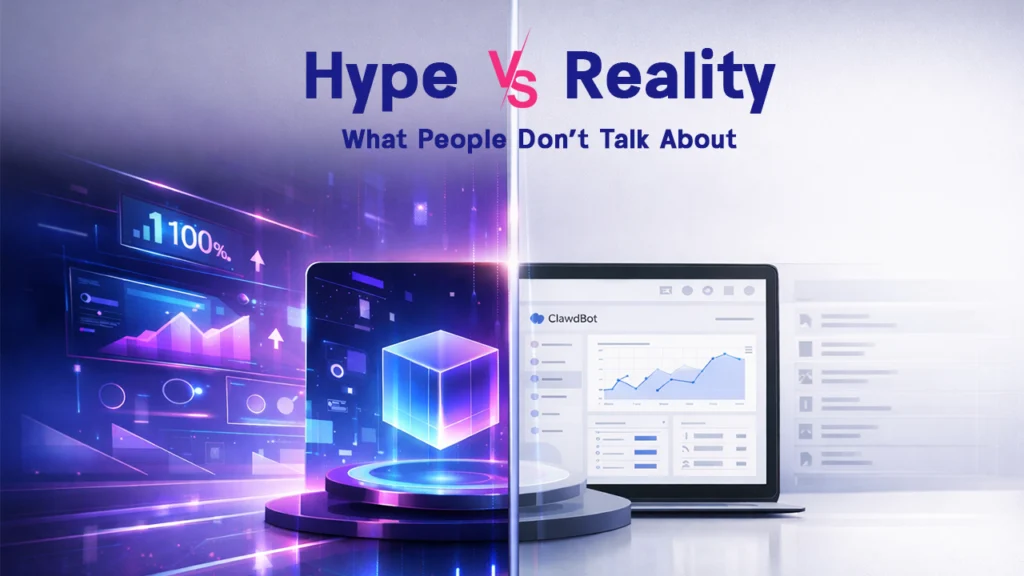
AI agent dashboard showing hype vs reality comparison, highlighting complex setup, model configuration, and onboarding challenges for beginners

This AI agent is not a plug-and-play solution. Setup requires time and planning. Users must configure models, tools, and workflows. Initial onboarding can feel complex for beginners.

Technical expertise is often required early. Users need familiarity with systems and APIs. Debugging failures is part of daily usage. This limits adoption for non-technical teams.

Security is another overlooked responsibility. Self-hosting shifts risk to the user. Access controls and secrets must be managed carefully. Ongoing updates and patches are essential.

Autonomy is also more limited than expected. The system cannot operate fully unsupervised. Humans must review outputs and actions. Oversight remains critical for reliable outcomes.

These factors directly impact implementation budgets. Setup, hosting, and maintenance increase long-term expenses. Many teams underestimate the AI agent development cost. Reality often differs from viral demos.

Security, Privacy, and Operational Risks

Self-hosting introduces serious responsibility. Infrastructure security rests entirely with users. Poor configurations can expose sensitive systems. This creates self-hosting risks that many teams overlook.

Plugins expand functionality but increase attack surfaces. Each permission adds potential vulnerabilities. Poorly reviewed plugins can access critical resources. This makes plugin permissions a common failure point.

Misconfiguration is another major concern. Incorrect role settings can trigger unintended actions. Automated tasks may run with excessive privileges. These misconfiguration dangers grow with system complexity.

Enterprises face higher operational exposure. In enterprise environments, these risks are often evaluated against internal security policies, compliance frameworks, and audit requirements before any autonomous agent is deployed.

Compliance requirements demand strict controls. Auditability and monitoring become mandatory. This is why large organizations must be cautious.

Organizations typically align autonomous AI systems with established security standards and internal governance models to reduce operational and compliance risk.

Who Should (and Shouldn’t) Use ClawdBot

Best Fit

  • Developers and engineers building automation systems

  • Startups and tech teams experimenting with workflows

  • Teams running AI automation experiments safely

Not Ideal For

  • Non-technical users needing simple tools

  • Mission-critical systems requiring guaranteed reliability

  • Regulated environments without strict controls

Choosing the right implementation partner matters. Many teams rely on an experienced AI agent development company. This helps reduce risk and improve outcomes.

Is ClawdBot the Future of AI Agents?

AI systems are becoming more autonomous. Many tools now focus on execution, not chat. This shift marks the rise of agentic AI systems. ClawdBot represents this broader movement.

Businesses will adopt AI agents gradually. Prior use cases will focus on internal automation. Teams will test agents in controlled environments. Trust and reliability will drive long-term adoption.

Several limitations still need resolution. Autonomy remains constrained by oversight needs. Security, accuracy, and governance require improvement. These gaps prevent immediate large-scale deployment.

Professional implementation will play a key role. Designing safe and scalable agents is complex. This is where professional AI development fits best. Experts help bridge innovation and reliability.

Final Thoughts: What ClawdBot Really Represents

ClawdBot signals a larger industry shift. AI is moving beyond simple conversations. Systems are evolving into AI workers that perform tasks. This change will redefine how work gets done.

For businesses, this trend matters greatly. AI can now execute actions, not suggest them. This opens new paths for efficiency and scale.

Still, timing and approach are critical. Some teams should experiment first. Others need secure, custom-built solutions. Knowing this difference reduces long-term risk.

Many teams explore AI agent development services for guidance. Experienced partners like Samyak Infotech help build reliable AI agents.


Frequently Asked Questions

Is ClawdBot free to use?

ClawdBot is open-source, but running it involves costs for hosting, models, and maintenance.

No. It can execute tasks independently, but human oversight is still required.

ChatGPT and Claude chat. ClawdBot executes tasks and manages workflows.

ClawdBot is designed for persistent, long-running workflows rather than short experiments.

Yes, but only with strong security controls, monitoring, and governance.

Non-technical users and highly regulated teams may find it difficult to adopt.

Incorrectly configured permissions, insecure plugins, and a lack of oversight.

Latest News from our end!

Please wait, copying in progress...

If you’re making a lot of copies it can take a while
(up to 5 minutes if you’re on a slow server).

Average time is 8 copies per second.

Image Issues

The images listed below are being resized to fit a container. To avoid serving oversized or blurry images, try to match the images to their container sizes.

Oversized
Undersized

All images are properly sized

Note: It’s not always easy to make this happen, fix up what you can.

Wait! Don’t Leave Without This !!

Get 1 Week of Free Custom AI Development

Our AI experts will help you prototype, automate, or build AI-powered solutions — risk-free.
⚡ Limited-time offer for new users.

Skip to toolbar