What Purpose Do Fairness Measures Serve in AI Product Development?

ON 20 December , 2025

Have you ever wondered why fairness measures play such a big role in AI product development? Many assume AI works without bias, but in reality, it often reflects the flaws of the data and the design behind it. Without fairness checks, AI can make decisions that are unfair, inaccurate, or even harmful.

In this blog, we’ll break down what fairness measures are and why they matter. You’ll learn how they reduce bias, improve trust, and guide the creation of ethical AI product development services. We’ll also explore the role of fairness measures in shaping AI that people can use with confidence.


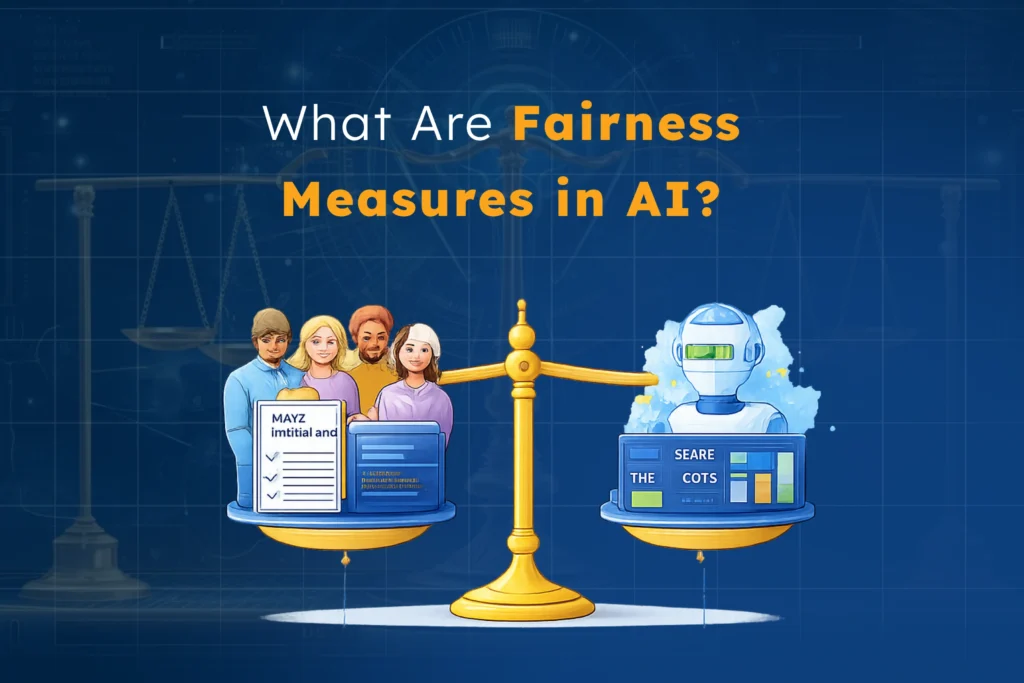
Illustration showing a balanced scale with diverse human figures and documents on one side and an AI robot with data charts on the other, symbolizing the role of fairness measures in AI product development to ensure ethical and unbiased decision-making.

What Are Fairness Measures in AI?

Fairness measures are methods used to make sure AI systems treat people fairly. They help reduce bias in the way AI learns, predicts, or makes decisions. AI is not automatically fair. It continuously learns from data provided, and if that data carries human bias, the AI can repeat the same mistakes. Sometimes, even the algorithms that are designed through AI can create unfair outcomes. 

For example, a hiring tool might favor one group of candidates over another because of biased training data. Or a facial recognition system might make more errors with certain skin tones. These issues show why fairness measures are needed.

Fairness measures act like checks and balances. They guide the design, training, and testing of AI so that it works in a more balanced and ethical way.

Why Fairness Measures Matter in AI Product Development

AI is now used in areas that can affect people’s lives, like healthcare, hiring, banking, and more. In all of these cases, fairness has no longer remained optional. If an AI system makes biased decisions, it can harm people and also damage the trust in the product. 

Fairness measures are used to reduce this risk. These measures make sure that AI models are tested for bias and designed in a way to treat users more equally. This is one of the key features for building systems people can rely on. 

For businesses, fairness is also about responsibility and growth. Biased AI can lead to discrimination, legal problems, and even loss of customers. On the other hand, fair AI helps to create trust, meet regulations, and help companies stand out in the competitive market. Using the right Custom AI Solution helps reduce risk, avoid legal issues, and build stronger customer trust.

Thus, in short, fairness measures protect users and businesses at the same time. They ensure that AI products are not only smart but also ethical and dependable.   

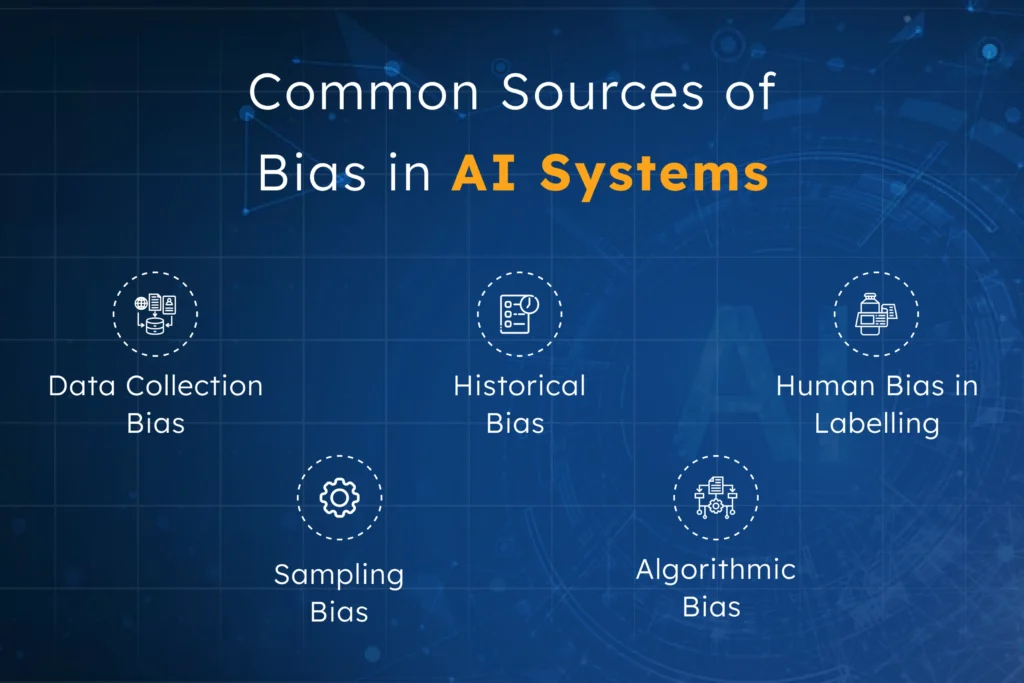
Infographic highlighting common sources of bias in AI systems, including data collection bias, historical bias, sampling bias, algorithmic bias, and human bias in labelling—illustrating why fairness measures are essential in AI product development.

Common Sources of Bias in AI Systems

Biases in AI often start with the data and the way systems are built.  Strong User Research and a clear Information Architecture Design process help reduce such risks from the start.  If these biases are not addressed, they can show up in how AI can make decisions. Here are the main sources of bias: 

  • Data Collection Bias

When the data is incomplete or unbalanced, the AI will not be able to perform fairly. For example, if a health dataset includes more records from men than women, the system may give less accurate results to women. 

  • Historical Bias 

AI often learns from records. If the past decisions were unfair, the AI model may continue to follow the same unfair pattern. A hiring AI model can prefer a particular age group because they were favored or hired before. 

  • Sampling Bias

If the training data does not represent the real-world users, bias can appear. For instance, a speech recognition tool that is trained only in one accent can find it difficult to manage with others. 

  • Algorithmic Bias 

Bias is not just in the data; it can also be in the way algorithms are designed. If there are certain features that are weighted more than others, the system might produce unfair outcomes. 

  • Human Bias in Labelling 

When humans label data for training, their own judgements can have an influence on the results. If labels carry bias, the AI will learn and repeat it. 

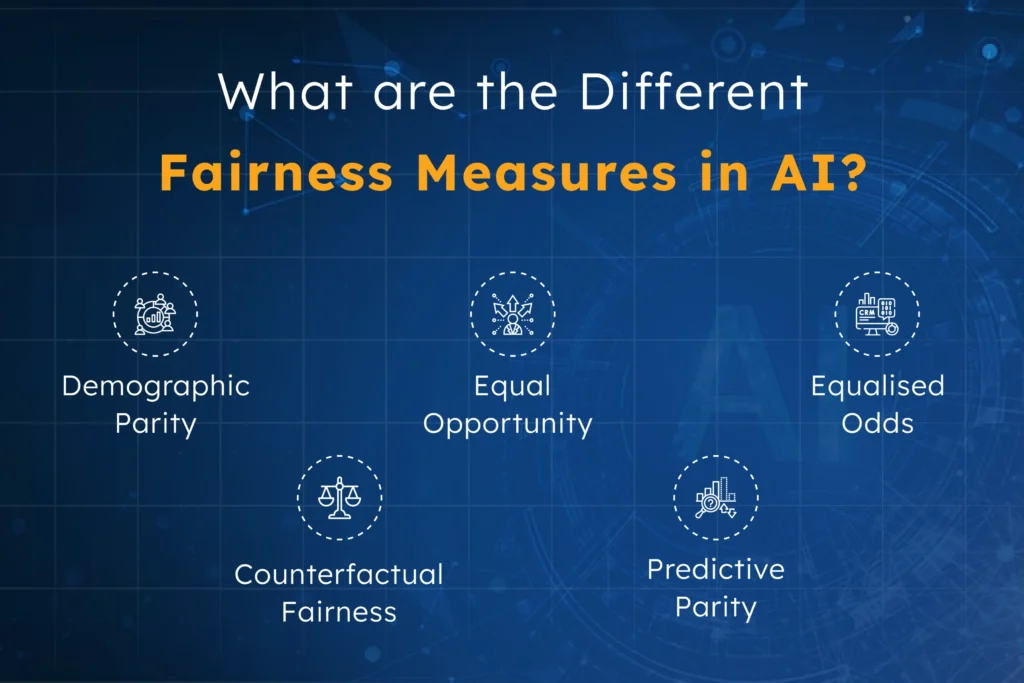
Infographic listing different fairness measures in AI—Demographic Parity, Equal Opportunity, Equalised Odds, Counterfactual Fairness, and Predictive Parity—used to reduce bias and ensure ethical outcomes in AI product development.

What are the Different Fairness Measures in AI?

Fairness can mean different things depending on how you look at it. That is why developers use different ways or measures to check if an AI system is treating people fairly. Here are some of the most common ones explained in simple terms. As with accuracy, every fairness check is part of strong Software Testing Service practices: 

Demographic Parity 

Demographic parity checks whether different groups can receive positive outcomes at the same rate. It does not matter if everyone in that group is equally qualified; it only looks at the outcome numbers. 


A simple example of this can be in a loan approval system, where demographic parity would mean that men and women are approved roughly at the same rate. 


This parity means this measure is easy to track, but it can sometimes overlook real differences in qualifications. That is why it is often combined with other fairness checks. 

Equal Opportunity 

Equal opportunity focuses on giving qualified people the same chance of success, no matter their group. It only looks at those who truly deserve a positive outcome. 


An example of this can be hiring equally skilled candidates; different groups should have the same chance of being selected. 


This fairness measure turns out to be important for people who are qualified, but also prevents unqualified individuals from being included just to balance out the numbers. 

Equalised Odds

Equalised odds are stricter. It checks that both the true positives and the false positives are balanced across groups. In other words, the errors must be evenly distributed. 


For example, when AI denies loans, it should not wrongly reject more qualified applicants from one group compared to another. 


This measure is important because it gives a better picture of fairness, but it is harder to achieve in practice. 

Counterfactual Fairness

Counterfactual fairness keeps its main focus on “would the AI make the same decision if only one sensitive trait (like gender or race) were different?” If the outcome changes, the system is not fair. 


Consider a scenario where there are two identical job applicants, and the only difference is in the applicants’ gender. If the AI selects one and rejects the other, it fails counterfactual fairness. 

This is one of the most intuitive measures because it mirrors how people think about fairness in the real world. 

Predictive Parity 

Predictive parity checks if the AI makes equally accurate predictions across groups. If the model is very accurate for one group but less accurate for the other, that can create unfair results. 


A simple example of this can be a medical AI that can predict disease risks with high accuracy for men but with less accuracy for women, which fails predictive parity. 


This measure is all about trust; users expect the AI to perform equally for everyone. 

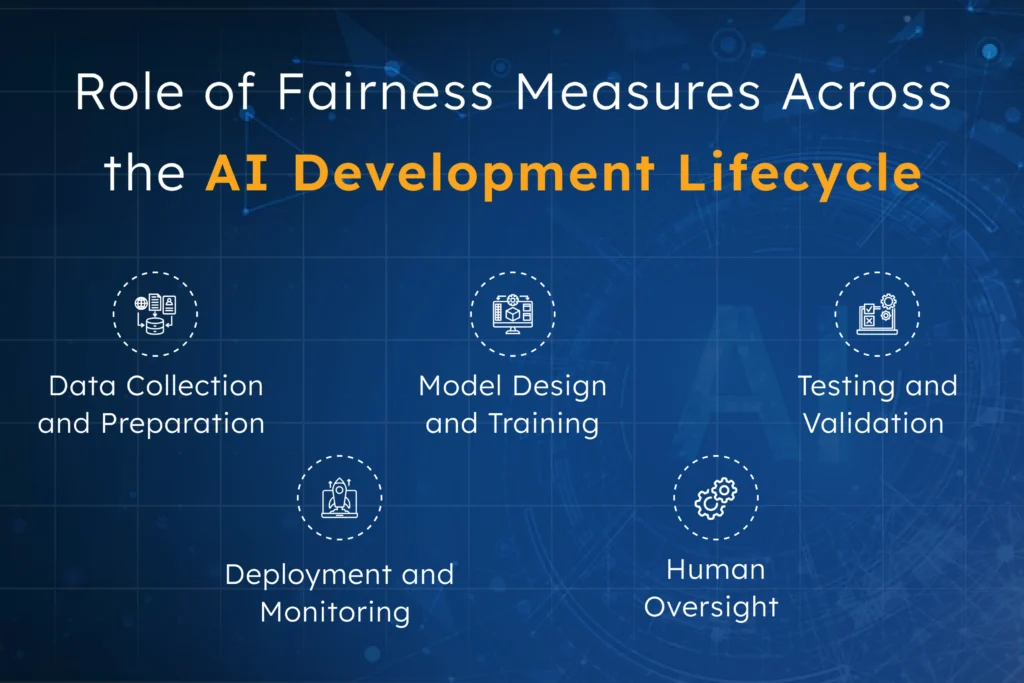
Infographic showing key stages of the AI development lifecycle—data collection, model design, testing, deployment, and human oversight—highlighting where fairness measures are applied to ensure ethical AI product development.

Role of Fairness Measures Across the AI Development Lifecycle

Fairness in AI is not a one-time check. It is part of the entire development process, from the first dataset to the moment the product is live. Let’s look at how fairness measures play a role at each stage of the AI lifecycle.

  • Data Collection and Preparation 

Most bias starts with data. If the dataset is unbalanced, the AI will also be unbalanced. Fairness checks here make sure the data represents different groups and doesn’t lean too heavily on one side.

  • Model Design and Training 

As the model is built, fairness measures help test whether outcomes are equal across groups. Developers may use metrics like equal opportunity or equalized odds to see if the system is treating people fairly during training.

  • Testing and Validation 

Before an AI product goes live, fairness is tested just like accuracy. This step helps catch unfair outcomes early and prevents biased systems from reaching end users.

  • Deployment and Monitoring 

Fairness doesn’t end at launch. AI needs ongoing monitoring to catch bias that may appear with new data.

  • Human Oversight 

Fairness measures work best with human judgment. Experts can review results, question outcomes, and make sure decisions match ethical standards and business goals.

At every stage of this lifecycle, many businesses choose to work with trusted AI partners. Samyak Infotech helps companies build AI solutions that are not only powerful but also fair, transparent, and ready for real-world use.

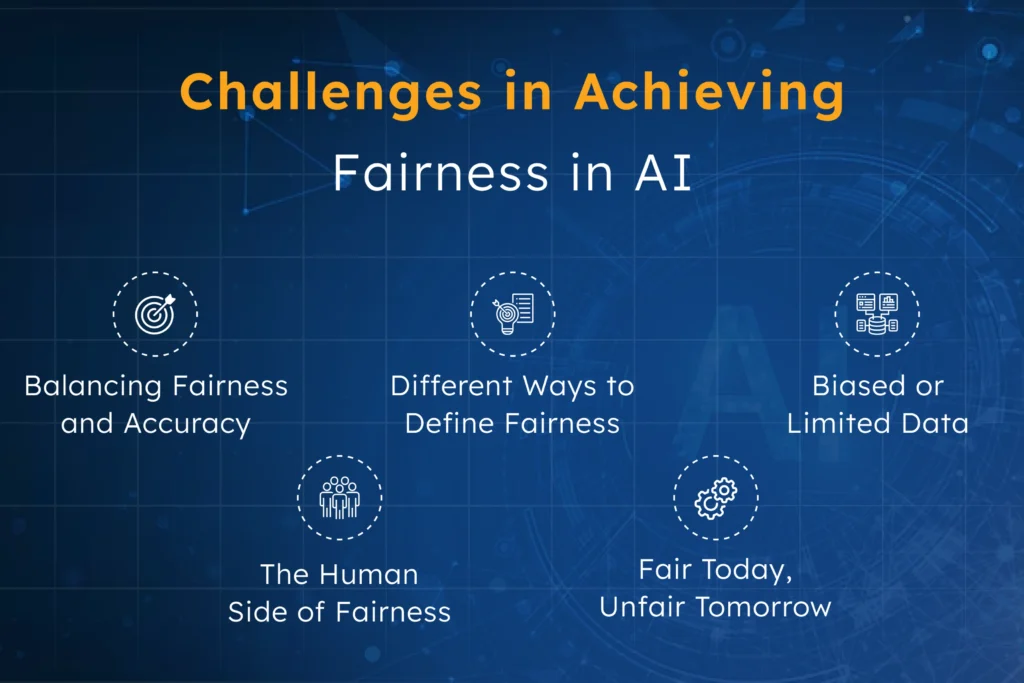
Infographic outlining challenges in achieving fairness in AI, including balancing fairness and accuracy, defining fairness, biased data, human judgment, and evolving fairness over time—highlighting the importance of fairness measures in AI product development.

Challenges in Achieving Fairness in AI

Making AI fair sounds simple, but in practice, it comes with real challenges. Partnering with an experienced AI agent development company can help address these effectively. Here are some of the most common challenges:

  • Balancing Fairness and Accuracy

Improving fairness for one group can sometimes lower accuracy for another. Striking the right balance depends on the goal of the system.

  •  Different Ways to Define Fairness

Not all fairness measures can be achieved at the same time. Meeting one measure, like demographic parity, may break another, like equal opportunity. Teams have to decide what matters most.

  • Biased or Limited Data

AI learns from data. If the data is biased or incomplete, the system will carry those same flaws. Clean, balanced datasets are often hard to find.

  • The Human Side of Fairness

Fairness isn’t just about numbers. What seems fair in one context may not be fair in another. Human judgment is always part of the process.

  •  Fair Today, Unfair Tomorrow

An AI system may look fair at first, but new data can create new bias. Ongoing monitoring is always needed.

Can AI Ever Be Truly Fair?

This is the big question. AI is built on data, and all data comes from the real world. A world that is not always fair. Because of this, complete fairness in AI may never be fully possible.

But that does not mean fairness measures are pointless. Each step taken to reduce bias makes AI systems more trustworthy, more accurate, and more useful. Fairness is not a final destination; it’s an ongoing effort.

The goal is not “perfect fairness.” The goal is to keep improving AI so that it treats people more fairly over time. With the right tools, oversight, and expertise, AI can move closer to that goal every day.

How Fairness Will Shape the Future of AI

Fairness in AI is still evolving. As technology grows, so does the need to make it more transparent, ethical, and trustworthy. Users are more likely to choose ethical, transparent tools backed by advanced AI agent development services. Here’s how fairness is likely to shape the future:

Stronger Regulations

Governments are starting to set rules around AI. Soon, fairness will not just be best practice; it will be the law.

Better Tools for Developers

New tools are being built to help developers test AI for bias. This will make it easier to catch problems early and build fairer systems.

More Human Oversight

Even as AI gets smarter, people will still guide fairness. Human reviews will stay important to keep decisions ethical.

Fairness as a Business Edge

Companies that focus on fairness will gain trust. Users are more likely to choose AI products that are ethical and transparent.

Continuous Growth in Fairness

Fairness methods are always improving. New measures and practices will keep shaping how AI is built and used.


The future of AI depends on trust, and fairness is the foundation of that trust. Businesses that use and value fairness today will be ready for tomorrow’s standard and earn stronger relationships with their users.


Illustration of a developer working with multiple AI interfaces, charts, and a robot assistant, representing Samyak Infotech’s expertise in ethical and fair AI product development with custom solutions and continuous support.

Why Partner with Samyak Infotech for AI Development?

Building fair and reliable AI products takes more than just good data and smart algorithms. It requires the right expertise, clear processes, and continuous oversight. This is where Samyak Infotech can help.

At Samyak Infotech, we specialize in:

  • AI Product Development – End-to-end solutions that keep fairness and trust at the core.


  • Custom AI Development – Tailored systems designed around your business goals and ethical standards.


  • Ongoing Support and Monitoring – Ensuring your AI products stay fair, accurate, and ready for real-world use.


Our team understands both the technical and ethical sides of AI. We work with businesses to reduce bias, improve transparency, and build AI systems that users can trust.

If you are ready to build AI that combines innovation with fairness, Samyak Infotech is your trusted partner.

Wrapping It Up: The Purpose of Fairness Measures in AI Product Development

Fairness in AI is not just a technical choice; it’s a responsibility. Every business that builds AI has to think about trust, ethics, and impact. Fairness measures help reduce bias, improve transparency, and create AI systems that people can rely on.

But fairness is not a one-time fix. It’s a journey of continuous improvement. Companies that invest in fairness today will not only meet future regulations but also build stronger relationships with their users.

If you’re ready to create AI products that are powerful, ethical, and future-ready, Samyak Infotech is here to help. Our team specializes in AI product development, custom AI solutions, and ongoing support, all built with fairness at the core.

Let’s build AI that’s smart, fair, and trusted. 

Contact Samyak Infotech today! 

FAQs on Fairness Measures in AI Product Development

What purpose do fairness measures serve in AI product development?

Fairness measures help ensure AI systems make decisions that don’t unfairly favor or harm any group. They reduce bias, build trust, and help align AI with ethical and business goals.

Yes. Some fairness metrics may not align. For example, achieving demographic parity might conflict with equal opportunity. That’s why you need to decide on priorities and trade-offs early.

Sometimes. Imposing stricter fairness may limit model freedom or penalize performance for certain groups. But the goal is to find a balance that maintains usefulness while improving fairness.

Continuously. After the model is live, new data may introduce new bias. Regular audits, performance reviews, and updates are crucial to maintain fairness over time.

Common sources include biased or incomplete data, biased labeling, algorithmic design choices, and sampling bias (where data doesn’t reflect real populations).

Probably not. Complete fairness is very hard because real-world data and human systems are imperfect. The aim is constant improvement, not perfection.

Yes, but it requires balance. Sometimes improving fairness lowers accuracy slightly, but it creates systems that are more trustworthy and reliable in the long run.

Common techniques include demographic parity, equal opportunity, equalized odds, counterfactual fairness, and predictive parity. Many modern AI frameworks now include fairness testing modules.

AI models can be made fair by using diverse datasets, applying fairness measures during training, testing for bias before deployment, and monitoring outcomes regularly. Human oversight is also key to spotting issues that metrics may miss.

Latest News from our end!

Wait! Don’t Leave Without This !!

Get 1 Week of Free Custom AI Development

Our AI experts will help you prototype, automate, or build AI-powered solutions — risk-free.
⚡ Limited-time offer for new users.