

The Voluntary Carbon Market (VCM) is experiencing a historic transformation. In the early iterations of carbon offsetting, environmental project developers could often rely on manual spreadsheets, episodic site visits, and paper-based tracking to prove their emission reductions to regulatory bodies. Today, corporate buyers and regulatory standards demand absolute, cryptographic proof of every single carbon credit generated.
This intense demand for data transparency has exposed the most critical vulnerability in the climate tech ecosystem: Measurement, Reporting, and Verification (MRV).
When MRV is executed manually—relying on site managers to type fuel receipts into Excel, track production batches on clipboards, or guess at baseline emissions—a carbon project becomes inherently unscalable. Human error introduces massive data discrepancies. Missing paper invoices destroy audit trails. Ultimately, the sheer administrative overhead of preparing for an audit eats directly into the profit margins of the carbon credits themselves.
To scale operations across multiple sites and guarantee the integrity of their environmental claims, modern project developers are abandoning manual tracking. Instead, they are deploying comprehensive Digital MRV (dMRV) software like the Samyak RMS. By integrating offline-first mobile applications with automated greenhouse gas (GHG) calculation engines, organizations can instantly digitize their entire carbon asset lifecycle, from the factory floor to the Verra registry.
Digital Measurement, Reporting, and Verification (dMRV) is the deployment of software, IoT sensors, and cloud architecture to fully automate the data collection and compliance reporting required to issue carbon credits.
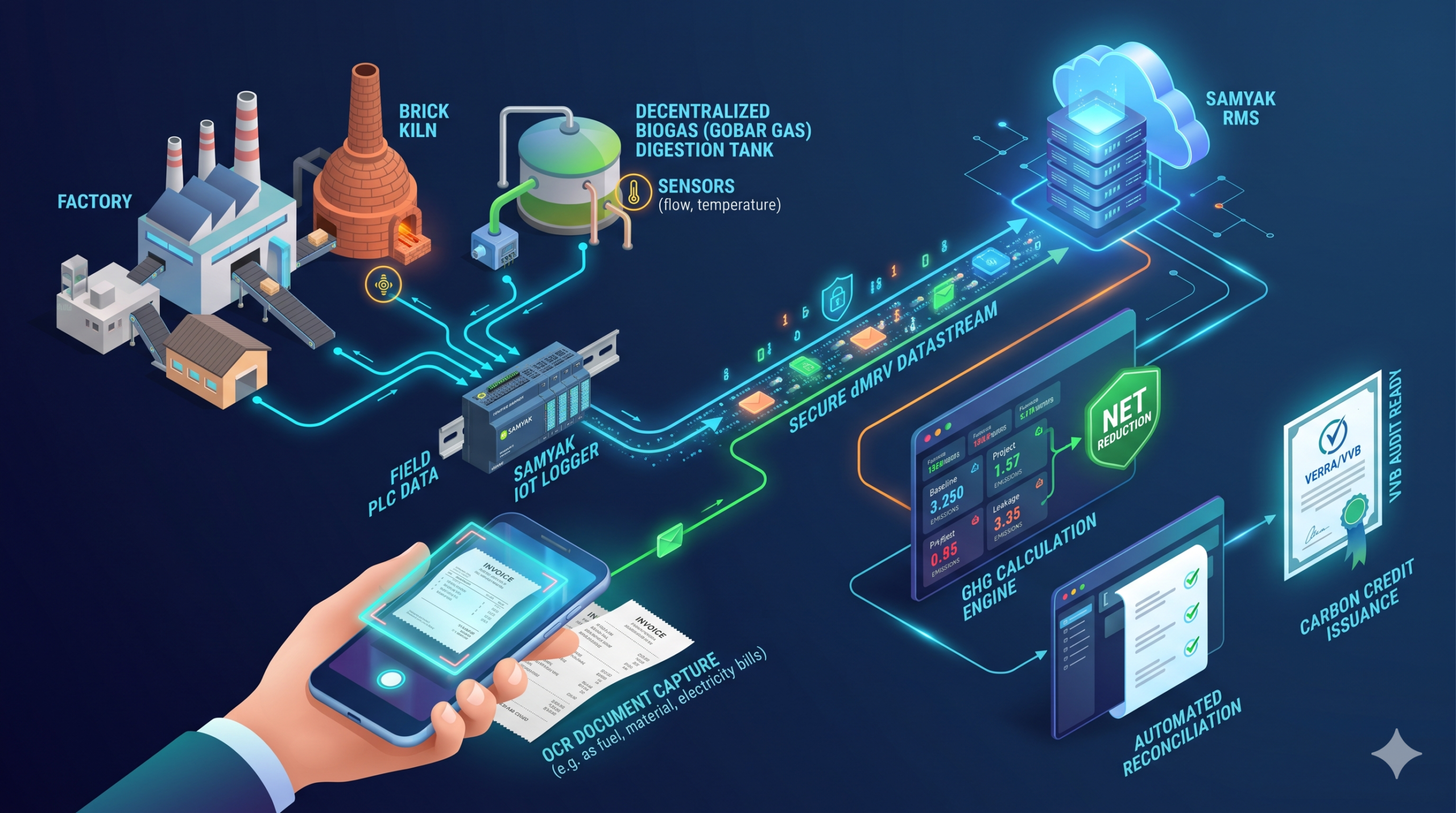
Instead of a human manually reading an industrial meter and writing the number down, a dMRV system automatically pulls that telemetry directly from the machine’s Programmable Logic Controller (PLC). It then cross-references that machine data with digitized utility invoices, automatically calculates the exact emission reduction using registry-approved math, and packages the entire dataset into a secure, unalterable format ready for registry submission.
Before understanding the architecture of dMRV, it is critical to understand why traditional “carbon accounting” fails at the project level.
Siloed Data Capture: Field operators capture data on paper, accounting teams process invoices in ERPs, and sustainability officers calculate emissions in Excel. These systems do not communicate, leading to data loss.
Lack of Source Traceability: If an auditor questions a specific emission reduction from six months ago, finding the physical electricity bill or delivery note that proves the calculation is often impossible.
The Reconciliation Gap: What operators claim they produced often does not match what the industrial machines actually processed, leading to rejected credits.
Building a software system capable of surviving a rigorous audit by a Validation and Verification Body (VVB) requires bridging the gap between chaotic field operations and rigid regulatory frameworks. Samyak Infotech engineers this solution through a multi-layered, highly integrated software architecture.
Carbon projects—whether they are sustainable manufacturing plants producing eco-friendly building materials, rural biogas facilities, or agricultural sites—rarely have perfect IT infrastructure. Data must be captured accurately at the absolute edge of the network.
To solve this, the Samyak RMS ecosystem utilizes a robust, offline-first mobile application designed specifically for field workers.
Offline Synchronization: Field workers can log operational data, scan compliance documents, and record machine breakdown events even in deep rural areas with zero cellular reception. The mobile application operates seamlessly offline and automatically syncs to the cloud the moment a network connection is restored.
AI-Powered Document Capture (OCR): Instead of manually typing out expenses, operators use the mobile app to photograph and scan critical documents like purchase invoices, delivery notes, lab reports, electricity bills, and fuel receipts. The system’s Optical Character Recognition (OCR) automatically extracts vital data (like diesel volume or raw material weight) and attaches the original image as cryptographic proof for the auditor.
The most common reason VVBs reject carbon credits is due to data discrepancies. A dMRV platform eliminates this risk by taking the human out of the verification loop.
When a field operator manually enters raw material consumption (such as cement or supplementary materials) into the mobile app, the Samyak RMS instantly cross-checks that entry against the live, unalterable dosing data pulled directly from the site’s PLC using Samyak Instrumentation’s IoT Data Loggers.
If the manually entered consumption does not mathematically match the machine’s actual telemetry, the system flags the discrepancy immediately. This automated reconciliation ensures that invalid data never enters the final carbon calculation, guaranteeing that every reported metric is backed by physical machine proof.
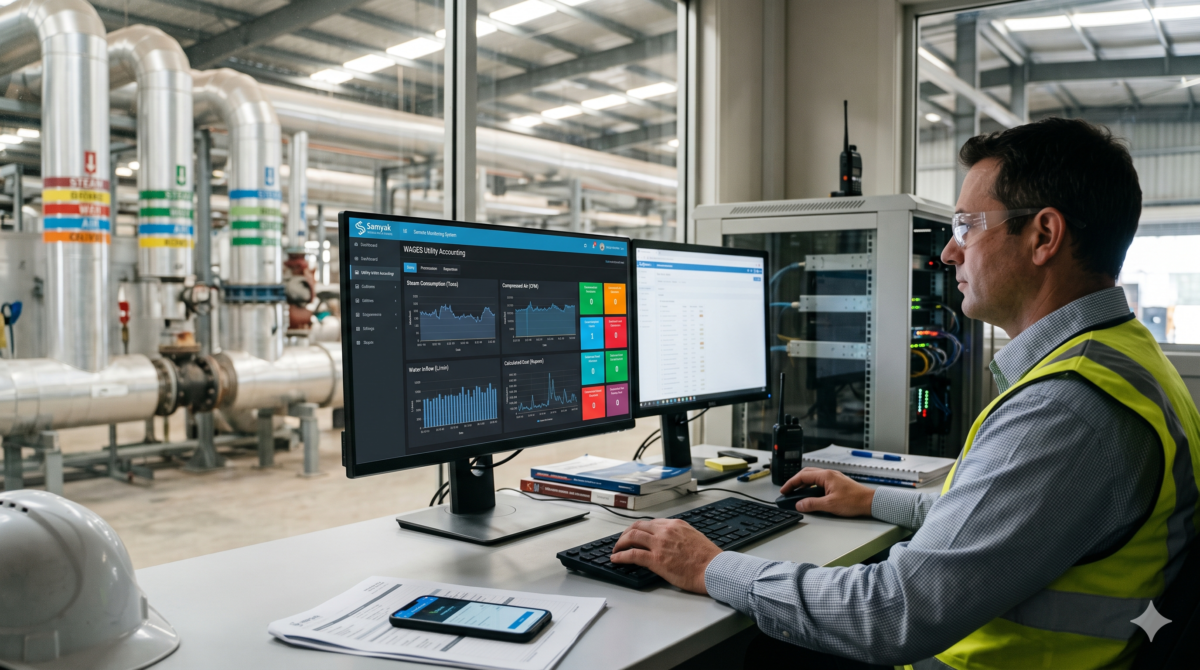
Project developers require instant visibility into both their physical industrial production and their environmental impact. The centralized Web Dashboard acts as the command center for the entire operation.
The Samyak RMS provides a live Site Summary view that continuously tracks physical production units directly alongside the estimated carbon credits earned. Furthermore, the dashboard generates highly granular batch and production reports—broken down hourly, daily, monthly, and cumulatively—ensuring that management can identify process bottlenecks or data gaps in real time before they impact carbon issuance.
The core value of an enterprise-grade Carbon MRV Software is its ability to instantly translate raw operational telemetry into verified carbon credits using complex, registry-approved methodologies.
The Samyak RMS features a built-in reconciliation and carbon calculation engine that automates the entire mathematical lifecycle of a carbon asset. To prove true environmental additionality, the software automatically computes four critical mathematical components:
To claim a carbon credit, you must prove what would have happened if your project did not exist. The software calculates the “Baseline Emissions”—the volume of greenhouse gases that would have been emitted under standard, historical, or regional industry practices. By automating this counterfactual math, developers establish the starting line for their environmental impact.
No industrial process is entirely carbon-free. The system calculates the actual, real-world emissions generated by the new, sustainable project itself. This includes tracking the electricity consumed by the facility and the diesel burned by backup generators, extracting these exact metrics directly from the OCR-scanned utility bills and fuel receipts.
Carbon projects must rigorously account for emissions that are displaced outside their direct operational control. A premium dMRV system automates complex leakage calculations. For example, the Samyak RMS calculates “leakage-from-transport” by utilizing the specific, known geographical distances between the project site and each individual raw material supplier.
Finally, the calculation engine executes the ultimate metric: The Net Emission Reduction. The software automatically subtracts the Project Emissions and the Leakage Emissions from the established Baseline Emissions. Because this final figure is computed dynamically from reconciled PLC data and scanned invoices, it is mathematically undisputed.
When it is time to verify the project and issue the credits, developers using manual methods typically spend hundreds of hours formatting chaotic data for the Validation and Verification Body (VVB).
With a digital MRV system, audit readiness is continuous and effortless. Because the software features automated report parsing configured specifically for the site’s unique format, every single calculation is backed by absolute source traceability.
The auditor can click on the final Net Emission Reduction figure and trace the math backward—through the automated leakage calculations, past the PLC reconciliation engine, all the way down to the original scanned PDF of the electricity bill captured by the operator’s mobile phone on a specific Tuesday.
To finalize the process, the Samyak RMS generates a full audit trail view and a secure ZIP export of all evidence. The platform is engineered to support VVB-ready exports and formats compatible with the Verra Registry, drastically reducing auditing costs and accelerating the time-to-market for credit issuance.
The bottleneck in the modern voluntary carbon market is no longer finding corporate buyers; it is proving the physical integrity of the asset. Relying on fragmented spreadsheets, isolated ERPs, and manual data entry exposes your environmental projects to catastrophic audit failures and massive administrative overhead.
By deploying the Samyak Carbon Credit MRV Software, project developers can entirely automate their GHG calculations, seamlessly capture field data via offline-first mobile apps, and present Validation and Verification Bodies with mathematically perfect, traceable audit trails.
Are you developing a carbon offset project and looking to digitize your Measurement, Reporting, and Verification process? Contact the Samyak Infotech enterprise software team today to design your automated dMRV architecture and secure your carbon assets.


©2026 Samyak Infotech Pvt Ltd. | All trademarks, images and logos are the property of their respective owners.

 explore more