Introduction
Most logistics teams are flying partially blind. According to a 2024 survey by Tive and GlobeNewswire, 45% of logistics professionals had visibility into less than half of their total shipments — across supply chains spanning dozens of countries, hundreds of carriers, and thousands of handoffs. Only 24% could see 75–100% of their freight at any given time.
The operational fallout is real: missed ETAs, detention fees, reactive firefighting, and customers chasing updates that no one can provide. That pain has driven significant investment in solutions. Global Market Insights estimates the supply chain visibility software market at USD $3.3 billion in 2025, projected to reach $10.9 billion by 2034 at a 13.4% CAGR — which means more vendors, more feature claims, and more complexity for buyers.
This guide helps logistics and operations decision-makers evaluate their options clearly. Whether you're comparing off-the-shelf platforms or scoping a custom-built solution, you'll find a structured approach to identifying what your operation actually needs — and what to watch out for — heading into 2026.
Key Takeaways
- 45% of companies lack visibility into more than half their shipments — a gap most operations teams can't afford to ignore
- Core features to prioritize: multimodal tracking, AI-driven ETAs, exception management, carrier scorecards, and ERP/TMS/WMS integration
- Evaluation factors that matter most: integration depth, data quality, scalability, and vendor implementation track record
- A strong platform cuts manual tracking overhead, lifts on-time delivery rates, and enables proactive customer communication
- Companies with complex logistics workflows often get stronger long-term fit from custom-built solutions, like those Samyak Infotech has developed for logistics clients over 20+ years, than from adapting to a packaged product's roadmap
What Is Supply Chain Visibility Software?
Supply chain visibility software is a technology platform that enables companies to monitor, track, and analyze the movement of goods, shipments, and inventory in real time — from raw materials sourcing through last-mile delivery.
Visibility vs. Transparency
These two terms get confused constantly in buying conversations, so a quick distinction:
- Supply chain visibility = operational tracking — where goods are, current ETAs, shipment status, exception flags
- Supply chain transparency = a disclosure strategy — what sourcing practices and supplier data a company shares with external stakeholders
Gartner's definition of real-time transportation visibility platforms (RTTVPs) focuses squarely on the operational side: platforms that provide real-time location and status insights into orders after they leave the warehouse. That's the category this guide covers.
Types of Supply Chain Visibility Solutions
| Solution Type | Primary Use Case |
|---|---|
| Real-time transportation visibility platforms (RTTVP) | In-transit shipment tracking across carriers and modes |
| Inventory visibility systems | Stock-level monitoring across warehouses and DCs |
| Supplier visibility tools | Purchase order status and upstream supplier tracking |
| End-to-end platforms | Full network visibility from procurement to last-mile |
| Custom-built visibility solutions | Fit-to-process solutions for complex or non-standard operations |
How Supply Chain Visibility Software Works
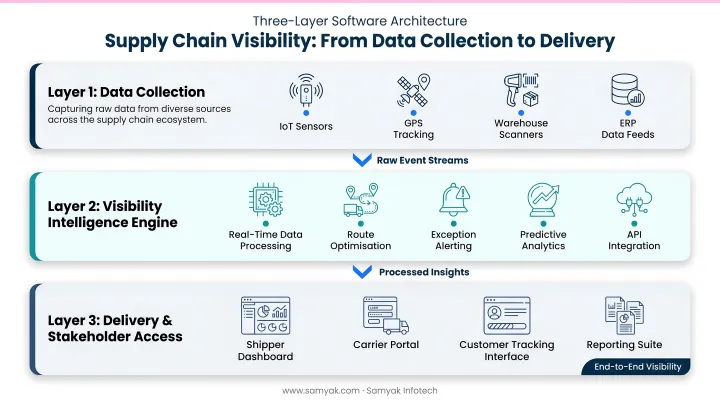
Modern platforms operate on a three-layer model:
- Data collection — IoT sensors, GPS/ELD telematics, RFID, and API/EDI integrations with carrier systems pull location, status, and condition data continuously. Tive's 2024 survey found 53% of logistics professionals already use IoT devices for real-time shipment tracking.
- Data processing — AI/ML algorithms convert raw inputs into predictive ETAs, risk scores, and exception flags. Gartner identifies predictive ETA (factoring in traffic, weather, and historical carrier performance) as a core RTTVP capability.
- Delivery — Dashboards and automated alerts route the right information to the right stakeholders without requiring manual intervention.
Gartner predicts that 50% of cross-functional supply chain management solutions will include agentic AI capabilities by 2030 — platforms that don't just flag exceptions but autonomously resolve them.
Benefits of Supply Chain Visibility Software
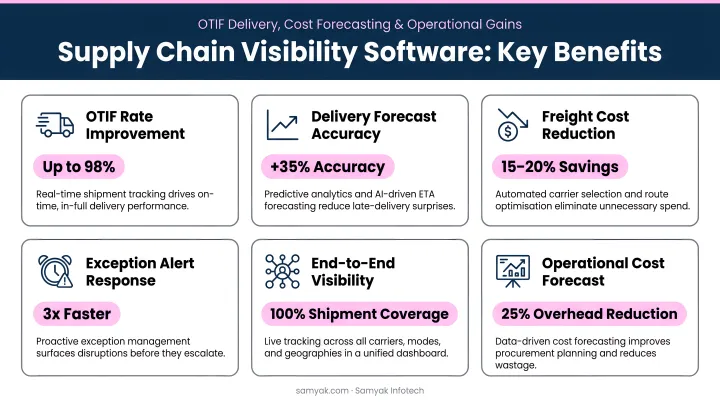
Well-implemented visibility platforms deliver measurable outcomes across multiple operational dimensions:
- Improved delivery performance — Nucleus Research found organizations integrating ERP and SCM systems achieved an 18% improvement in on-time, in-full (OTIF) delivery rates
- Stronger demand forecasting — Nucleus Research also reported 19% better demand forecast accuracy
- Cost reduction — a 16% reduction in COGS for companies with integrated supply chain visibility
- Better customer communication — a FreightWaves/Tive survey found only 20% of shippers were satisfied with visibility from their logistics providers, and more than 80% wanted proactive alerts
Core Features to Look for in Supply Chain Visibility Software (2026)
Not all visibility platforms are feature-equivalent. The right feature depth depends on your freight volumes, modal mix, and industry requirements. Here's what to evaluate.
Real-Time Multimodal Tracking
Capable platforms track shipments continuously across road, ocean, air, rail, and intermodal moves. Losing visibility during mode transitions — for example, when freight transfers from a container ship to a dray carrier — is a consistent failure point in single-mode tools. If your operation touches more than one freight mode, single-mode coverage creates the exact blind spots you're trying to eliminate.
Predictive ETA and AI-Powered Analytics
Static location pings tell you where a shipment is. Predictive ETAs tell you when it will actually arrive — accounting for traffic conditions, weather, port congestion, and that specific carrier's historical performance on that lane.
The difference matters because a predicted delay gives you a window to act: reroute the shipment, communicate proactively with the customer, or reallocate inventory before the miss becomes a problem. Passive tracking doesn't offer that window.
Exception Management and Automated Alerts
Manual shipment monitoring doesn't scale. Exception management workflows automatically surface at-risk shipments — without requiring anyone to manually check every order — when triggered by conditions such as:
- Geofencing boundary violations
- Temperature threshold breaches
- Schedule deviations beyond defined tolerances
The result: teams focus on shipments that actually need intervention, instead of monitoring everything equally and missing what matters.
Carrier Performance and Compliance Dashboards
Visibility platforms that scorecard carriers give procurement and logistics teams something concrete for contract negotiations and carrier selection decisions. Key metrics to track include:
- On-time delivery rates by lane and carrier
- Responsiveness to exception alerts
- Compliance history against contracted SLAs
Without this data, carrier relationships are managed on gut feel and anecdote.
Integration with TMS, WMS, and ERP Systems
A visibility platform that doesn't connect to your existing enterprise systems creates a new data silo rather than eliminating existing ones. API-based, bidirectional data exchange with your TMS, WMS, ERP, and CRM is the standard to require in 2026 — not a nice-to-have.
Research from Nucleus Research confirms the impact: companies that successfully integrate ERP and SCM systems see measurably better outcomes across delivery performance, forecasting, and cost. The integration layer is what makes visibility data actionable across your entire operation.
Key Factors to Consider When Choosing Supply Chain Visibility Software
Features get you to the shortlist. These factors help you make the final call.
Integration Compatibility with Existing Systems
Integration depth matters more than feature count. A platform that connects natively to your TMS, ERP, and WMS reduces implementation friction, shortens time-to-value, and prevents the data inconsistencies that erode decision-making accuracy.
Ask vendors specifically: which systems do they integrate with natively versus through third-party connectors? What does the data exchange look like — batch updates or real-time bidirectional sync?
Real-Time Data Quality and Coverage
The value of any visibility platform is entirely dependent on the quality and freshness of its underlying data. A dashboard showing stale or incomplete information is worse than no dashboard — it creates false confidence.
Key questions to put to vendors:
- How frequently does location data update?
- What percentage of your carrier network provides automated tracking vs. manual check calls?
- How do you handle data gaps when carrier integrations fail?
Data quality issues are pervasive. A 2025 report by Supply & Demand Chain Executive found 65% of supply chain organizations cited missing or inconsistent data as a top operational challenge — and only 30% had truly integrated supply chain standards across their organizations.
Scalability and Deployment Model
Cloud-based solutions now account for roughly 57% of the supply chain visibility software market (Global Market Insights, 2025), and that segment is projected to grow at 14.1% CAGR through 2035. Cloud deployment offers flexibility and lower upfront cost, but on-premise and hybrid models remain relevant for organizations with strict data governance requirements.
Beyond deployment model, evaluate whether the platform scales with shipment volume growth and supports multi-site or multi-region operations. Platforms that can't scale force re-platforming projects within a few years — a costly and disruptive outcome.
Multimodal and Industry-Specific Coverage
Scalability and coverage go hand in hand. Companies moving freight across FTL, LTL, ocean, air, and rail need a single platform covering all modes — stitching together disconnected point solutions recreates the visibility gaps the investment was supposed to solve.
Certain industries add another layer of complexity. Pharmaceutical, food and beverage, and chemical shippers need more than location tracking — they need temperature monitoring, condition alerts, and compliance reporting built into the platform.
Vendor Track Record, Support, and Implementation
Platform stability, implementation quality, and post-go-live support are differentiating factors that rarely surface in vendor demos. Before committing, verify:
- References from clients with similar freight volumes and system environments
- Realistic implementation timelines based on comparable deployments
- A defined customer success program that extends beyond go-live
Poor implementation support is one of the most common reasons visibility investments fail to deliver projected ROI within the first year — not platform capability gaps.
Off-the-Shelf vs. Custom-Built Supply Chain Visibility Software
This is the build-vs-buy decision most buyers face eventually.
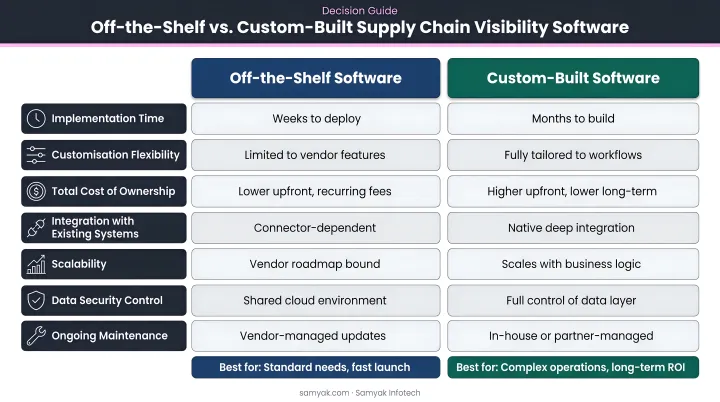
Off-the-shelf platforms offer faster deployment and lower upfront cost. They work well when your logistics workflows align reasonably well with the vendor's product design — and when you're comfortable adapting some processes to fit the software.
Custom-built solutions require a longer build cycle but deliver precise fit-to-process, full data ownership, and competitive differentiation that packaged software can't replicate. Custom development makes sense when:
- Your logistics network involves non-standard multi-tier workflows
- You have specialized compliance requirements (pharma cold chain, hazmat, etc.)
- You need deep integration with legacy systems the major platforms don't support natively
- You want proprietary data architecture rather than a vendor-controlled data environment
Companies like Samyak Infotech, which has spent over 20 years building custom logistics tracking and supply chain visibility solutions, offer an alternative to adapting your operations to fit a vendor's product roadmap. The platform gets built around your workflows, not the other way around.
How Samyak Infotech Can Help
When off-the-shelf platforms fall short of your operational requirements, a custom-built solution often closes the gap faster than months of workarounds. Samyak Infotech is a custom software development partner based in Ahmedabad, India, with over 25 years of enterprise software experience — including 20+ years building real-time logistics tracking and supply chain visibility systems for Fortune 100 companies and global logistics operators. Clients include Carisbrooke Shipping, MNX, and Ship Network.
What sets Samyak apart for supply chain visibility projects:
- AI/ML, IoT, and Blockchain development with 20+ years of logistics application context
- ISO 9001-certified development processes since 2004
- Microsoft Silver Certified Partner (Top 5%)
- Recognized by Clutch, GoodFirms, and Upwork — 150+ satisfied global clients
- Proven IoT hardware-to-software integration capability, including proprietary industrial gateways, Modbus/Profinet/OPC-UA protocol support, and cloud/on-premise deployment on Azure and AWS
That track record translates directly into what Samyak builds — solutions engineered around your workflows, not around a vendor's feature roadmap.
What Samyak builds for supply chain visibility:
- Custom real-time shipment tracking dashboards with role-based access for customers, operations teams, and field agents
- AI-powered route optimization that has delivered documented outcomes including 25% improvement in on-time deliveries and 20% reduction in fuel costs for logistics clients
- Carrier and supplier performance analytics modules
- ERP/TMS/WMS integration via REST APIs and EDI
- IoT-connected temperature and condition monitoring — including 21 CFR Part 11-compliant solutions for pharmaceutical and regulated cold chains
- Predictive analytics engines for demand forecasting and disruption detection
- Mobile applications for field agents and end customers
- Middleware solutions for legacy system integration that eliminate the OT/IT translation gap
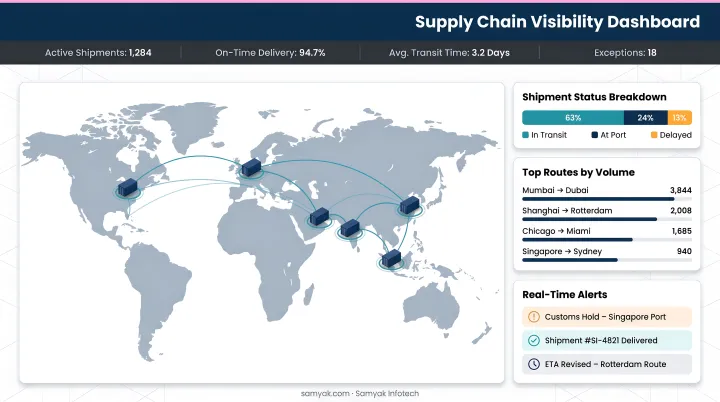
If your operation has outgrown what packaged software can handle, Samyak scopes and builds to your exact requirements — from a single integration to a full visibility platform.
Conclusion
Choosing supply chain visibility software in 2026 is not a category decision — it's a fit decision. The right platform is the one that matches your freight modes, integration environment, operational complexity, and growth trajectory. High G2 ratings and feature-rich demos don't change that reality.
Visibility investment delivers measurable value only when the platform is fully integrated, properly implemented, and continuously refined as your supply chain evolves. A well-chosen off-the-shelf solution, implemented with discipline, can deliver strong results. So can a purpose-built custom solution designed around your specific workflows.
What rarely works is a technically capable platform that was never properly integrated or never fully adopted.
Working with an experienced implementation partner, whether that's a platform's professional services team or a custom development firm like Samyak Infotech, is often the difference between achieving projected ROI and spending months troubleshooting a platform that never quite fit.
Frequently Asked Questions
What is supply chain visibility software?
Supply chain visibility software is a platform that lets companies track, monitor, and analyze the movement of goods, shipments, and inventory in real time across the full supply chain. It gives operations teams the data they need to resolve exceptions proactively — before delays escalate into firefighting.
How do you measure supply chain visibility?
The most useful KPIs include OTIF (On-Time In-Full) delivery rate, average shipment delay time, daily exception resolution rate, and carrier tracking compliance rate. Nucleus Research found that integrated supply chain visibility systems can improve OTIF rates by 18% — a practical benchmark for evaluating ROI.
How is Excel used in supply chain management?
Excel remains a widely used workaround for tracking shipments, managing carrier data, and generating reports — and a 2025 Supply & Demand Chain Executive report found most supply chain professionals still rely on it. The core limitations are data latency, human error, and poor scalability, all of which purpose-built visibility platforms address directly.
What is the difference between supply chain visibility and supply chain transparency?
Visibility refers to operational tracking efficiency — where goods are, current ETAs, shipment status, and exception alerts. Transparency is a disclosure strategy — what a company chooses to share about its supplier practices, ethical sourcing, and environmental data with external stakeholders.
What technologies power modern supply chain visibility software?
The core enabling technologies are IoT sensors for real-time condition and location data capture, GPS/ELD telematics for in-transit tracking, AI/ML for predictive ETAs and exception detection, RFID for automated inventory identification, and REST APIs or EDI for integration with TMS, ERP, and WMS systems. Agentic AI — which can autonomously resolve exceptions without human intervention — is beginning to appear in leading platforms.
How long does it take to implement supply chain visibility software?
Timelines vary based on integration complexity, carrier onboarding, and data readiness. Off-the-shelf SaaS platforms deploy faster, but both approaches take longer when legacy system integrations or regulated-industry compliance requirements are involved. Custom-built solutions typically take more time upfront yet avoid the workflow compromises that slow SaaS time-to-value for complex operations.