](https://file-host.link/website/samyak-9zj1at/assets/refined-images/1782200533702000_4563dfa18bad40d98b9798ab0a2ae854/720.webp)
The numbers back this up. A FreightWaves/Tive survey of 500+ logistics professionals found that only 20% of shippers were satisfied with shipment visibility, and just 56% tracked shipments in real time despite over 80% wanting proactive status updates. Meanwhile, a separate FreightWaves/Logixboard report found that 52% of shippers had already stopped working with a provider over poor digital tracking tools.
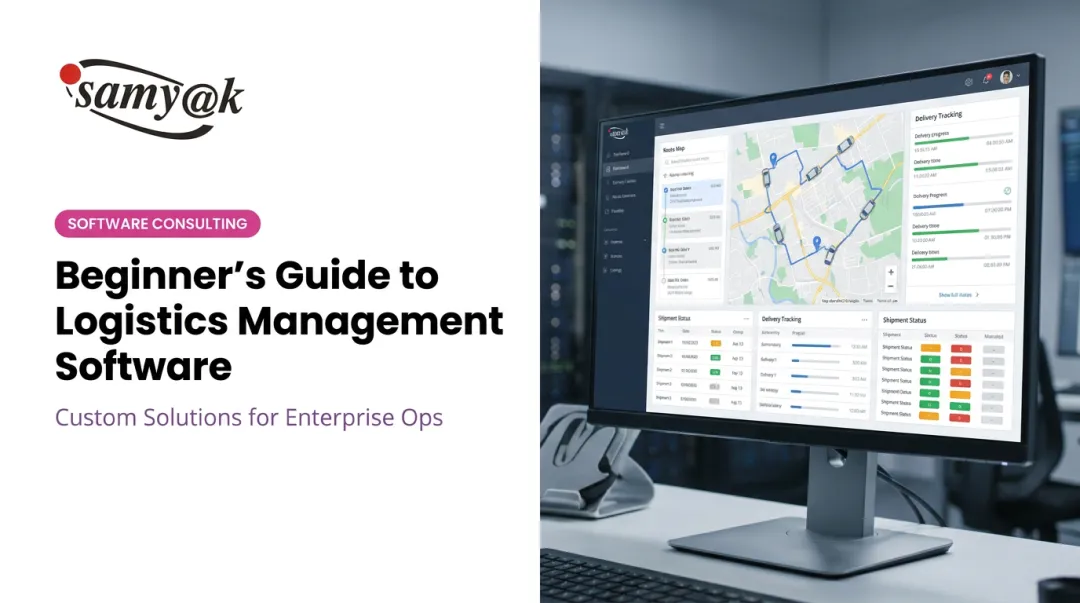
This guide walks through exactly how to build custom logistics management software — what you need before you start, the five build phases, factors that shape outcomes, and mistakes that sink projects.
Key Takeaways
- Custom logistics software matches your workflows, carrier relationships, and operational rules — off-the-shelf tools force you to adapt instead
- Successful builds need documented requirements, a scalable tech stack, phased development, and a logistics-experienced development partner
- The build process covers five phases: discovery, architecture, UI/UX design, development with QA, and deployment with maintenance
- Most failures trace back to skipping discovery, underestimating integration complexity, or building only for today's volume
- Custom is the right choice when your workflows are unique, integrations are complex, or SaaS licensing costs have become hard to justify at scale
What You Need Before You Start Building
The most common cause of blown budgets isn't poor development — it's entering development without a complete picture of current operations.
Before any vendor conversations begin, document your existing workflows, data flows, and system landscape. Specifically:
Current System and Integration Inventory
List every tool the new software must connect with and flag integration complexity for each:
| System Type | Examples | Complexity Flag | |-------------|----------|-----------------|| | ERP | SAP, Oracle, NetSuite | High — often requires middleware | | TMS/WMS | Legacy on-premise systems | High — API availability varies | | Carrier portals | FedEx, UPS, regional carriers | Medium — EDI or API dependent | | CRM | Salesforce, HubSpot | Low-Medium | | Accounting | QuickBooks, Xero | Low-Medium |
Internal Stakeholder Alignment
Logistics software touches operations, IT, finance, and customer service simultaneously. Misaligned expectations between these groups kill projects before development even begins. Before signing any development contract:
- Get written sign-off on requirements — not verbal agreement
- Confirm priority ranking across departments (what gets built first)
- Document which team owns each integration or data source
- Agree on success metrics before scope is finalized
Steps to Build Custom Logistics Management Software
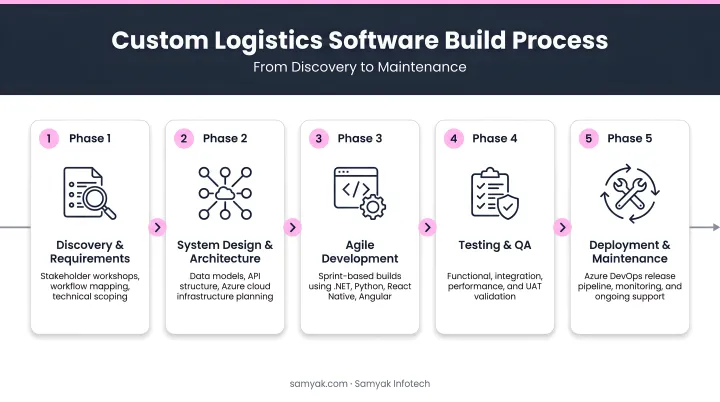
Step 1: Discovery, Requirements Gathering, and Scoping
This phase is the foundation. Rush it, and you'll spend the rest of the project fixing the consequences.
Discovery involves interviewing operations managers, dispatchers, warehouse staff, drivers, and IT teams to map current workflows, surface pain points, and separate must-have features from nice-to-haves.
Samyak Infotech's discovery process covers stakeholder interviews, competitor analysis, scope definition, and risk identification — all before a single line of architecture is drawn.
What this phase should produce:
- A detailed requirements document covering functional needs (real-time tracking, route optimization, warehouse management), non-functional needs (uptime targets, scalability thresholds), and integration touchpoints
- A prioritized feature list distinguishing MVP requirements from Phase 2 features
- Defined KPIs — what does "better" look like in measurable terms? Delivery time, error rate, cost per shipment, manual hours saved
Poor requirements management isn't just an inconvenience. PMI research found that 47% of failed projects cited poor requirements management as the primary cause, and roughly $51M of every $1B spent on projects is wasted from requirements failures alone.
Step 2: Technology Stack Selection and Architecture Design
Every technology decision made here shapes your system for years — and each choice involves real tradeoffs.
Key decisions:
- Cloud vs. on-premise — Cloud-native deployments on AWS or Azure offer faster scaling and lower infrastructure maintenance; on-premise may be required for certain compliance environments
- Microservices vs. monolithic — Microservices handle variable load better and allow independent module updates, which matters when shipment volumes spike seasonally
- Database architecture — Relational databases (PostgreSQL, MS SQL) for transactional data; NoSQL (MongoDB, Cassandra) for high-volume event streams like GPS location updates
- Backend/frontend frameworks — Common choices include .NET or Node.js for backend logic, Angular or React for web interfaces, React Native for mobile
Samyak Infotech's logistics builds typically combine Azure or AWS cloud infrastructure with a stack spanning .NET, Python, Angular, and React Native — selected based on the client's existing environment and scalability requirements.
Integration architecture warrants its own planning session. How the system connects with existing ERPs, carrier APIs, IoT fleet devices, and customer portals is a design decision with direct impact on reliability and cost. Samyak uses REST APIs, EDI, and OData/SOAP for ERP connections, plus a Store and Forward queuing architecture that ensures zero data loss when ERP servers go offline temporarily.
Step 3: UI/UX Design and Prototyping
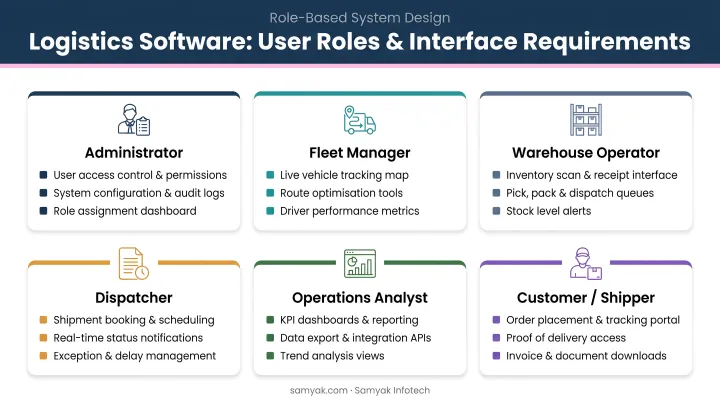
Logistics software serves fundamentally different users under fundamentally different conditions. A dispatcher tracking 200 shipments needs a different interface than a warehouse picker scanning barcodes or a customer checking delivery status from a mobile device.
Typical user roles requiring distinct interfaces:
- Dispatchers — bulk shipment views, exception alerts, carrier assignment
- Warehouse staff — scan-and-confirm workflows, inventory lookups
- Drivers/field agents — mobile-first, minimal input required
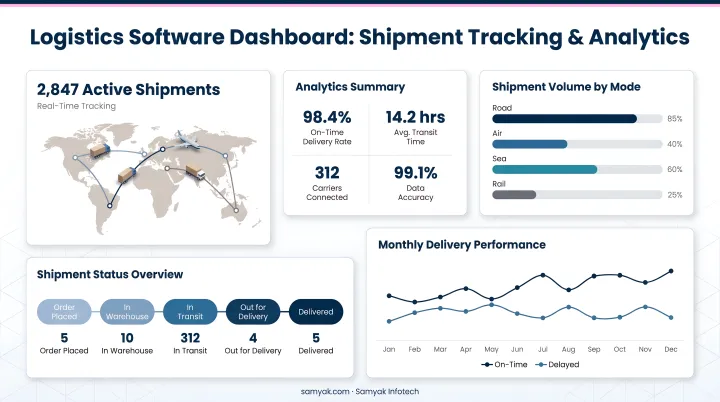
- Managers — dashboards, analytics, cost reporting
- Customers — shipment tracking, status notifications
The prototyping sequence matters: wireframes first, then clickable mockups in Figma or Adobe XD, then usability testing with actual staff before full development begins. Testing usability at this stage costs a fraction of fixing it after build. Role-based design reduces training time and adoption friction — two factors that determine whether users actually use the system.
Step 4: Development, Integration, and Quality Assurance
Core modules are built iteratively, not all at once. A practical build sequence starts with shipment tracking and order management (the highest-value features), then warehouse functionality, then analytics and reporting. Continuous integration runs throughout — QA is not a final-stage gate.
Logistics-specific QA must cover:
- Real-time tracking reliability under high data volume
- Route optimization edge cases (road closures, weight restrictions, multi-stop sequences)
- API performance under load — carrier API timeouts and retry logic
- Security testing for shipment data and customer PII
- Integration testing with third-party systems as a dedicated cycle, separate from unit testing
Integration issues are a consistent source of project delays. Salesforce/MuleSoft's Connectivity Report found that 40% of IT leaders cite outdated, disconnected architecture as a top delivery blocker, and only 27% of enterprise applications are integrated at the average organization. In logistics, carrier APIs, ERP connections, and IoT device feeds each require their own dedicated test cycles — not a shared pass at the end.
Step 5: Deployment, Training, and Ongoing Maintenance
Launch with an MVP — core tracking and order management — then phase in advanced features. This reduces deployment risk and surfaces real-world issues before the full system is live.
Post-launch support should include:
- User training and adoption support
- Data migration assistance for historical records
- Continuous performance monitoring
- Bug fixes and iterative improvements based on actual usage patterns
- Compliance updates as carrier regulations, customs documentation rules, and data privacy requirements evolve
Samyak Infotech's post-launch engagements include server monitoring, infrastructure maintenance, backup and disaster recovery, and version upgrades — structured around keeping the platform effective as operations grow and regulations change.
Key Factors That Affect Development Outcomes
Two projects with identical feature lists can produce wildly different results. These are the variables that actually drive timeline, cost, and quality:
Scope Definition and Change Control
Vague or shifting requirements are the single biggest driver of budget overruns. PMI's scope research found that 52% of projects experienced scope creep, up from 43% five years prior. In logistics software, new features often require reworking integrations — the cost compounds quickly.
Establish a formal change request process before development starts. Any requirement added after sign-off goes through impact assessment before acceptance.
Tech Stack and Scalability Choices
A stack chosen for current volume may fail under 3x growth. Logistics operations experience sharp seasonal spikes — FedEx reports that U.S. express package volumes surge in late November and December, with international peaks in October. Architecture decisions made at the start determine whether your platform handles those spikes gracefully or degrades under load.
Cloud-native architectures with microservices offer better long-term scalability for platforms handling variable shipment volumes.
Integration Complexity
Each integration point introduces failure risk if not properly designed. Common sources of integration breakdown include:
- Carrier APIs that change versioning without notice
- ERP connections with inconsistent data schemas
- Customer portals requiring custom authentication flows
- IoT devices sending high-frequency data that overwhelms standard endpoints
Allocate dedicated time and budget for integration QA — it rarely fits within the general development timeline and is consistently underestimated.
Development Partner's Logistics Domain Expertise
Generic developers can write the code. They can't always anticipate carrier API quirks, customs documentation edge cases, or the specific logic required for multi-modal routing. Logistics-specific knowledge reduces rework and increases first-pass accuracy on the modules that matter most.
Samyak Infotech has spent over 20 years building logistics software for clients including Carisbrooke Shipping, MNX, and Ship Network. Documented outcomes from that work include 200+ manual work hours saved per day and quarterly cost savings exceeding $250,000 for one logistics client.
When Does Building Custom Logistics Software Make Sense?
Custom development is not automatically the right answer. It requires time, budget, and organizational capacity to manage a build.
Custom is the right investment when:
- Your operations have unique workflows that mature SaaS platforms consistently fail to support (specialized freight types, proprietary routing rules, non-standard carrier relationships)
- You need deep integration with existing enterprise systems that off-the-shelf platforms handle poorly
- Scale has made SaaS licensing costs difficult to justify against a one-time build cost
- You're managing multi-modal or cross-border logistics where no single platform covers all your compliance and operational requirements
Custom may be premature when:
- You're still validating your logistics model and workflows will change significantly
- Your operations are straightforward and a mature SaaS platform already handles them well
- Your organization lacks the internal capacity to manage a development project through to completion
The honest test is a three-to-five year total cost comparison: what you'd spend on SaaS licensing, workarounds, and lost efficiency versus a purpose-built system. For most businesses, that number — not the upfront build cost — is what tips the decision.
Common Mistakes When Building Custom Logistics Software
These four mistakes account for the majority of blown budgets and missed timelines in logistics software projects.
- Skipping or rushing discovery — Building without documented workflows means building the wrong features. Discovery gaps are the leading cause of costly mid-project rebuilds.
- Underestimating integration complexity — Carrier APIs, ERP connections, and IoT feeds each require their own authentication, error handling, and testing workstream. Treating integration as a late-stage task is a reliable path to delays.
- Building for today's volume only — Ignoring future scale produces performance degradation as shipment volumes grow. Seasonal spikes need to be addressed at the architecture level, not patched in afterward.
- Choosing a partner based on price alone — The lowest bid often signals a lack of logistics domain experience, which surfaces in missed edge cases for routing logic, compliance rules, and carrier-specific behaviors — rework that typically costs more than the original price difference.
Frequently Asked Questions
What is the best custom logistics software?
The best custom logistics software is the one built for your specific workflows, carrier relationships, and integration requirements. For businesses with unique processes or complex multi-system environments, custom development consistently outperforms off-the-shelf alternatives.
How much does custom logistics software cost?
A basic TMS build typically starts around $50,000–$100,000; a full platform with WMS, fleet management, analytics, and multiple integrations can reach $300,000–$500,000 or more. Scope, module count, integration complexity, and the development partner's location all affect final cost. Notably, the 2024 MHI Annual Industry Report found 88% of organizations planning supply chain tech investments over two years expected to spend more than $1M.
How long does it take to build custom logistics management software?
MVP timelines typically run three to six months for core tracking and order management. A full-featured platform with multiple integrations, WMS, analytics, and extensive QA cycles generally takes nine to eighteen months. Timeline is most affected by integration count, requirement clarity at the start, and QA depth.
What are the core features of custom logistics management software?
The essential modules include real-time shipment tracking, route optimization, warehouse and inventory management, order management, carrier integration (API and EDI), and reporting and analytics dashboards. Advanced builds add AI-driven demand forecasting, automated compliance documentation, and customer self-service portals.
Custom logistics software vs. off-the-shelf: which is better?
Custom wins when standard platforms can't support your workflows or integration requirements. Off-the-shelf works for straightforward operations a mature SaaS platform already handles well. The decision comes down to complexity, growth trajectory, and total cost of ownership over three to five years, not just upfront price.
Do I need a technical background to manage a custom logistics software build?
A technical background helps but isn't the critical requirement. What matters more is clear documentation of your operational needs and a development partner who can translate business requirements into technical specifications without losing operational nuance. Clear requirements documentation consistently has more impact on outcomes than technical knowledge on the client side.