A Warehouse Management System (WMS) and a Transportation Management System (TMS) each address real parts of this problem. But running them as disconnected tools is where the inefficiency lives. The gap between "order picked" and "carrier dispatched" is where schedules break down, costs accumulate, and customers feel the impact.
This article focuses on what TMS–WMS integration actually changes at the operational level — in visibility, cost, and fulfillment performance — not the theoretical case for connectivity.
Key Takeaways
- TMS manages movement of goods outside the warehouse; WMS manages operations inside it — integration connects both into one synchronized workflow
- Core gains are real-time order visibility, lower freight and storage costs, and faster order cycle times
- Disconnected systems force manual handoffs, creating scheduling mismatches and errors that multiply as volume grows
- Maximum value requires consistent data standards (API or EDI) and ongoing measurement against defined KPIs
- Manufacturers, 3PLs, and e-commerce operators use this integration to cut costs and improve delivery accuracy without adding headcount
What Are TMS and WMS?
A Warehouse Management System controls what happens inside the four walls — receiving, inventory tracking, picking, packing, and outbound shipping.
A Transportation Management System manages everything outside those walls — carrier selection, route optimization, freight tracking, and delivery scheduling.
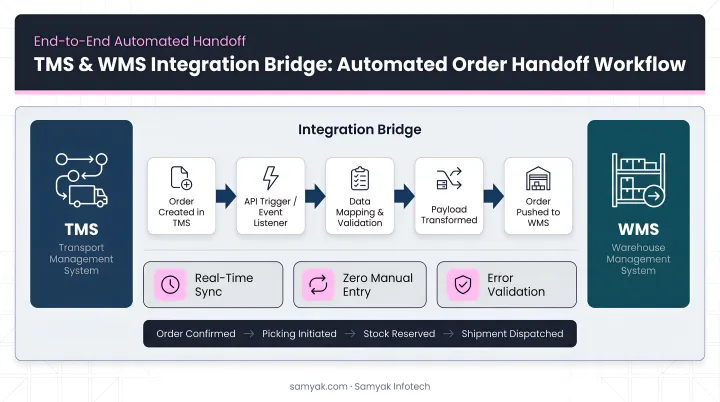
Integration is the operational bridge between them. When an order is picked and confirmed in the WMS, the TMS is immediately notified — triggering carrier assignment, dock slot allocation, and dispatch scheduling automatically, without anyone manually transferring data between systems. That handoff, when automated, is where the real efficiency gains begin.
Key Advantages of TMS–WMS Integration
Each advantage below maps directly to metrics logistics and supply chain teams track: cost per shipment, cycle time, delivery accuracy, and service levels. These gains compound — they're most pronounced when both systems share data in real time, not in scheduled batches.
Real-Time Visibility Across the Entire Order Lifecycle
Integrated systems give warehouse, yard, and transport teams a single shared view of every order — from the moment it enters the WMS through final delivery confirmation.
When an order is picked and ready, the TMS receives that signal immediately. Carrier scheduling, dock slot allocation, and route planning happen proactively rather than reactively. The scheduling lag that causes dock congestion and missed pickup windows disappears.
The cost of that lag is well documented. According to a U.S. DOT Office of Inspector General audit, a 15-minute increase in average driver dwell time is associated with $1.1B–$1.3B in annual earnings reductions for for-hire truckload drivers and $250.6M–$302.9M in annual net income reductions for truckload carriers. Poor dock scheduling has measurable financial consequences — not just operational inconvenience.
With shared real-time data, managers can redirect loads, adjust staging, and reroute shipments in response to disruptions without waiting for manual updates from another team.
KPIs impacted:
- On-time delivery rate
- Dock utilization
- Order-to-ship cycle time
- Carrier scheduling accuracy
Best suited for: Operations managing high order volumes, multi-warehouse networks, or time-sensitive freight — perishables, pharmaceuticals, just-in-time manufacturing inputs. These categories have zero tolerance for information lag.
Lower Costs Through Smarter Freight and Warehouse Optimization
Integration gives both systems the shared data needed to improve load consolidation, route selection, carrier utilization, and warehouse slotting — areas where even marginal gains add up quickly at scale.
The WMS knows where inventory is stored and when it will be ready. The TMS uses that data to schedule full loads, select optimal carriers, and reduce empty miles. Without that connection, transportation planning often starts after orders are already staged — too late to consolidate loads or negotiate rates effectively.
The scale of the underlying problem justifies the urgency: ACEEE research shows that 20–35% of U.S. truck miles are driven empty, and non-empty trucks average only 57% load factor. Better warehouse-to-transport data sharing directly addresses both figures.
KPIs impacted:
- Freight cost per unit shipped
- Load consolidation rate
- Empty mile percentage
- Warehouse cost per order
- Fuel consumption
Where the ROI is highest: Businesses running high shipment volumes or managing their own fleet. Even marginal improvements in route efficiency or load fill rate translate to significant dollar savings at scale.
Faster and More Accurate Order Fulfillment
When the WMS and TMS operate from the same data, the handoff between fulfilment and dispatch becomes automated. The manual steps that introduce delays and errors are removed from the process entirely.
Once an order is picked and confirmed in the WMS, the TMS automatically selects the carrier, generates shipping labels, schedules pickup, and updates tracking. No team member manually moves data between systems.
MD Logistics, a 3PL serving pharmaceutical and retail clients, integrated their Agile TMS with their JDA/RedPrairie WMS. Before integration, warehouse pickers had to scan individual barcodes for SKUs containing 10–20 or more items per case. After integration, a single 2D barcode scan captured all serial numbers on a pallet or case — cutting manual entry time and eliminating the errors that came with it.
For broader context on fulfilment baselines, APQC benchmarking across 13,590 companies shows median perfect order performance at 88%. That 12-point gap from perfect represents significant room for improvement — and manual data handoffs between disconnected systems are a primary contributor.
KPIs impacted:
- Order accuracy rate
- Average order cycle time
- Customer complaint rate
- On-time and in-full (OTIF) delivery rate
Critical for: E-commerce and retail operations, where customers expect real-time tracking and zero-error delivery — and where a single incorrect shipment triggers costly returns.
What Happens When TMS and WMS Operate in Silos
When TMS and WMS don't share data, both teams work blind. Warehouse teams dispatch orders without knowing carrier availability. Transport teams plan routes without knowing what's staged and ready. Every handoff becomes a guessing game.
The consequences compound quickly:
- Manual re-entry errors are often discovered too late — at the dock or after dispatch, when correction costs are highest
- Scheduling mismatches create dock congestion and idle carrier time, both of which carry direct financial costs
- Reactive decision-making becomes the default operating mode: teams respond to problems rather than anticipating them
- Volume makes friction worse — a manual handoff error at low volumes is an inconvenience; at high volumes, it becomes a systemic reliability problem
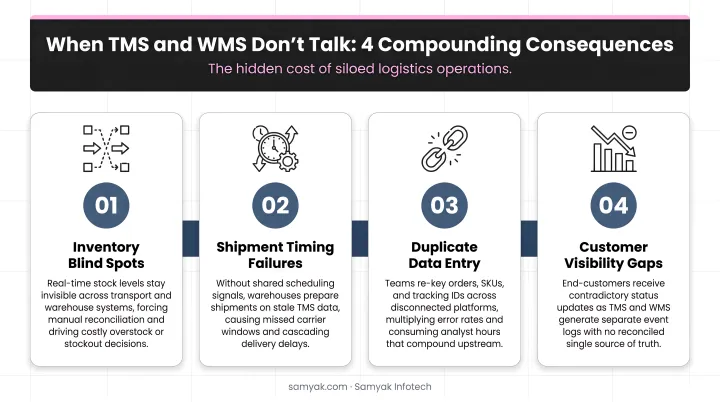
The root cause — disconnected data — is also the hardest to diagnose. Teams see the symptoms (delays, errors, congestion) without clear visibility into why they keep recurring. Connecting TMS and WMS addresses that root cause directly, which is why the operational gains from integration tend to be durable rather than temporary.
How to Get the Most Value from TMS–WMS Integration
Integration delivers maximum value when the foundation is right before automation is built on top of it.
Start with data standards. Field mapping, order status codes, and shipment identifiers must be consistent across both systems. Inconsistent identifiers are the most common reason integrations degrade over time.
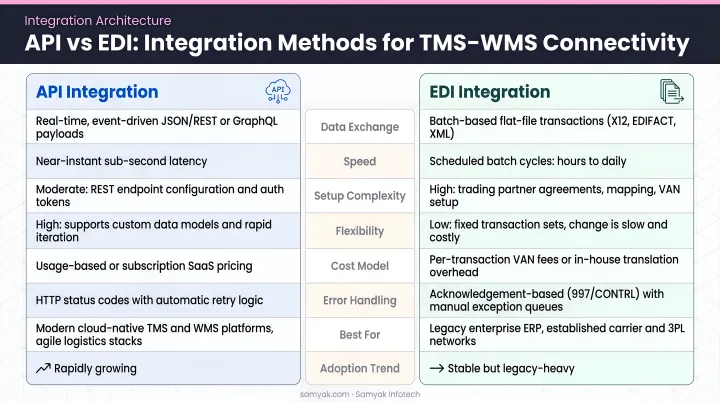
Choose the right integration method for your environment:
| Method | Best For | Tradeoff |
|---|---|---|
| API-based | Real-time, bidirectional data exchange; modern cloud systems | Higher implementation complexity |
| EDI | Standardized, high-volume transaction flows; legacy platforms and established trading partners | Less flexible for real-time use cases |
Measure from day one. Define KPI baselines before go-live. Track them in the first 90 days. Adjust workflows based on what the data shows, not what was planned in the implementation document. Integrations that aren't monitored tend to drift.
Older TMS and WMS platforms that weren't designed to communicate often need more than an off-the-shelf connector. Samyak Infotech has over 20 years of experience building logistics software — including real-time end-to-end tracking systems for Fortune 100 companies — and builds custom API connectors tailored to specific tech stacks. Their process covers data field mapping, connector development, and post-go-live support to keep integrations stable at production volume.
Conclusion
TMS–WMS integration represents a structural change in how logistics operations work — moving from reactive, siloed systems to a coordinated workflow that delivers measurable gains in cost, speed, accuracy, and customer experience.
The value compounds over time. Shared data becomes more powerful as order volumes increase and network complexity grows. But that only happens when the integration is monitored and optimized after go-live, not treated as a one-time implementation milestone.
The businesses that extract the most from this investment build it on solid data standards, measure it against real KPIs, and continue refining it as operational needs evolve.
Frequently Asked Questions
What are TMS and WMS systems?
A TMS (Transportation Management System) is software for planning and optimizing the movement of goods — covering carrier selection, routing, and freight tracking. A WMS (Warehouse Management System) manages internal warehouse operations including inventory, picking, packing, and shipping.
What is the difference between TMS, ERP, and WMS?
A WMS focuses on warehouse operations, a TMS focuses on transportation logistics, and an ERP manages company-wide business processes including finance, HR, and procurement. TMS and WMS are commonly integrated with ERP systems to give finance teams visibility into logistics costs across the full supply chain.
How does TMS–WMS integration reduce supply chain costs?
Integration gives transportation planners real-time warehouse readiness data, enabling better load consolidation, optimized routing, and reduced empty miles. The result is lower freight costs, fewer expedited shipments, and reduced carrier fees — all from moving planning decisions upstream before staging locks them in.
What integration methods are used to connect TMS and WMS?
The two main approaches are API-based integration (preferred for real-time, bidirectional data exchange between modern cloud systems) and EDI, which is reliable for standardized, structured transfers between established trading partners or legacy platforms. Many organizations use both, depending on the partner or system involved.
Is TMS–WMS integration suitable for small and mid-sized businesses?
Yes. While some benefits scale with volume, smaller businesses still gain meaningfully from reduced manual data entry, improved order accuracy, and better carrier scheduling. Cloud-based integration options have made implementation more accessible and cost-effective than legacy on-premise approaches.
What's the ROI of integrating a TMS with a WMS?
ROI varies by operation size and complexity. Measurable gains typically come from freight cost reduction through better load consolidation, labour savings from eliminated manual handoffs, improved order accuracy, and reduced returns. Businesses also report customer retention benefits from faster, more reliable delivery performance.