This guide is written for business owners, CTOs, and IT decision-makers who are serious about evaluating custom AI. It covers what custom AI development actually is, how to decide whether to build or buy, the step-by-step development process, which industries see the highest returns, and how to choose a partner worth trusting.
According to Stanford HAI's 2025 AI Index Report, 78% of organisations used AI in 2024 — up from 55% the year before. The competitive pressure is real. What separates organisations that capture value from those that don't is usually whether the AI they deploy actually fits how they work.
Key Takeaways
- Custom AI is built around your specific workflows, data, and systems rather than adapted from generic use cases
- Build vs. buy is the most consequential decision before any AI investment
- A prototype-first approach dramatically reduces cost and late-stage project risk
- Post-deployment monitoring and retraining are required to maintain accuracy and performance over time
- Data quality consistently matters more than model sophistication
What Is Custom AI Development?
Custom AI development is the process of designing, building, and deploying AI systems engineered around a specific business's data, processes, and goals. Unlike pre-built tools designed for a broad, generic audience, custom AI is built specifically for your context.
Solutions that fall under this category include:
- AI-powered chatbots trained on proprietary knowledge bases and internal documentation
- Predictive analytics engines built on company-specific historical data
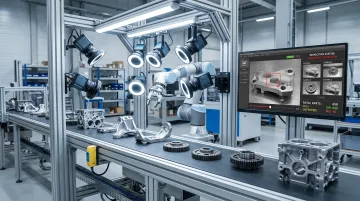
- Computer vision systems for quality inspection, defect detection, or visual monitoring
- Intelligent document processing tools that extract, classify, and route structured data
- Process automation platforms that handle multi-step workflows across existing systems
The core advantage is architectural fit. Rather than adapting your processes to meet the constraints of a generic tool, a custom AI solution is built to mirror how your business actually operates — including unique data formats, legacy system integrations, and compliance requirements specific to your industry.
As AWS describes it, model customisation means further training on a smaller, specialised dataset related to your specific use case. That distinction between domain-specific training and general-purpose training is what drives the difference in business impact.
Samyak Infotech's work illustrates this well. For one automotive manufacturer, the team built a computer vision quality inspection system trained on thousands of component images. The result: 98% defect detection accuracy and a 60% reduction in inspection time — outcomes a generic vision tool cannot produce without understanding that client's specific defect types and production line setup.
Custom AI vs. Off-the-Shelf Tools: How to Decide
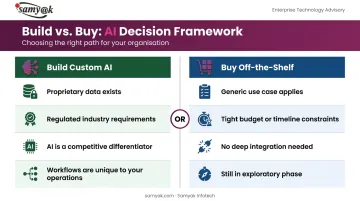
The build vs. buy decision is the most critical step before any AI investment. Getting it wrong in either direction is costly: overbuild and you waste budget on unnecessary complexity; underbuild and you implement a tool that solves the wrong 70%.
McKinsey describes three implementation archetypes: takers who use off-the-shelf tools, shapers who customize models with proprietary data, and makers who build bespoke systems from scratch. Most businesses land somewhere between shaper and maker — and knowing which one applies to your situation shapes your budget, timeline, and competitive position.
Signals Your Business Needs Custom AI
Custom development is the right path when:
- Your business has proprietary data that generic tools cannot access or learn from
- Your workflows follow logic no existing product maps to
- You operate in a regulated environment (healthcare, fintech, legal) with data privacy or compliance requirements that demand controlled deployment
- AI is a genuine competitive differentiator, not just a convenience — and a generic tool exposes that advantage to easy replication
When Off-the-Shelf AI Is Enough
Buying a packaged solution makes more sense when:
- The use case is generic: content writing, basic customer support, email automation
- Your systems don't require deep integration with the AI layer
- Budget is tight and speed to deployment matters more than fit
- You're still in exploratory mode and don't yet know exactly what you need
One question cuts through the analysis: "Does this tool solve 90% or more of my specific problem — and does the remaining gap directly affect business outcomes?" If yes to both, custom is worth the investment. If the gap is cosmetic, buy.
The Custom AI Development Process: Step by Step
Skipping straight to development without structured discovery and prototyping is the fastest way to waste budget. Gartner predicts that at least 30% of generative AI projects will be abandoned after proof of concept by end of 2025 — primarily due to poor data quality, unclear business value, and inadequate risk controls. A phase-gated process is what prevents a project from becoming that statistic.
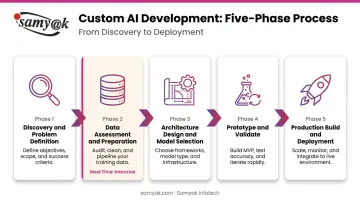
Discovery and Problem Definition
The process starts by translating a business challenge into a concrete, measurable task — not a technology wish list.
A proper discovery phase produces:
- A defined problem statement tied to a specific workflow or outcome
- Identified data sources and initial assessment of quality and volume
- Agreed-upon success metrics (e.g., reduce invoice processing time by 40%, improve lead qualification accuracy to 85%)
- A scoped project plan with phases, dependencies, and decision gates
Data Assessment and Preparation
Data is the foundation of any AI system. Before any model work begins, the available data must be audited.
This phase involves:
- Evaluating data volume, format, completeness, and bias
- Cleaning, labelling, and structuring datasets for model use
- Establishing data governance protocols to maintain quality over time
The time investment here is significant — and worth it. RAND research found that data scientists spend roughly 80% of AI development time on data engineering tasks. A simple model trained on clean, well-labelled data will consistently outperform a sophisticated model trained on messy data.
Architecture Design and Model Selection
Engineers select model types based on the use case: machine learning classifiers, transformer-based LLMs, computer vision architectures, or time-series forecasting models. Starting with a pre-trained foundation model — such as GPT-4 or a domain-specific fine-tuned variant — and adapting it to your data is almost always faster and more cost-effective than training from scratch.
That selection spans a broad technology stack. Samyak Infotech's engineering team, for example, works across TensorFlow and PyTorch for deep learning, OpenCV for computer vision, LangChain and LlamaIndex for LLM-powered applications, and MLflow with Kubernetes for production ML operations.
Prototype and Validate
The prototype phase is a risk management tool, not a deliverable milestone. A working prototype built on real business data — typically achievable in one to two weeks — lets stakeholders confirm the approach actually solves the problem before committing to a full production build.
Inexperienced teams frequently skip this phase, and that shortcut accounts for the majority of costly late-stage failures.
Production Build, Integration, and Deployment
What separates a prototype from a production-grade system:
- Error handling and edge-case coverage
- Security layers and access controls
- API integrations with existing tools — CRMs, ERPs, internal platforms
- Scalability infrastructure for variable load
- Compliance controls embedded in the architecture
Integration work frequently consumes more time than model development. Plan for it early, not during deployment.
Monitoring, Retraining, and Continuous Improvement
Once deployed, a model's work isn't finished — it's just beginning. As IBM defines it, model drift occurs when real-world data patterns shift away from what the model was trained on, causing accuracy to drop without obvious warning signs.
Production-ready deployments include:
- Scheduled retraining pipelines triggered by data drift or calendar cadence
- Performance monitoring dashboards tracking accuracy against baseline
- Alert thresholds that flag degradation before it affects business outcomes
Industries Getting the Most Value from Custom AI
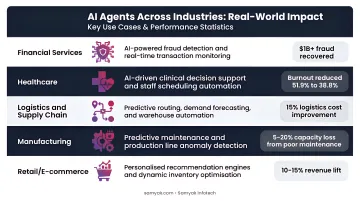
Custom AI delivers the highest ROI in sectors where high-volume repetitive tasks, complex proprietary data, or customer-facing operations create natural automation opportunities. The industries below show where purpose-built systems consistently outperform generic tools.
| Industry | Primary Use Cases | Representative Results |
|---|---|---|
| Financial Services | Fraud detection, document processing, credit analysis | US Treasury recovered $1B+ in fraud using ML in FY2024 |
| Healthcare | Clinical documentation, scheduling, diagnostic support | AI scribes reduced clinician burnout from 51.9% to 38.8% (JAMA, 2025) |
| Logistics & Supply Chain | Route optimization, demand forecasting, inventory management | Early AI adopters improved logistics costs by 15%, inventory by 35% |
| Manufacturing | Predictive maintenance, quality control | Poor maintenance strategies cost 5%-20% of productive capacity |
| Retail / E-commerce | Personalization, inventory optimization | Personalization drives 10%-15% revenue lift on average |
Industries with strict regulatory requirements — healthcare, fintech, legal — benefit most from custom builds because compliance controls can be built into the architecture from day one rather than patched in later.
Tips for a Successful Custom AI Development Project
These four principles consistently separate projects that ship on time from those that stall or get quietly shelved.
Start with the business problem, not the technology. Choosing a model or framework before defining the problem produces solutions looking for problems. The right starting questions: which workflow consumes disproportionate time, what measurable outcome indicates success, and how will that outcome be tracked?
Build an MVP first, then expand. A focused first deployment on one workflow delivers a working win that justifies further investment. Attempting to automate everything at once typically delivers nothing on schedule. Samyak Infotech's logistics clients saw this directly — automating a single shipment-tracking workflow first produced a 50% reduction in manual workload before broader platform development began.
Prioritize data quality before model complexity. Budget significant time for cleaning, labelling, and governance before selecting any model architecture. Gartner projects that 60% of AI projects unsupported by AI-ready data will be abandoned through 2026.
Define concrete success metrics before development begins. Vague objectives like "make it smarter" cannot drive development decisions or measure outcomes. Concrete KPIs — reduce invoice processing time by 35%, increase lead qualification accuracy to 80% — keep projects accountable and prevent scope creep.
How to Choose the Right Custom AI Development Partner
The AI services market is expanding fast. IDC projected enterprise AI solution spending will grow from $166B in 2023 to $423B by 2027 — which means the number of vendors claiming AI capability is growing just as quickly.
What separates credible partners from those that appeared overnight:
- A verifiable portfolio of shipped products, not just case study summaries
- Engineers involved in pre-sales conversations — not just sales representatives
- Transparency about trade-offs and limitations before contracts are signed
- A process that starts with a prototype before scaling to full production build
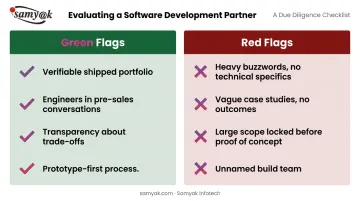
Red flags to avoid:
- Heavy buzzwords with no technical specifics
- Vague case studies with no measurable outcomes
- Contract structures that lock in large scope before any proof of concept
- Inability to name the actual team members who will build the solution
Questions to ask any prospective partner:
- Can you show me a similar project you've shipped, with measurable outcomes?
- Who will actually build this — and can I meet them before signing?
- What happens if the first technical approach doesn't work?
- How do you handle data privacy and compliance for my industry?
- What does post-deployment monitoring and retraining look like in practice?
Once you have answers to those questions, verify the credentials behind them. Look for partners with industry certifications, documented client results across relevant verticals, and verifiable ratings on third-party platforms like Clutch, GoodFirms, or Upwork.
To illustrate what that track record looks like in practice, Samyak Infotech meets each of these benchmarks directly:
- 25+ years of software and AI development experience
- ISO 9001 certified since 2004; Microsoft Silver Partner (top 5%)
- 100% Job Success rate on Upwork with verified 5-star ratings on Clutch and GoodFirms
Samyak's clients span logistics, healthcare, manufacturing, and fintech — including organizations like Indian Oil, ISRO, BASF, and Goodyear — with documented outcomes including 98% defect detection accuracy in manufacturing and 50% manual workload reduction in logistics.
Frequently Asked Questions
What is the difference between custom AI and off-the-shelf AI tools?
Off-the-shelf tools are built for broad, generic use cases. Custom AI is engineered around your specific data, workflows, and systems. A custom solution is built to address the exact workflow, integration, and compliance requirements your business depends on — where generic tools fall short.
How much does custom AI development typically cost?
Scope determines cost. Gartner cites business-model transformation GenAI deployments in the $5M–$20M range, though focused single-workflow projects cost far less. Key cost drivers include:
- Number of integrations and data complexity
- Compliance requirements
- Whether custom model training is needed
How long does it take to build and deploy a custom AI solution?
McKinsey research shows most organizations require one to four months from project start to production deployment. A working prototype typically takes two to four weeks. Highly customised solutions are 1.5x more likely to require five or more months. Simpler, narrower tools ship faster; multi-system enterprise deployments take longer.
What data does my business need before starting a custom AI project?
The quality, volume, and structure of your existing data determines what's buildable. Businesses should audit data sources for completeness and bias before development begins, and budget meaningful time for cleaning and labeling as part of the project scope. Starting model development before completing this audit will derail the project.
Can custom AI integrate with my existing software and systems?
Yes — and integration with existing tools (CRMs, ERPs, databases, internal platforms, APIs) is a primary reason businesses choose custom AI over packaged solutions. Integration planning should begin during the discovery phase, not at deployment. Integration work often takes as long as model development itself.
How do I prevent my custom AI model from becoming outdated over time?
This is model drift : when real-world data patterns shift away from training data and performance degrades. Production AI systems should include scheduled retraining pipelines, performance monitoring dashboards, and alert thresholds configured to catch degradation before it affects business outcomes. Post-deployment maintenance is not optional; it is part of the solution.