Introduction
Global competition is accelerating. Supply chains are fragmenting. Labor shortages are worsening. And customers expect faster delivery, higher quality, and greater customization than most manufacturers can currently deliver.
The pressure to modernize is operational, not theoretical. According to a 2025 Deloitte survey of 600 manufacturing executives, 92% said smart manufacturing will be the primary driver of competitiveness over the next three years.
The broader market reflects the same urgency: digital transformation spending is projected to reach $1.86 trillion by 2031, growing at a 9.1% CAGR.
For manufacturers still operating on legacy systems and reactive maintenance schedules, the window to act is narrowing.
This guide covers what digital transformation actually means for manufacturers, which technologies drive it, the real benefits and honest challenges, and a practical roadmap to move from intent to execution.
Key Takeaways
- Digital transformation in manufacturing integrates AI, IoT, automation, and digital twins across production and supply chains
- Core benefits include higher productivity, long-term cost savings, fewer defects, safer workplaces, and more resilient supply chains
- High upfront costs, legacy systems, and skill gaps are manageable through a phased, pilot-first approach
- Technology selection should always follow business outcomes, not precede them
What Is Digital Transformation in Manufacturing?
Digital transformation in manufacturing is the integration of advanced digital technologies into production processes, supply chain operations, and back-office functions—fundamentally changing how manufacturers design, produce, and deliver products. It's a strategic, organization-wide shift in how a business operates, competes, and creates value.
From Industry 3.0 to Industry 5.0
Understanding where this fits historically helps clarify why it's urgent now:
- Industry 3.0 introduced basic automation, PLCs, and early computerisation
- Industry 4.0 connected machines, people, and physical assets into an integrated digital ecosystem—as described by NIST—with interconnectivity, machine learning, and real-time data at its core
- Industry 5.0, as defined by the European Commission, moves beyond efficiency alone to place worker wellbeing at the center of production while respecting planetary boundaries
Most manufacturers are still navigating the Industry 3.0-to-4.0 transition—many have connected machines and digitized records, but few have integrated those data streams into decisions that drive measurable outcomes. The manufacturers building those capabilities now will be best positioned as Industry 5.0 standards take hold.
Three Terms Worth Distinguishing
Many leaders confuse these—and that confusion leads to misaligned investments:
| Term | What It Means |
|---|---|
| Digitisation | Converting analog data to digital format (scanning paper records) |
| Digitalisation | Using digital data to improve existing processes (ERP, digital quality logs) |
| Digital Transformation | Rethinking business models entirely through digital technology |
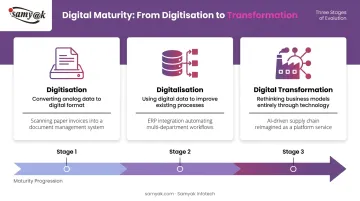
Most manufacturers have digitised. Many are digitalising. True digital transformation means questioning how products are made and how the business creates value—not just running the same processes on newer software.
Key Technologies Enabling Manufacturing Digital Transformation
Artificial Intelligence and Machine Learning
AI's most immediate manufacturing application is predictive maintenance—analyzing sensor data to identify equipment failure before it happens. According to McKinsey, condition-based maintenance frameworks can reduce labor, downtime, and parts costs by 30%. Poor maintenance strategies, by contrast, reduce asset productive capacity by 5–20%.
Beyond maintenance, AI is transforming quality control. BMW's GenAI4Q pilot at Plant Regensburg generates tailored inspection catalogues for approximately 1,400 vehicles daily, with a new vehicle leaving the line every 57 seconds.
Bosch's generative AI pilot for stator welding defect detection, trained on 15,000 synthetic images, is expected to achieve nearly 100% error detection compared to 70–90% for human inspectors, while shortening project timelines by six months.
Industrial Internet of Things (IIoT)
IIoT connects factory floor sensors and devices to provide real-time visibility into equipment performance, energy usage, and production line status. That data feeds predictive analytics systems, enabling data-driven decisions rather than reactive firefighting.
IIoT now accounts for 34.42% of the manufacturing digital transformation market, according to Mordor Intelligence. Supply chain applications add further value: tracking inventory levels, shipment conditions, and delivery timelines in real time.
Automation and Robotics
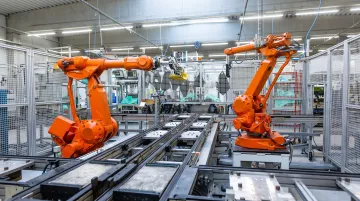
Industrial robots handle welding, assembly, packaging, and precision inspection at speeds and accuracy levels manual labor can't match. The scale of adoption is striking: the International Federation of Robotics reports 542,000 industrial robots were installed globally in 2024—more than double the number installed ten years earlier. Global robot density has reached 162 robots per 10,000 employees, also more than double the figure from seven years prior.
Robotic process automation (RPA) extends this logic to administrative manufacturing workflows—purchase orders, compliance documentation, scheduling—freeing up human capacity for higher-value work.
Digital Twins
A digital twin is a virtual replica of a physical asset or process, used to run simulations, test scenarios, and predict failures before they occur in the real world.
Rolls-Royce uses engine digital twins to optimize maintenance schedules based on individual engine conditions, detecting problems earlier and maximizing system availability rather than relying on probability-based maintenance windows.
For factory layout, digital twin simulations let engineers test production line reconfigurations virtually before committing capital. Cleveland Systems Engineering, using Siemens simulation tools, cut allocated design time by 50% and reduced on-site commissioning time by 50%.
Cloud Computing, Analytics, AR/VR
Cloud platforms unify data from previously siloed ERP, MES, and shop-floor systems into a centralized repository that supports real-time analysis without heavy on-premises investment. This foundation makes advanced demand forecasting and continuous process improvement tractable at scale.
AR and VR are changing how workers learn and operate. Two examples show what this looks like in practice:
- Airbus deployed mixed reality across manufacturing and training workflows, cutting manufacturing time by one-third while accelerating designer validation by 80%, according to Microsoft.
- Ford and Bosch used a VR training system to prepare technicians for the all-electric Mustang Mach-E's high-voltage systems before they ever touched a live vehicle.
Key Benefits of Digital Transformation for Manufacturers
Operational Efficiency and Productivity
Digitising production eliminates human error, reduces rework, and shortens cycle times. Deloitte's 2025 smart manufacturing survey found smart manufacturing initiatives delivered average improvements of 10–20% in production output, 7–20% in employee productivity, and 10–15% in unlocked capacity.
Real-world outcomes from WEF's Global Lighthouse Network reinforce this: Agilent Malaysia reduced manufacturing lead time by 75%, and Unilever Tinsukia increased labor productivity by 3.9x.
Cost Savings and ROI
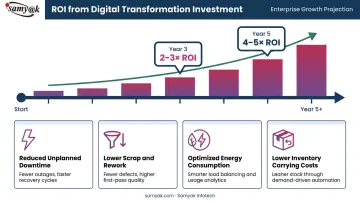
Upfront investment is real—but so is the return. WEF's Global Lighthouse Network data shows transformation programs generated 2–3x ROI over three years and 4–5x ROI over five years. Those returns come from:
- Reduced unplanned downtime (Deloitte estimates unplanned downtime costs industries $50B annually)
- Lower scrap and rework rates
- Optimized energy consumption
- Lower inventory carrying costs
Improved Product Quality
AI-powered inspection catches defects earlier in the production cycle, reducing the cost of rework, scrap, and warranty claims. Siemens' Electronics Works Amberg plant—widely referenced as a digital manufacturing benchmark—maintains a quality standard of 99.999%, with 75% of the value chain handled independently by machines and robots.
Workplace Safety
Automation keeps workers out of the most physically dangerous situations. Key applications include:
- Removing personnel from heavy lifting, chemical exposure, and high-temperature operations
- Real-time monitoring that detects unsafe conditions and triggers alerts before incidents occur
- AR/VR training that lets workers master high-risk procedures in a controlled virtual environment first
Supply Chain Resilience
The same data infrastructure that improves safety on the floor also strengthens the supply chain. Demand forecasting, real-time inventory tracking, and digital twin simulations of supply disruptions give manufacturers visibility to act on problems before they compound—rather than reacting after the fact. In markets where disruption has become routine, that lead time is a measurable operational advantage.
Common Challenges—and How to Overcome Them
High Upfront Investment
Capital requirements for equipment, software, infrastructure, and skilled personnel are significant. Start with high-ROI, contained pilots to demonstrate value early. Predictive maintenance on a single critical production line or automated quality inspection at one facility can demonstrate value quickly, building internal support for broader investment. Cloud-based solutions also reduce the need for large on-premises infrastructure spending upfront.
Legacy Infrastructure and Integration
Most manufacturers operate decades-old machinery and siloed software that resists easy connection to modern systems. The answer isn't wholesale replacement—it's phased modernization. APIs and middleware can bridge legacy and new systems incrementally. The rule: plan for interoperability before selecting any technology.
Workforce Skills Gap
Resistance to change is partly cultural, but the skills gap is structural. The Manufacturing Institute and Deloitte project the US manufacturing industry will need 3.8 million new employees between 2024 and 2033, with approximately 1.9 million positions potentially remaining unfilled if skills gaps aren't addressed.
65% of manufacturers already identify talent attraction and retention as their primary business challenge.
The response: communicate the why of transformation clearly, involve frontline workers in the process, and invest in reskilling programs proactively—not after deployment.
Cybersecurity Risks
Increased IT-OT connectivity expands the attack surface dramatically. Manufacturing is the hardest-hit industrial sector for ransomware—Dragos reported 1,693 ransomware attacks on industrial organisations in 2024, an 87% increase year-over-year, with 75% of incidents causing partial OT shutdown.
Practical defences:
- Implement zero-trust network segmentation between IT and OT systems
- Conduct security impact assessments before any new deployment
- Encrypt data in transit and at rest
- Establish and test incident response plans before an incident occurs
How to Build a Manufacturing Digital Transformation Roadmap
Step 1: Assess and Align
Before selecting any technology, audit your current operations honestly. Where are the actual pain points? What are the measurable business goals—reduce downtime by X%, cut scrap rate by Y%?
Transformation tied to specific operational outcomes succeeds; vague aspirations rarely do.
Identify which processes have the highest potential impact and the clearest data foundation. A useful starting audit covers:
- Where unplanned downtime most frequently occurs
- Which manual processes create the most rework or scrap
- Where data is siloed or unavailable to decision-makers
- Which KPIs the business can actually measure today
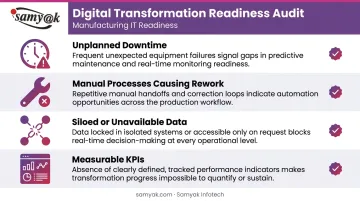
Those are your starting points.
Step 2: Start Small, Scale Fast
Launch a focused pilot in one high-impact area. Use pilot results—both successes and failures—to refine before rolling out enterprise-wide. The risk here is "pilot purgatory": endlessly running small experiments without ever committing to scale. Avoid this by setting pre-defined success criteria and a clear decision timeline before the pilot begins.
Step 3: Build for Integration and Iteration
Stand up a cross-functional governance team—IT, operations, finance, HR—before deployment. Ensure every technology selection prioritizes interoperability. Set KPIs and monitor continuously. Teams that review KPIs monthly catch integration gaps early—before a failed tool adoption derails the broader rollout.
How Samyak Infotech Helps Manufacturers Go Digital
Samyak Infotech is a custom software and AI development company with over 25 years of experience serving manufacturing and industrial clients. The team holds ISO 9001 certification and Microsoft Silver Partner status, with expertise spanning AI and machine learning, IIoT, blockchain, and cloud infrastructure. Every solution is built around a specific operational problem—not a generic platform adapted after the fact.
Where off-the-shelf platforms require manufacturers to adapt their processes to the software, Samyak's custom development model works the other way: solutions are designed around existing workflows and legacy infrastructure, integrating with the systems already in place and scaling as operations grow. For manufacturers with decades of accumulated complexity, that difference is significant.
Samyak has served manufacturing and industrial clients including BASF, Goodyear, Masibus, and Thermolab. Typical engagements include:
- Predictive maintenance systems that reduce unplanned downtime
- Real-time production monitoring dashboards for floor-level visibility
- Supply chain tracking tools with end-to-end traceability
- AI-powered quality inspection modules for defect detection
Manufacturers planning their digital transformation roadmap can connect with the Samyak team for a consultation at samyak.com.
Frequently Asked Questions
What are the 4 pillars of digital transformation?
The four pillars are technology (tools and platforms), process (rethinking how work gets done), people (skills, culture, and change management), and data (collecting, integrating, and acting on information). Labels vary across frameworks, but these four dimensions underpin every serious transformation effort.
What are the 5 steps of digital transformation?
The five steps are: (1) assess your current state and define measurable goals, (2) build a transformation roadmap, (3) pilot key initiatives in contained areas, (4) scale successful pilots enterprise-wide, and (5) continuously monitor, measure, and iterate. Transformation is cyclical: each iteration informs the next, so the work continues even after initial goals are met.
What is digital transformation in the manufacturing industry?
It's the integration of digital technologies—AI, IoT, automation, cloud computing, and analytics—into all aspects of manufacturing operations to improve efficiency, quality, safety, and competitiveness. The defining characteristic is that it reshapes business models, not just individual processes.
What are the key benefits of digital transformation in manufacturing?
The primary benefits are increased production efficiency, long-term cost savings, improved product quality and fewer defects, safer work environments, and stronger supply chain resilience against disruptions.
What technologies are most important for manufacturing digital transformation?
The core technologies are AI and machine learning, Industrial IoT, automation and robotics, digital twins, cloud computing, and big data analytics. The right mix depends on each company's goals, operational maturity, and where the highest-impact problems sit.
How long does digital transformation take in manufacturing?
Pilot projects can show measurable results within months; enterprise-wide transformation typically unfolds over 3–5+ years in phases. The priority is continuous, deliberate progress rather than waiting for a perfect plan before starting.