Introduction
Nearly half of all field service appointments don't go according to plan. According to Salesforce's 2025 survey of 350 U.S. tradespeople and technicians, 47% of appointments fail to run on schedule — and technicians spend more time on admin and information gathering (30% of working hours) than on actual service delivery (28%).
That imbalance has a direct cost. When schedules collapse mid-day — a traffic incident, an emergency call, a last-minute cancellation — manual dispatching can't recover fast enough, and customers end up waiting. Revenue stalls, and trust erodes with it.
This guide covers everything operations managers need to know about field service route optimization: what it actually is, how the core components work together, the measurable benefits, best practices for implementation, and how to decide between off-the-shelf platforms and custom-built solutions.
Key Takeaways
- Route optimization balances skills, time windows, job priority, and live traffic simultaneously — not just shortest distance
- 47% of field appointments don't go as planned, making schedule resilience the central business case
- AI-driven systems reroute automatically as conditions change, turning static daily plans into adaptive workflows
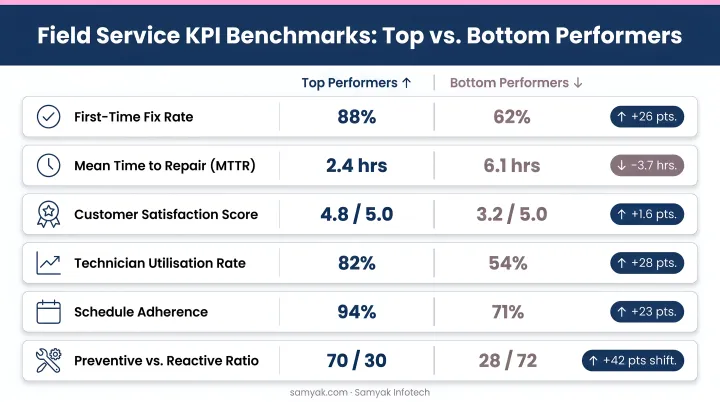
- Skill-aware dispatch directly improves first-time fix rates — top performers achieve 86% FTFR vs. 53% for bottom performers
- Complex workflows and proprietary integrations cause most businesses to outgrow off-the-shelf tools quickly
What Is Field Service Route Optimization?
Field service route optimization is a data-driven planning process that sequences technician schedules and travel paths to maximize operational efficiency — rather than just minimize driving distance. The system considers multiple variables simultaneously:
- Job urgency and SLA deadlines
- Technician certifications and skill sets
- Customer time windows
- Real-time traffic and road conditions
- Vehicle equipment and parts availability
The result is a dynamic daily plan that adapts throughout the shift, not a static list of addresses fed into a GPS.
Route Optimization vs. Simple GPS Navigation
GPS navigation solves one problem: getting from point A to point B efficiently. Route optimization solves a fundamentally different problem — sequencing dozens of jobs across multiple technicians while respecting business rules, workforce constraints, and customer commitments.
| Dimension | GPS Navigation | Route Optimization |
|---|---|---|
| Optimization scope | Single trip, fastest path | Multi-stop, multi-technician sequencing |
| Resource management | No awareness of workforce | Matches skills, availability, and equipment to each job |
| Business system integration | Standalone navigation | Connected to CRM, ERP, inventory, and SLA tracking |
The Evolution: Manual Planning to AI-Driven Optimization
Most field service organizations have passed through the same painful progression:
- Paper schedules and whiteboards: workable for three technicians, impossible at ten
- Spreadsheets: faster to update, but blind to what's actually happening in the field
- Standalone GPS: solves navigation while ignoring scheduling complexity entirely
- Integrated AI-driven FSM platforms: connects dispatch, routing, technician matching, and customer communication into one adaptive system
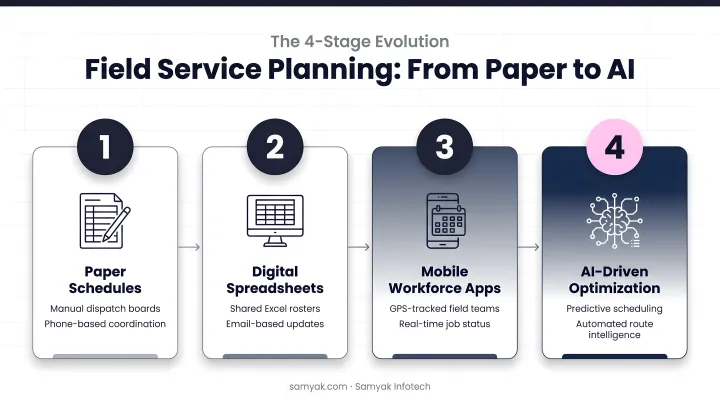
The breaking point is always an unexpected event: a traffic jam, an emergency call, a technician running 45 minutes late. Manual systems have no mechanism to recover and re-sequence the entire day automatically. AI-driven routing handles that recovery in real time.
It also gets smarter over time. Historical job durations, traffic patterns by time of day, and technician performance data continuously refine future route recommendations.
In home social care, a documented optimization study found that structured route planning reduced travel time by 16-18% on weekdays, illustrating that smarter sequencing — not faster driving — is where efficiency is won.
How Field Service Route Optimization Works: Core Components
Modern route optimization runs as an interconnected system — multiple components working continuously across the service day, not a single toggle you switch on. Each layer builds on the last.
Smart Dispatching and Technician Matching
The dispatch engine cross-references every open job against the full technician roster, evaluating:
- Geographic proximity to the job site
- Required certifications and skill match
- Current workload and available time within the customer's window
- Tools and parts loaded in the vehicle
This eliminates the manual guesswork of traditional dispatch. Aquant's 2024 benchmark of 145 service organizations and 24M+ work orders found that top-performing technicians achieve an 81% first-time fix rate with a 3.7-day resolution time, while lower-skill matches average 64% FTFR and 5.9 days. Routing the right person first isn't just more efficient. It's substantially cheaper.
Real-Time Tracking and Dynamic Rerouting
Live GPS feeds technician locations into the dispatch dashboard continuously. When a high-priority emergency job appears, a cancellation opens a gap, or a traffic incident extends estimated arrival times, the system automatically calculates a revised sequence and flags it for review.
Dispatchers retain override control throughout. They can approve, reject, or modify any suggested reroute. Automation supports their decisions. It doesn't replace them.
Predictive ETAs and Automated Customer Notifications
Predictive ETA engines combine three data streams:
- Real-time GPS position of the technician
- Live traffic conditions along the projected route
- Historical job-duration benchmarks for similar work
When the ETA changes — because of rerouting or a job running long — customer SMS and email alerts update automatically. Fewer inbound "where is my technician?" calls, less dispatcher distraction.
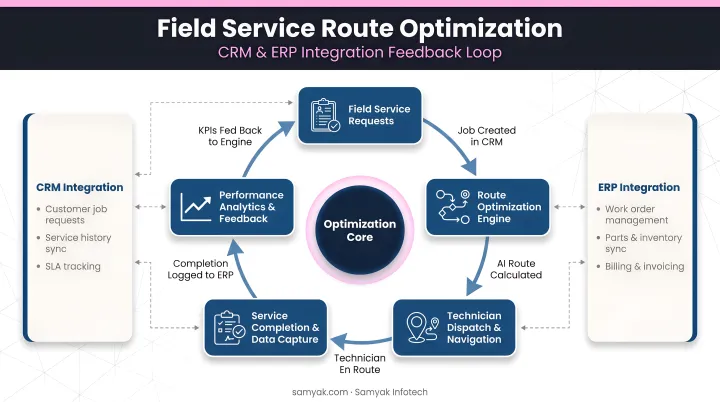
System Integration and Analytics
Route optimization connects the full service lifecycle when integrated with the broader FSM ecosystem:
- CRM integration pulls job requirements and customer history from work orders
- ERP/inventory connections confirm parts availability before technician assignment
- Post-job data (actual vs. estimated travel time, SLA compliance, fuel used) feeds back into routing algorithms
This feedback loop compounds efficiency gains over time. Each planning cycle benefits from the data generated by the previous one — tightening ETA accuracy, reducing travel variance, and surfacing patterns dispatchers can act on. An API-first architecture makes this possible: the optimization logic connects directly with whatever CRM, ERP, or legacy system the business already runs, rather than requiring a full-stack replacement.
Benefits of Field Service Route Optimization
Reduced Travel Time and Fuel Costs
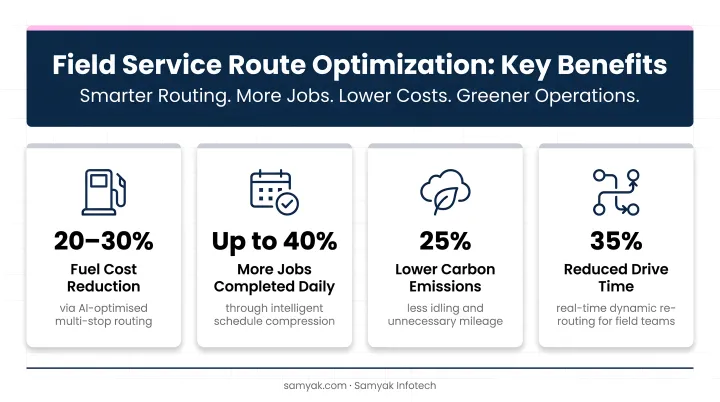
Geographic clustering — grouping jobs by zone to eliminate backtracking — is where most of the mileage reduction happens. The system avoids scheduling a technician on the north side of the city in the morning, the south side at noon, and back north in the afternoon.
In documented logistics implementations, AI-driven route optimization has delivered a 20% reduction in fuel costs and a 30% improvement in delivery times. Fewer miles driven also translates directly into lower vehicle maintenance costs over time.
More Jobs Completed Per Day
When technicians spend less time in transit, available capacity within the same shift increases. For a team of ten, even recovering 45 minutes of travel time per technician per day represents substantial additional job capacity — without adding headcount.
Freight and cargo operators have recorded a 25% reduction in route miles driven after implementing custom route optimization. A retail client using the same approach achieved a 50% increase in on-time deliveries.
Improved On-Time Performance and Customer Satisfaction
More jobs completed per day only matters if customers actually notice. According to Salesforce, 74% of mobile workers say customers expect more than ever, and 72% say customers feel more rushed. Accurate ETAs and proactive communication — not just faster arrival — are what drive satisfaction scores.
When rerouting updates flow automatically to customer notifications without dispatcher intervention, customers receive a fresh ETA before they even think to call. Businesses using automated ETA alerts consistently report fewer inbound customer inquiries and measurable gains in satisfaction scores.
Better Dispatcher Visibility
Real-time map views with color-coded job status pins give dispatchers a live picture of the entire field operation. Rather than reacting to problems after they've escalated, dispatchers can spot a technician running behind schedule and reassign an upcoming job before the customer's time window closes.
Reduced Carbon Footprint
Transportation accounts for 28% of total U.S. greenhouse gas emissions, with more than 94% of that fuel being petroleum-based. For companies with ESG commitments, route optimization is one of the most direct levers available — fewer miles driven means lower emissions without requiring fleet electrification or infrastructure investment.
Best Practices for Implementing Field Service Route Optimization
Set Clear Optimization Goals and Job Priorities
Before configuring any system, define what you're actually optimizing for. The three most common goals pull in different directions:
- Minimize total travel time — prioritizes geographic efficiency
- Maximize jobs per day — may accept slightly longer routes to fit more appointments
- Improve first-time fix rates — prioritizes technician-to-job skill matching over proximity
Each requires different algorithmic weights. Trying to optimize all three equally without clear priorities leads to mediocre results across the board.
Build a structured job-priority framework early:
- Emergency jobs — immediate dispatch, override existing sequences
- SLA-bound jobs — sequenced within contractual windows, high constraint weight
- Routine maintenance — flexible timing, fill gaps in optimized schedules
Use Skill-Based and Zone-Based Assignment Rules
Geographic clustering alone is not enough. Routing the nearest technician to every job ignores a critical variable: qualifications. If that technician lacks the certification for the equipment, the result is a failed first visit, a repeat dispatch, and a customer who waited twice.
The most effective implementations pair:
- Zone-based assignment to reduce backtracking and travel time
- Skill-based matching to ensure the right qualifications and tools arrive at each job
Aquant's 2025 benchmark found that 14% of all truck rolls are unnecessary, and top performers reduce avoidable dispatch rates to just 3%. Skill-aware routing is what separates those outcomes — dispatching the right technician the first time, not just the closest one.
Continuously Monitor KPIs and Refine the System
Routing algorithms improve only when fed accurate performance data. Track these metrics post-deployment:
- First-time fix rate — industry median is 75-76%; top performers reach 86%
- Avoidable dispatch rate — target below 5%
- Average resolution time — top performers average 3 days; bottom performers average 11
- SLA compliance rate
- Fuel cost per technician per week
Review these monthly. When observed patterns diverge from algorithm assumptions: for example, a job type consistently taking 40% longer than estimated — update the system's duration benchmarks.
Custom vs. Off-the-Shelf: Choosing the Right Route Optimization Solution
The decision comes down to operational complexity. Most off-the-shelf tools handle standard scenarios competently. The gaps appear when business requirements don't fit the vendor's assumptions.
When Off-the-Shelf Tools Work Well
Standard route optimization platforms are a good fit when the business has:
- Relatively uniform job types with predictable durations
- Standard technician roles without complex certification requirements
- Team sizes that fit within the platform's tier limits
- CRM and ERP systems already in the vendor's native integration library
For these organizations, the configuration overhead of a packaged tool is manageable and the time-to-value is fast.
When Custom Route Optimization Software Makes Business Sense
Several scenarios consistently push businesses toward custom-built solutions:
- Regulated industries (utilities, pharmaceuticals, oil and gas) with compliance-specific scheduling constraints that off-the-shelf tools weren't designed to accommodate
- Deep integration requirements with proprietary or legacy ERP systems where the vendor's native connectors don't reach
- Multi-fleet or multi-region operations requiring coordination logic across divisions or geographies
- Non-standard workforce rules — specialized overtime rules, union agreements, or equipment certification tiers that don't map to standard platform logic
- Embedding route optimization into a broader custom FSM platform rather than running it as a standalone tool
Samyak Infotech has built custom route optimization and field service management software for clients across logistics, healthcare, manufacturing, and retail — including the AgentTrack platform and a Route Optimizer API. Both are delivered as API-first components that connect directly to existing systems, rather than requiring operations to conform to a vendor's predefined feature set.
With over 25 years of logistics software development experience and clients including Fortune 100 companies, Samyak Infotech regularly handles the non-standard scenarios where off-the-shelf platforms fall short.
Frequently Asked Questions
What is field service route optimization?
It's a data-driven process for planning the most efficient travel sequences and job schedules for field technicians, considering multiple variables simultaneously — technician skills, customer time windows, job priority, parts availability, and live traffic. Unlike GPS, it solves a workforce planning problem across your entire team at once.
What is an example of field service route optimization?
An HVAC company receives an emergency repair request. The system identifies the nearest certified technician, reroutes them from their current schedule, reassigns their remaining jobs to other available technicians, and sends the customer an updated ETA — with no dispatcher involvement required.
What are the three key elements of field service management?
The three core operational pillars are:
- Scheduling — assigning the right technician to the right job at the right time
- Dispatching — communicating assignments and managing real-time changes
- Route optimization — ensuring technicians travel efficiently between jobs
How does route optimization differ from simple GPS navigation?
GPS finds the fastest route for a single trip. Route optimization sequences multiple stops across multiple technicians simultaneously, accounting for skills, SLAs, inventory, and business rules — it's solving a workforce planning problem, not a navigation problem.
How does AI improve field service route optimization?
AI enables predictive routing by learning from historical job durations and traffic patterns, and triggers automatic rerouting when conditions shift mid-day. It also improves technician matching using past performance data, turning fixed daily plans into workflows that adapt in real time.
How do you implement field service route optimization?
Define your optimization goals first, then ensure your data is clean (technician skills, job locations, time windows). Select or build the right software, integrate it with your CRM and ERP systems, and monitor KPIs continuously to refine algorithm performance over time.