Introduction
A single ecommerce business in 2026 might pull orders from Shopify, Amazon, and Etsy simultaneously, route them through multiple warehouses, and coordinate with five different carriers — all before noon. According to a TechNet/Ipsos survey, 90% of online sellers use at least two ecommerce marketplaces, with the average small retailer active across three sales channels plus two additional platforms.
Manual coordination at that scale isn't just inefficient — it breaks.
The right shipping management software consolidates carrier selection, label generation, real-time tracking, and returns into a single operational layer. Pick the wrong platform, and you've only moved the bottleneck.
This list was compiled by evaluating platforms against real operational criteria — integration depth, automation capability, scalability, and fit for specific business models. The ten tools below serve distinct use cases, from solo sellers to enterprise logistics teams.
Key Takeaways
- Shipping management software automates carrier selection, label generation, tracking, and returns — replacing fragmented manual workflows.
- Top 2026 solutions include ShipStation, Shippo, Easyship, ShipBob, ShipHero, Ordoro, EasyPost, Narvar, Sendcloud, and Pirate Ship.
- Each tool targets a distinct use case: multi-channel retail, international shipping, dropshipping, or API-level integration.
- Key selection criteria: multi-carrier support, automation depth, scalability, and total cost of ownership.
- Complex logistics workflows or proprietary ERPs often call for a custom-built solution over off-the-shelf software.
What Is Shipping Management Software?
Shipping management software (SMS) is a digital platform that centralises the end-to-end shipping lifecycle. Core functions typically include:
- Order import and carrier rate comparison
- Shipping label generation and printing
- Dispatch scheduling and carrier handoff
- Real-time tracking and delivery confirmation
In the broader logistics stack, SMS sits between your OMS, ERP, or ecommerce platform (which generates the order) and the physical carrier network (which moves the package). It converts order data into shipment actions without requiring manual intervention at every step.
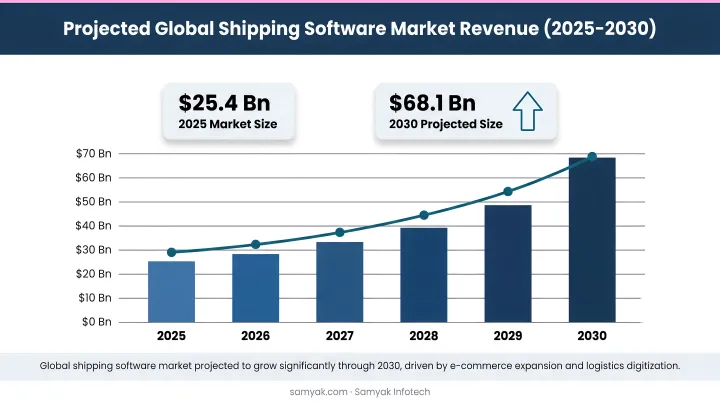
Mordor Intelligence estimates the shipping software market at $14.26 billion in 2025, projected to reach $22.23 billion by 2030 — a 9.29% CAGR driven by ecommerce growth and rising fulfillment complexity.
US parcel volume alone hit 22.37 billion shipments in 2024, up 3.4% year-over-year.
For any business processing more than a few dozen shipments per week, manual carrier selection and label generation is no longer operationally viable.
Top 10 Shipping Management Software Solutions in 2026
These platforms were selected based on their ability to reduce fulfillment friction, support multiple carriers, integrate with existing business systems, and scale with operational demand.
1. ShipStation
ShipStation is one of the most widely adopted multi-channel shipping platforms in the US, used by businesses selling across Shopify, Amazon, eBay, Etsy, and dozens of other storefronts from a single dashboard. It reports over 1.3 million customers served and 400+ integrations across carriers and selling channels.
Its core strength is automation depth. Businesses can configure rules that automatically assign carriers, service levels, and packaging based on order criteria — reducing the manual decision-making that slows high-volume operations. The built-in Rate Shopper reportedly saves an average of 3.4% per label automatically.
| Category | Details |
|---|---|
| Best For | Multi-channel ecommerce sellers managing orders from several storefronts simultaneously |
| Key Features | Multi-carrier rate shopping, automation rules, branded tracking pages, returns management portal, batch label printing, 400+ integrations |
| Pricing | Starter $14.99/month · Standard $29.99/month · Premium $349.99/month |
2. Shippo
Shippo takes a developer-friendly, pay-as-you-go approach with 40+ global carrier integrations and a free starter tier — making it a practical entry point for startups and growing brands that aren't ready for a monthly subscription commitment. Over 4.6 million businesses use the platform.
The API-first architecture means engineering teams can embed Shippo's carrier connectivity directly into custom commerce workflows, rather than forcing users into a separate shipping dashboard.
| Category | Details |
|---|---|
| Best For | Startups, low-volume shippers, and engineering teams building custom commerce workflows |
| Key Features | API-first architecture, multi-carrier rate comparison, address validation, return label generation, branded tracking (paid plans) |
| Pricing | Starter free (up to 30 labels/month, $0.05/label for own carrier accounts) · Pro from $17/month · Premier: contact sales |
3. Easyship
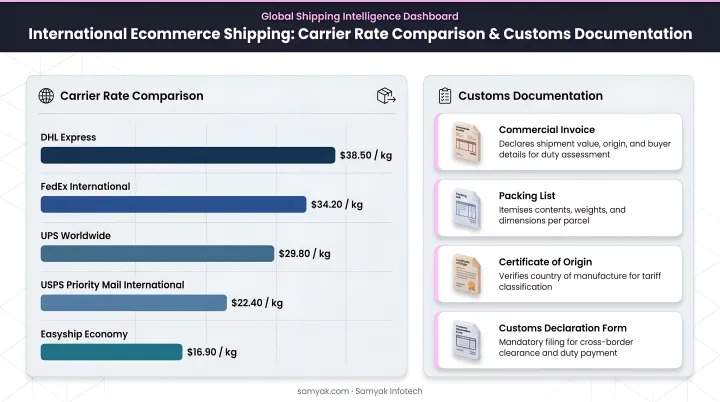
Easyship leads for cross-border ecommerce, giving merchants access to 550+ courier services worldwide while automating the compliance requirements that make international shipping genuinely complicated. It covers customs documentation for 220+ destinations and supports both DDP and DDU duty workflows.
Pre-negotiated carrier discounts of up to 91% off retail rates, combined with strong Asia-Pacific coverage across 13 markets, make it the clearest choice for brands expanding internationally.
| Category | Details |
|---|---|
| Best For | Businesses shipping internationally or entering cross-border ecommerce markets |
| Key Features | 550+ global carriers, automated customs documentation, duty/tax calculation, multi-currency support, smart shipping rules |
| Pricing | Free plan available · Plus, Premier, Scale, and Enterprise tiers (paid plans start from $29/month — verify current pricing at easyship.com) |
4. ShipBob
ShipBob is a hybrid solution that combines shipping software with a physical distributed fulfillment network across 60+ fulfillment centers in 6 countries (US, Canada, UK, EU, Australia). For brands that want to outsource warehousing alongside their shipping platform, it removes the need for a separate 3PL relationship.
Automated order routing to the nearest fulfillment center reduces transit times and shipping costs — and the real-time inventory sync across locations means you're never manually reconciling stock levels.
| Category | Details |
|---|---|
| Best For | Ecommerce brands seeking combined shipping software and outsourced fulfillment (3PL) services |
| Key Features | 60+ fulfillment centers, inventory synchronization, automated order routing, shipment tracking, returns processing |
| Pricing | Custom/quote-based tied to fulfillment volume — request pricing at shipbob.com |
5. ShipHero
ShipHero targets merchants running their own warehouse operations, combining full WMS capabilities with carrier integration and shipping automation in a single platform. It's built for high-volume environments where pick/pack efficiency directly impacts margin.
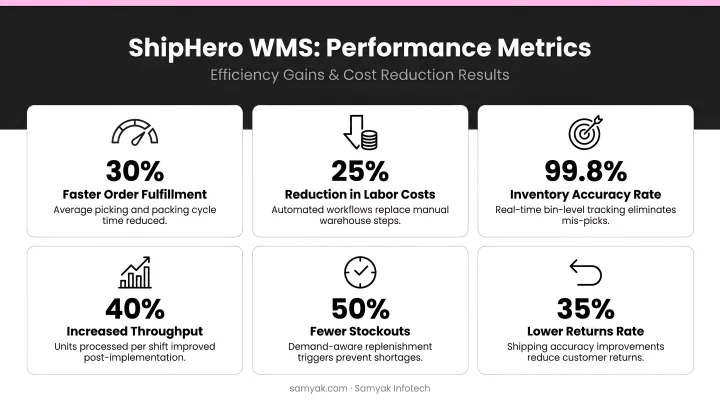
The platform's performance numbers are specific:
- Picking efficiency improves up to 3x with mobile barcode scanning workflows
- Warehouse costs drop up to 35% through automation and labor management dashboards
- Mis-picks and mis-ships reduced by 99.9% via real-time inventory tracking
| Category | Details |
|---|---|
| Best For | High-volume merchants running warehouse-based fulfillment operations |
| Key Features | WMS functionality, pick/pack workflow automation, barcode scanning, mobile replenishment, carrier integrations, labor management dashboards |
| Pricing | Brand Standard WMS from $1,850/month (includes 5 users, unlimited SKUs and orders) · 3PL WMS: contact sales |
6. Ordoro
Ordoro is built for dropshippers and multi-supplier retailers, combining inventory synchronization with shipping automation and vendor management in a modular app structure. Its standalone shipping app is free — inventory and dropshipping capabilities are priced separately, letting businesses pay only for what they need.
The dropshipping automation is genuinely purpose-built: it routes orders to the correct supplier automatically, manages vendor portals, and handles purchase orders with dedicated tools for each step of the supplier workflow.
| Category | Details |
|---|---|
| Best For | Dropshippers and retailers managing multiple suppliers or fulfillment sources |
| Key Features | Dropshipping automation, supplier/vendor management, multi-channel inventory sync, purchase order management, multi-warehouse support |
| Pricing | Shipping app: free · Inventory Advanced from $349/month · Dropshipping Advanced from $299/month |
7. EasyPost
EasyPost is infrastructure, not a shipping dashboard. It's the API layer that enterprises and platform builders use to embed carrier connectivity, rate shopping, real-time tracking, and address verification directly into their existing systems — without building carrier integrations from scratch.
Its AI-powered tool, Luma AI Select, automatically chooses the optimal carrier for each shipment based on cost, speed, and live carrier performance data. EasyPost also holds FedEx Compatible 2026 Diamond Tier and Solution of the Year status — a key credential for enterprise procurement teams.
| Category | Details |
|---|---|
| Best For | Enterprise shippers and technology platforms requiring API-level carrier integration and AI-driven shipping decisions |
| Key Features | 100+ carrier integrations, Luma AI carrier selection, real-time tracking API, address verification, performance analytics |
| Pricing | Free Access Plan: first 3,000 labels/month free (via EasyPost Wallet), then $0.08/label · BYOCA: $20/month + $0.08/label · Enterprise: contact sales |
8. Narvar
Narvar focuses on what happens after the order ships. It's a post-purchase experience platform rather than a traditional shipping tool — covering branded tracking, proactive customer notifications across email, SMS, and WhatsApp, and a self-service returns portal that reduces reverse logistics support costs.
With 1,500+ retail brands and approximately 2 billion packages processed annually, Narvar works as a complement to other shipping systems, not a standalone replacement. For teams where post-shipment customer experience drives retention, it addresses a gap most shipping platforms don't touch.
| Category | Details |
|---|---|
| Best For | Mid-to-large brands focused on post-purchase customer experience and reducing returns-related support load |
| Key Features | Branded tracking pages, self-service returns portal, proactive delivery notifications (email/SMS/WhatsApp), post-purchase analytics |
| Pricing | Enterprise/quote-based — request a demo at narvar.com |
9. Sendcloud
Sendcloud is Europe's dominant shipping platform, trusted by 30,000+ businesses across the EU. Its regional carrier depth — 160+ carriers including DHL, DPD, GLS, and UPS across Europe — gives it coverage that US-centric platforms simply can't match for European operations.
Standout features include a service-point picker widget at checkout (letting customers choose a local pickup point), multi-language tracking pages, and WhatsApp Business integration for delivery notifications.
| Category | Details |
|---|---|
| Best For | European ecommerce businesses needing regional carrier depth and multi-language customer communication |
| Key Features | 160+ European carriers, checkout service-point picker, branded tracking in 8 languages, returns portal, WhatsApp notifications |
| Pricing | Free €0/month · Lite €33/month + €0.11/label · Growth €99/month + €0.10/label · Premium €195/month + €0.09/label · Pro €799/month + €0.07/label · Enterprise: custom |
10. Pirate Ship
Pirate Ship is completely free for US-based small businesses — no monthly fees, no subscriptions, no per-label charges for standard usage. It provides access to USPS Commercial Pricing (up to 87% off retail rates) and UPS discounted rates (up to 85% off Daily Rates), including Priority Mail Cubic pricing that most small businesses can't access directly.
For cost-conscious small businesses shipping domestically via USPS or UPS, nothing else comes close on price-to-value.
| Category | Details |
|---|---|
| Best For | US-based small businesses and solo sellers shipping primarily via USPS or UPS |
| Key Features | USPS Commercial Pricing, UPS discounted rates, Priority Mail Cubic access, batch label printing, address book |
| Pricing | Completely free — no monthly fees, no per-label charges for standard usage |
How We Selected These Shipping Management Solutions
Capterra's 2024 US Tech Trends Report found that 58% of US software buyers regretted at least one software purchase in the prior 12-18 months — and 56% described the financial impact as significant or monumental. Choosing the wrong shipping platform carries exactly that kind of cost.
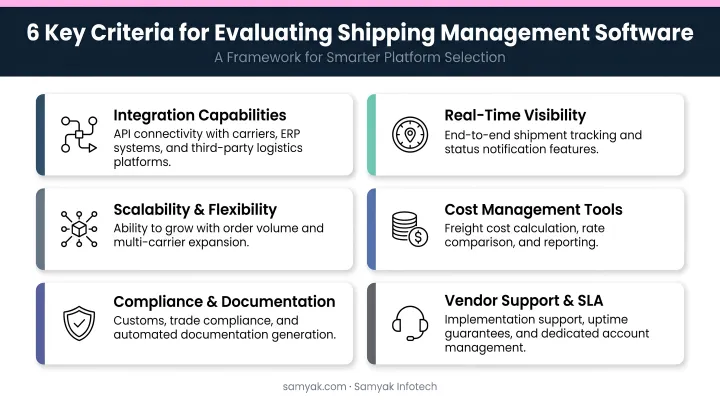
The platforms above were evaluated against six core criteria:
- Multi-carrier support — breadth of carrier integrations and live rate shopping capability
- Ecommerce and ERP integration depth — native connections to Shopify, Amazon, WooCommerce, and enterprise systems
- Automation and rule-based workflows — ability to automate carrier selection, label generation, and routing without manual input
- Scalability — performance across low-volume and high-volume scenarios without degradation
- Specialized use case coverage — cross-border compliance, dropshipping, WMS functionality, or post-purchase experience
- Total cost of ownership — subscription costs, per-label fees, and integration overhead relative to business size
These criteria reflect how differently businesses actually use shipping software. A dropshipper routing orders to 15 suppliers has fundamentally different requirements than a warehouse shipping 10,000 parcels daily or a DTC brand managing cross-border compliance in 30 countries. The rankings below reflect those differences.
Conclusion
The "best" shipping management software is the one that fits your operational model — not the one with the longest feature list. A mismatch between platform and workflow creates new inefficiencies rather than solving old ones.
Before committing, evaluate each shortlisted tool against your current integration requirements, projected shipment volume, carrier diversity needs, and actual budget. Request demos using your real order scenarios, not vendor-provided test cases.
For businesses with proprietary ERP systems, multi-modal freight requirements, or workflows that standard platforms cannot accommodate without heavy workarounds, a custom-built shipping management solution is the more scalable path.
Samyak Infotech has over 25 years of experience building end-to-end logistics and shipping software for Fortune 100 companies, with shipping clients including Carisbrooke Shipping, MNX, and Ship Network. Their custom solutions cover:
- Multi-carrier integrations across transport modes
- Real-time tracking dashboards with live shipment visibility
- WMS functionality built to your warehouse workflows
- ERP connectivity via secure APIs
Connect with the Samyak Infotech team to explore whether a tailored solution is the right fit.
Frequently Asked Questions
What is the best shipping management software?
The right choice depends on your business model, order volume, carrier needs, and existing systems. ShipStation suits multi-channel ecommerce sellers, Easyship leads for international shipping, and Pirate Ship is the top pick for cost-conscious US-based small businesses.
What is a shipping management system?
A shipping management system is a digital platform that automates and centralizes shipping operations — covering carrier selection, label generation, real-time tracking, and returns. It acts as the operational layer between your order management system and the carrier network.
What features should shipping management software include?
Core capabilities include multi-carrier integration, automated label generation, rate shopping, real-time shipment tracking, returns management, and analytics. Advanced platforms also offer rule-based automation, ERP/WMS integration, and AI-powered carrier selection.
How does shipping management software reduce shipping costs?
Platforms cut costs through real-time carrier rate comparison, automated routing to the cheapest qualifying option, and analytics that reveal where money is being lost. EasyPost reports users save around 40% on overall shipping costs after switching.
What is the difference between shipping management software and a WMS?
A WMS manages internal warehouse operations — inventory location, picking, packing. A shipping management system handles outbound carrier interactions — rate shopping, label printing, tracking. Some platforms, like ShipHero, combine both functions in a single product.
When should a business consider custom shipping management software?
Custom solutions make sense when a business has proprietary ERP systems, multi-modal freight requirements, unique compliance needs, or workflows too complex for standard platforms. They also eliminate vendor lock-in and avoid per-seat or per-label pricing as you scale.