Introduction
Last mile delivery accounts for 53% of total shipping costs, according to FreightWaves — making the depot-to-doorstep stretch the single highest-cost segment in any logistics operation. With US parcel volume hitting 22.37 billion shipments in 2024 and still climbing, the pressure to squeeze efficiency out of that final mile has never been more acute.
The problem most operations face isn't awareness — it's execution. Manual spreadsheets and basic Google Maps planning might work for a two-van operation, but they fall apart fast under real-world complexity: overlapping time windows, vehicle capacity limits, driver schedule gaps, and last-minute order additions. The result is predictable: missed delivery windows, ballooning fuel costs, and customers who don't come back.
Route optimization software addresses each of these failure points directly. This guide covers the five strongest last mile platforms for 2026: Routific, Onfleet, DispatchTrack, OptimoRoute, and FarEye — with verified pricing, feature differentiators, and clear guidance on which tool fits which operation.
Key Takeaways
- Last mile route optimization software automates multi-stop route planning to cut fuel costs, improve on-time rates, and reduce dispatcher workload
- Tool selection depends on fleet size and dispatch model — planned batch routes vs. on-demand dynamic assignment require fundamentally different platforms
- Core features to evaluate: AI route planning, real-time GPS re-routing, driver app quality, customer notifications, and integration flexibility
- Covered tools: Routific, Onfleet, DispatchTrack, OptimoRoute, and FarEye — ranging from SMB to large enterprise
- Operations with unique or complex routing needs may get better ROI from custom-built logistics software than any off-the-shelf platform
What Is Last Mile Route Optimization Software?
Last mile route optimization software computes the most efficient multi-stop delivery sequence for drivers — accounting for vehicle capacity, customer time windows, driver shift lengths, depot locations, and real-time traffic — and does it in minutes, not hours.
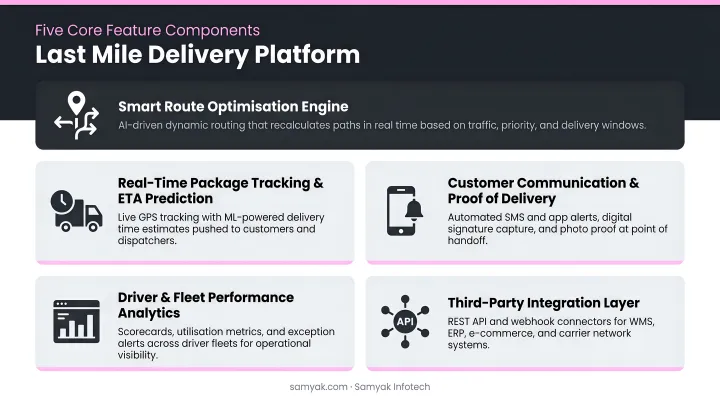
It sits inside a broader last mile delivery platform that typically includes:
- Dispatch management — assigning orders to drivers manually or automatically
- Real-time GPS tracking — live driver location and ETA visibility
- Driver mobile app — turn-by-turn navigation, stop management, proof of delivery
- Customer notifications — automated SMS/email updates with tracking links
- Analytics and reporting — on-time rates, stop counts, fuel usage, SLA compliance
Route optimization is what every other feature depends on. Get it wrong, and the rest underperforms — faster notifications don't help if the ETA is wrong because the route was poorly planned.
The global last mile delivery software market is projected to grow from $7.11 billion in 2025 to $14.14 billion by 2035. That growth is being driven by rising delivery volumes, tighter SLA requirements, and the operational cost pressure that comes with both. The platforms reviewed below cover the leading options available to logistics teams evaluating this investment.
Top Last Mile Route Optimization Software for 2026
Each tool below was evaluated on route optimization depth, real-world constraint handling, dispatcher usability, driver app quality, integration ecosystem, and verified user ratings from G2 and Capterra.
Use this list to match your operation type — planned vs. on-demand, SMB vs. enterprise, single-depot vs. multi-depot — to the platform built for it.
Routific
Routific is built for local delivery businesses — farms, meal prep companies, florists, food distributors — that plan and dispatch routes in advance rather than dynamically. It handles up to 50,000 stops per day, scaling from a single van to fleets of 50 vehicles without any workflow changes.
The combined map-and-timeline dispatcher view puts every driver, route, and stop on one screen. Dispatchers can drag stops between drivers without rebuilding routes from scratch. The algorithm also balances mathematical efficiency with human readability, avoiding the "spaghetti routes" that undermine driver trust and adoption — a known failure point of purely algorithmic planners.
| Attribute | Details |
|---|---|
| Best For | Growing local delivery businesses running 3–50 vehicles with planned (not on-demand) routes |
| Key Features | AI route optimization, combined map + timeline view, automated customer notifications, barcode scanning, photo proof of delivery, GPS tracking |
| Pricing (2026) | First 100 orders/month free; $150/month for up to 1,000 orders; per-order pricing above that, scaling down with volume |
| G2 / Capterra | 4.8/5 (46 reviews) / 4.9/5 (144 reviews) |
Onfleet
Onfleet targets mid-market and enterprise operations, offering one of the broadest feature sets in the category: on-demand auto-assign, live driver chat, barcode scanning, age verification, and detailed analytics.
Auto-assign sets it apart from planned-route tools: incoming orders route to the nearest available driver in real time, without dispatcher intervention. That makes Onfleet a natural fit for courier services, grocery delivery, and any operation where orders arrive continuously rather than in planned batches. Auto-assignment works via dashboard, bulk import, API, or Zapier (confirmed via Onfleet's support page, updated March 2026).
| Attribute | Details |
|---|---|
| Best For | Mid-market and enterprise operations with on-demand or mixed dispatch workflows |
| Key Features | Real-time auto-assign, live driver chat, barcode scanning, age verification, analytics dashboard |
| Pricing (2026) | Launch: $619/month (2,500 tasks); Scale: $1,349/month (5,000 tasks); Enterprise: $3,099/month (10,000+ tasks) |
| G2 / Capterra | 4.6/5 (140 reviews) / 4.6/5 (95 reviews) |
DispatchTrack
DispatchTrack leads on ETA precision. The platform claims 98% ETA accuracy by applying machine learning to historical delivery data, traffic patterns, and real-world route constraints. Industries with contractually binding delivery windows — furniture, appliances, building supplies, food and beverage — rely on it for that reason.
Beyond route generation, the AI covers customer scheduling, rescheduling automation, exception handling, and compliance logging. For white-glove or time-sensitive deliveries where a missed window has a direct cost, that full-stack approach matters more than point-solution accuracy.
| Attribute | Details |
|---|---|
| Best For | Enterprises in furniture, building supplies, food & beverage, or field services requiring high ETA accuracy |
| Key Features | AI route optimization, 98% ETA accuracy, automated customer scheduling and rescheduling, compliance logs, real-time tracking |
| Pricing (2026) | Not publicly listed — contact sales for a quote |
| G2 / Capterra | 4.5/5 (13 reviews) / 4.5/5 (34 reviews) |
OptimoRoute
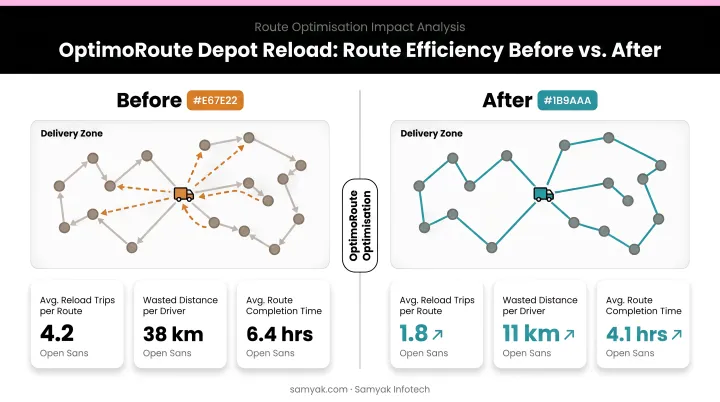
OptimoRoute is built around operational complexity: multi-depot routing, depot reloading mid-route, and capacity planning that handles weight and volume limits simultaneously. Food distributors, medical supply companies, and high-volume couriers use it precisely because standard route planners can't handle these scenarios.
The depot-reload feature is the clearest proof of this: drivers return to a warehouse mid-route, pick up additional orders, and continue. OptimoRoute's published example shows this reducing combined man-hours from 12:50 to 7:40 while also cutting mileage — a significant gain for operations that can't fit a full day's load in one trip.
| Attribute | Details |
|---|---|
| Best For | Multi-depot operations, reloading routes, and businesses needing simultaneous weight + volume capacity constraints |
| Key Features | Depot reloading, multi-constraint capacity planning, individual driver profiles, real-time tracking, proof of delivery, 30-day free trial |
| Pricing (2026) | Lite: $35.10/driver/month (billed annually); Pro: $44.10/driver/month (billed annually); Custom: contact sales |
| G2 / Capterra | 4.8/5 (53 reviews) / 4.6/5 (255 reviews) |
FarEye
FarEye serves large-scale logistics operations, retail chains, courier networks, and healthcare distributors globally. It combines AI route optimization with a full workflow automation engine, covering driver onboarding, dispatch, dynamic re-routing, proof of delivery, customer experience management, and 3PL performance benchmarking in a single platform.
For enterprise buyers, the depth of integration is what distinguishes it from narrower route tools.
The BPM (Business Process Management) engine lets operations teams customize workflows, automate exception handling, and connect with existing WMS, OMS, TMS, and CRM systems through a low-code interface. FarEye's published performance figures: 10%–30% reduction in cost-per-delivery, up to 22% improvement in first-attempt delivery success, and a 20–30 point NPS uplift. EV-enabled routing and sustainability dashboards are included for operations with emissions targets to track.
| Attribute | Details |
|---|---|
| Best For | Large enterprises in e-commerce, courier & parcel, retail, grocery, and healthcare requiring end-to-end last mile management |
| Key Features | AI route optimization, BPM workflow automation, driver app (Android & iOS), dynamic re-routing, 3PL management, EV routing, sustainability dashboards |
| Pricing (2026) | Not publicly listed — enterprise pricing on request |
| G2 / Capterra | 4.8/5 (252 reviews) / 4.6/5 (15 reviews) |
Key Features to Look for in Last Mile Route Optimization Software
Not every tool marketed as a "route optimizer" handles real-world complexity equally. Many solve simple single-driver problems but break down under multi-vehicle, multi-depot, or time-window-constrained scenarios. Use this as a buyer's checklist.
Route Optimization Engine Depth
A surface-level planner sequences stops. A true optimization engine does all of this simultaneously:
- Multiple drivers and vehicles with different start/end points
- Vehicle capacity constraints (weight and volume, not just one)
- Customer delivery time windows (with tolerance handling)
- Driver shift lengths and break requirements
- Multiple depot locations
- Predictive traffic conditions , not just current conditions
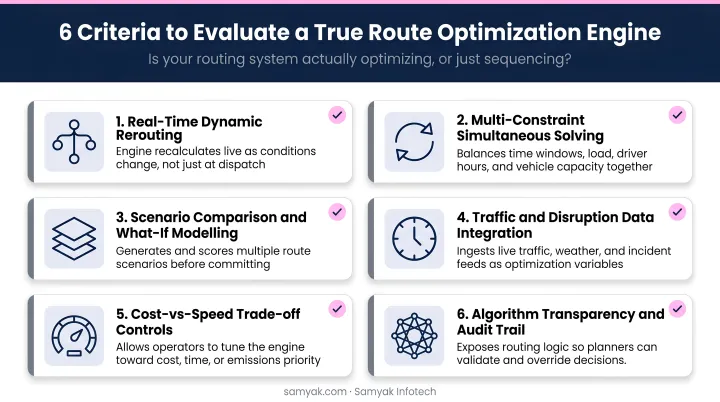
And it produces results in minutes, not hours. If a vendor's demo only shows single-driver scenarios, ask specifically how the algorithm performs with 20+ drivers and mixed time windows before committing.
Real-Time Visibility and Dynamic Re-Routing
Live GPS tracking tells you where drivers are. What actually prevents late deliveries is software that:
- Flags at-risk stops before they become missed deliveries
- Recalculates ETAs automatically as conditions change
- Offers one-click re-optimization when exceptions occur : vehicle breakdowns, order cancellations, urgent additions
Some tools surface the problem; the better ones solve it without requiring dispatcher intervention.
Driver App Quality and Adoption
Dispatcher-side tools are only as effective as driver-side adoption. A clunky driver app produces workarounds, lost proof-of-delivery data, and inaccurate tracking , undermining the entire investment.
Evaluate driver apps on:
- Route readability — logical stop sequences, not algorithmic spaghetti
- Proof of delivery — photo, signature, barcode, OTP support
- Low-connectivity performance — does it work in areas with poor signal?
- Onboarding time — how long does it take a new driver to get comfortable?
Customer Communication and Experience Tools
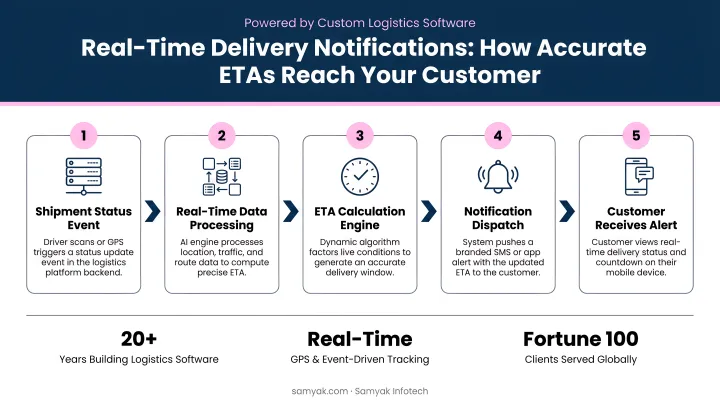
Automated customer notifications do more than reduce "where is my order?" calls — they directly affect whether customers buy again. According to Narvar, nearly 90% of consumers prioritize reliable delivery dates over pure speed.
That reliability is built through accurate ETAs, proactive status updates, and self-serve tracking links. Look for platforms that automate notifications at each stage (order confirmed, driver en route, delivered) without requiring manual dispatcher action.
Integration and Scalability
Customer-facing features only deliver value when the platform connects cleanly to the rest of your operations. The best tools fit into your existing tech stack without a full overhaul. Prioritize:
- Pre-built connectors to Shopify, WooCommerce, or your OMS/ERP
- Open API for custom integrations
- Pricing that scales with delivery volume rather than punishing growth at the next tier
How We Chose These Tools
Every tool on this list was evaluated against a consistent set of criteria — the same factors that matter when you're managing real fleets, not just running demo routes.
Inclusion criteria:
- Route optimization algorithm depth and scalability (single-driver vs. full multi-vehicle constraint handling)
- Dispatcher UX and driver app quality
- Verified user reviews from G2 and Capterra — with review volume noted alongside score
- Pricing transparency and per-unit value at different fleet sizes
- Coverage across SMB, mid-market, and enterprise use cases
Exclusion criteria:
- Basic single-driver route planner apps (insufficient for multi-vehicle operations)
- Tools without independently verifiable user feedback
Pricing data reflects publicly available information as of 2026. Verify directly with vendors before purchasing — particularly DispatchTrack and FarEye, which do not publish pricing publicly.
Conclusion
The right last mile route optimization software depends less on brand reputation and more on operational fit: fleet size, dispatch model (planned batch vs. on-demand), integration requirements, and whether the pricing structure scales with your delivery volume or against it.
Before finalizing any decision, run a free trial with your own real delivery data (not a vendor demo optimized for ideal conditions). Involve drivers in the evaluation too; their adoption rate determines whether the software actually delivers ROI or just adds another system to manage.
When off-the-shelf platforms can't handle the complexity — multi-modal workflows, unique depot configurations, or custom compliance requirements — Samyak Infotech builds logistics software designed around your specific operation.
With 25 years of experience and over 20 years building end-to-end tracking and routing solutions for logistics companies including Fortune 100 clients, the team delivers platforms built around your depot layout, driver workflows, and routing logic from day one.
Frequently Asked Questions
What is last mile optimization?
Last mile optimization uses algorithms, real-time data, and AI to determine the most efficient routes and sequences for delivering orders from a depot to end customers — minimizing fuel costs, driver time, and missed delivery windows while maximizing successful stops per route.
What is the difference between last mile delivery software and route optimization software?
Route optimization is one component within a broader last mile delivery platform. Pure route optimizers build efficient multi-stop sequences. Full last mile platforms go further, bundling routing with dispatch management, driver apps, real-time GPS tracking, customer notifications, proof of delivery, and analytics.
What features should last mile route optimization software have?
Look for these core capabilities:
- Multi-vehicle and multi-depot route planning
- Real-time traffic-aware optimization
- Driver mobile app with proof of delivery
- Automated customer notifications with accurate ETAs
- KPI dashboards and reporting
- API integrations with order management or ERP systems
How much does last mile route optimization software cost?
Pricing follows three models: per-order, per-driver per month, or tiered/contact-sales. For small-to-mid operations, costs typically run $150–$1,500/month depending on volume and features. Enterprise platforms like FarEye and DispatchTrack require custom contracts.
Which last mile route optimization software is best for enterprise operations?
FarEye and DispatchTrack are the strongest enterprise options, given their workflow automation depth, BPM engines, 3PL management, and integration capabilities. Very large or specialized operations may find custom-built logistics software a better long-term fit.
Can last mile route optimization software handle on-demand deliveries?
Not all tools support this. Onfleet is built specifically for dynamic auto-assignment as orders arrive continuously. Routific and OptimoRoute are designed for planned batch routes dispatched in advance. The dispatch model — on-demand vs. planned — should be the first decision point when evaluating platforms.