Introduction
Logistics teams manually process hundreds of shipments daily. Healthcare organizations chase approvals through email chains. Financial services firms run reconciliation on spreadsheets. These inefficiencies quietly drain time, budget, and accuracy — and the losses add up faster than most teams realize.
Intelligent automation (IA) has become the answer most enterprises are turning to. Unlike basic workflow tools, IA combines AI, machine learning, RPA, and process mining to handle complex, judgment-dependent work at scale. It goes well beyond clicks and copy-paste tasks.
The global intelligent process automation market is projected to reach $44.74 billion by 2030, which signals how rapidly businesses are committing to this technology layer.
This guide covers what IA software actually is, profiles the five most widely adopted platforms in 2025, and outlines the evaluation criteria that matter when selecting one.
Key Takeaways
- IA combines RPA, AI/ML, NLP, and process mining to automate complex, multi-step workflows beyond simple repetitive tasks
- Top platforms in 2025: UiPath, Automation Anywhere, Microsoft Power Automate, IBM watsonx Orchestrate, and Pega Systems
- The right tool depends on company size, existing tech stack, industry compliance needs, and low-code vs. custom requirements
- Standard platforms cover common workflows; specialized industries often need custom-built automation layers
- Evaluate on total cost of ownership, integration depth, and scalability — not just feature lists
What Is Intelligent Automation Software?
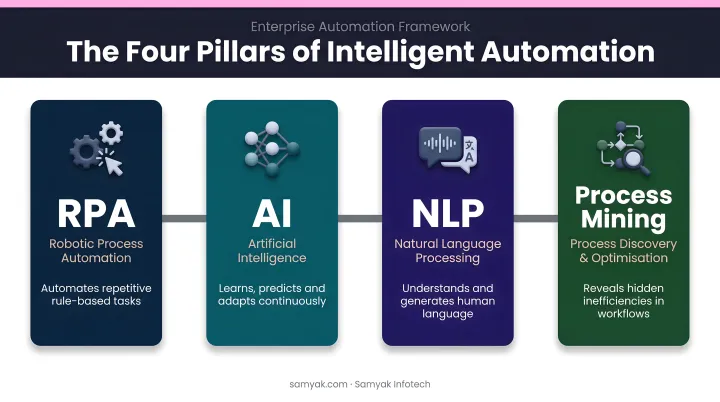
Intelligent automation is the combination of RPA, AI/ML, NLP, computer vision, and process mining to automate end-to-end workflows that involve unstructured data, multi-step decisions, or cross-system interactions. Traditional RPA handles only scripted, rule-based tasks — IA picks up where that stops, managing exceptions, interpreting language, and making context-aware decisions.
The Four Technology Pillars
| Pillar | Role |
|---|---|
| RPA | Execution layer — mimics user actions in digital systems to handle repetitive UI-based tasks |
| AI/ML | Decision-making layer — learns from data patterns, handles exceptions, and improves over time |
| NLP | Language layer — interprets unstructured text, emails, and voice inputs for automated processing |
| Process Mining | Discovery layer — analyses system logs to identify automation opportunities and bottlenecks |
Together, these four pillars enable IA platforms to handle workflows that once required human judgment: document processing, fraud detection, compliance approvals, and dynamic customer interactions.
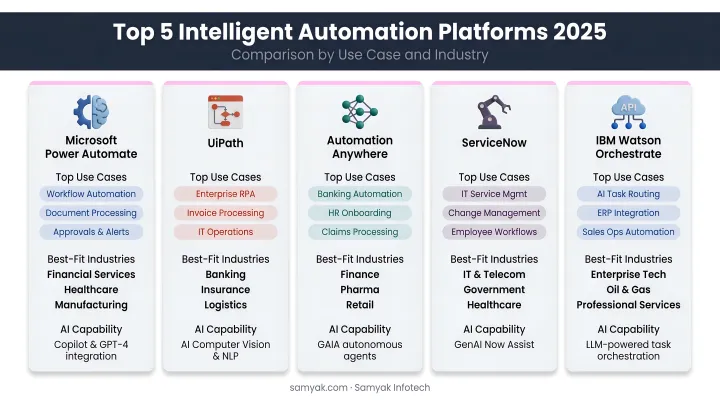
Choosing the right platform depends on your infrastructure, team capability, and automation scope. The five tools below represent the most widely deployed options across enterprise and mid-market organisations in 2025.
Top Intelligent Automation Tools and Software
These tools were selected based on market leadership, feature depth, enterprise adoption, integration ecosystem, and verified customer outcomes across multiple industries.
UiPath
UiPath pioneered the RPA space and has since evolved into a full agentic automation platform. Its capabilities now span AI-powered process discovery, orchestration, and intelligent document processing. Its client base includes Fortune 500 companies such as Coca-Cola and Verizon, with case studies showing thousands of hours saved annually through automated workflows.
The unified platform approach — RPA, AI agents, Intelligent Document Processing (IDP), and process mining all under one roof — is where UiPath pulls ahead. Its low-code Studio environment enables both developers and business users to build automations, which matters when scaling beyond a single IT-led pilot.
| Category | Details |
|---|---|
| Best For | Large enterprises needing end-to-end automation with strong governance and compliance requirements |
| Key Features | Agentic AI orchestration, process and task mining, IDP, low-code Studio, pre-built templates, AI Center for model integration |
| Pricing | Subscription-based (per robot/user); enterprise pricing on request; free trial available |
Automation Anywhere
Automation Anywhere has held its position as a Gartner Magic Quadrant Leader for RPA for seven consecutive years, and its platform has shifted toward agentic process automation (APA). It combines RPA with AI agent orchestration, document automation, and process discovery in a cloud-native architecture built for large, distributed teams.
Its standout differentiators include the Mozart Orchestrator for coordinating multi-agent workflows and Automator AI, which lets users create bots using natural language — removing the technical barrier that often slows IA adoption.
| Category | Details |
|---|---|
| Best For | Enterprises in financial services, healthcare, and manufacturing seeking AI-first automation at scale |
| Key Features | AI Agent Studio, Automation Co-Pilot, document automation, process discovery, CoE Manager, cloud-native deployment |
| Pricing | Subscription-based; Community Edition free; enterprise pricing on request |
Microsoft Power Automate
Part of Microsoft's Power Platform, Power Automate enables workflow automation across Microsoft 365, Azure, and 900+ third-party connectors. It's the natural entry point for organizations already running on the Microsoft stack.
Its key advantages: AI Builder for pre-built ML models (OCR, form processing, predictions), desktop flows for RPA-style automation, and native integration with Azure OpenAI and Copilot. For businesses already paying for Microsoft 365 enterprise licences, Power Automate represents a cost-effective path into intelligent automation without adding a new vendor.
Samyak Infotech, as a Microsoft Silver Certified Partner, has implemented Power Automate across manufacturing, healthcare, logistics, and retail engagements — connecting it with Dynamics 365, SharePoint, SAP, Salesforce, and custom ERPs .
| Category | Details |
|---|---|
| Best For | SMBs and mid-market companies in the Microsoft ecosystem seeking accessible, cost-effective automation |
| Key Features | AI Builder, desktop flows, cloud flows, 900+ connectors, Azure OpenAI and Copilot integration |
| Pricing | Per-user and per-flow plans; included in select Microsoft 365 enterprise licences |
IBM watsonx Orchestrate
IBM watsonx Orchestrate uses conversational AI and a pre-built skills catalog to automate work across business applications — targeted squarely at regulated industries with strict governance requirements.
Its differentiation lies in depth rather than breadth: strong security and compliance posture, conversational AI-driven task automation (rather than UI scripting), and tight integration with SAP, Salesforce, and ServiceNow. IBM's 2021 acquisition of MyInvenio added process mining capabilities, giving Orchestrate a full discovery-to-automation workflow.
| Category | Details |
|---|---|
| Best For | Enterprises in banking, insurance, and government requiring AI automation with enterprise-grade governance |
| Key Features | Conversational AI skills, pre-built automation catalog, process mining, SAP/Salesforce/ServiceNow integration, IBM Cloud and hybrid deployment |
| Pricing | Usage-based SaaS pricing; enterprise contracts available |
Pega Systems
Pega combines BPM, CRM, and AI-driven decision intelligence into a single platform built for complex, customer-facing workflows. Its "case management" approach handles exceptions and human-in-the-loop scenarios that pure RPA platforms struggle with. Major financial institutions, insurers, and healthcare providers globally use Pega for exactly this reason.
Its Next-Best-Action AI engine makes real-time decisioning across customer interactions — connecting front-office CRM with back-office automation in a way few platforms can. Pega was named a Leader in The Forrester Wave for AI Decisioning Platforms, Q2 2025, reinforcing its position in complex decisioning workflows.
| Category | Details |
|---|---|
| Best For | Large enterprises in financial services, insurance, and healthcare needing AI-driven decisioning with CRM and BPM |
| Key Features | Next-Best-Action AI, case management, low-code App Studio, RPA integration, real-time analytics, cloud/on-premise deployment |
| Pricing | Subscription-based (per user/case volume); enterprise licensing on request |
Key Features to Look for in an Intelligent Automation Platform
Choosing an IA tool goes well beyond comparing feature checklists. The platforms above all have impressive capabilities on paper — what actually determines success in deployment is fit with your environment.
Integration Depth
Does the platform connect natively to your existing ERP, CRM, or cloud systems, or will you need significant custom connector work? Native integrations reduce implementation time and ongoing maintenance costs significantly.
Scalability
Can the platform handle growing process volumes without re-architecting? Many organisations start with a single department pilot and later discover the platform wasn't designed for enterprise-wide rollout.
Governance and Security
Regulated industries — banking, pharmaceuticals, healthcare — need platforms with audit trails, role-based access controls, and compliance certifications baked in, not bolted on.
Low-Code vs. Pro-Code Balance
Platforms that empower non-technical business users (citizen developers) to build and maintain automations reduce IT dependency. But enterprise deployments also need depth for complex workflows. The best platforms offer both tracks — low-code for speed, pro-code for customisation.
When Standard Platforms Aren't Enough
Off-the-shelf IA platforms cover common workflows well. The gap emerges with industry-specific requirements that pre-built connectors simply can't address:
Off-the-shelf IA platforms cover common workflows well. The gap emerges with industry-specific requirements that pre-built connectors can't address:
- Pharmaceutical batch compliance workflows
- Logistics EDI integrations
- Manufacturing quality inspection logic
- Financial fraud detection models
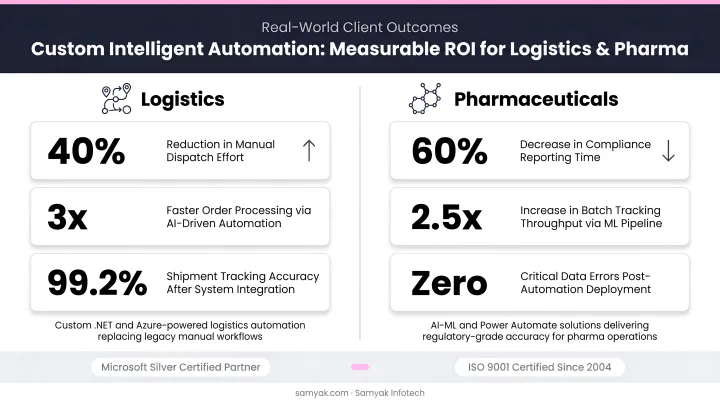
Samyak Infotech has built custom solutions for exactly these scenarios. For a global shipping client, the team developed a hyperautomation layer combining ML-based delivery partner selection, EDI integration, and real-time Google Maps API transit calculation — saving over 200 manual work hours per day and $250,000+ quarterly.
For a pharmaceutical manufacturer, custom workflow automation — including approval workflow automation — eliminated paper-based approval processes for more than 100 users across PMO, Purchase, RCD, and PPIC departments, with measurable SAP license cost reductions.
Both projects layered custom AI models (built on TensorFlow, PyTorch, and Azure AI), custom connectors, and tailored data pipelines on top of existing platforms — filling the gaps pre-built tools couldn't reach.
How We Selected These Intelligent Automation Tools
These five platforms were evaluated on:
- Market presence — Gartner Magic Quadrant and Forrester Wave rankings
- Feature breadth — coverage across RPA, AI/ML, IDP, and process mining
- Verified enterprise adoption — documented customer outcomes across industries
- Diversity of use cases — relevant whether you're a mid-market company or a global enterprise
Common Selection Mistakes to Avoid
- Brand recognition over integration fit — a market-leading platform that doesn't connect cleanly to your ERP creates more problems than it solves
- Underestimating total cost of ownership — licensing is just the start; implementation, training, and ongoing customization add up fast
- Ignoring scalability requirements — selecting a platform for an initial use case without assessing whether it can expand to other workflows locks you into costly re-platforming later
Conclusion
The best intelligent automation tool is the one that fits your operational reality — not the one with the biggest marketing presence. Pilot tools on real workflows before committing. Assess vendor support quality. Check whether the platform's roadmap aligns with where your automation needs will be in three years.
For organizations in logistics, healthcare, fintech, or manufacturing whose workflows demand more than standard platforms provide, Samyak Infotech builds custom intelligent automation tailored to your specific processes — whether that means extending an existing platform or developing a solution from scratch.
With 25+ years of experience, ISO 9001 certification, and 150+ clients worldwide, the team has the depth to handle complex, industry-specific automation challenges that off-the-shelf tools weren't built for.
Reach out to Samyak Infotech for a consultation and discuss what intelligent automation can look like for your specific workflows.
Frequently Asked Questions
What is intelligent process automation software?
Intelligent process automation (IPA) software combines RPA with AI technologies — including machine learning, NLP, and computer vision — to automate complex, multi-step business workflows. Unlike basic RPA, IPA handles unstructured data and dynamic decision-making, going beyond simple rule-based repetition to support end-to-end process logic.
What are the top RPA software tools for intelligent process automation?
The leading RPA-based IA tools in 2025 are UiPath, Automation Anywhere, Microsoft Power Automate, Pega Systems, and Blue Prism. The right choice depends on enterprise size, industry, integration requirements, and whether low-code accessibility or deep customization is the priority.
Which is better for automation: RPA or Python?
RPA tools suit non-developers automating UI-based, repetitive business workflows without writing code. Python offers more flexibility for data-heavy or API-driven automation but requires developer expertise. For enterprise-scale IA, RPA platforms with AI integration typically deliver faster deployment and stronger governance — Python works better for custom ML models or backend logic.
What is the difference between intelligent automation and RPA?
RPA automates rule-based, repetitive tasks by mimicking user actions in digital systems. IA extends this with AI/ML to handle unstructured data, learn from patterns, and make decisions — making it suitable for complex, end-to-end process automation that RPA alone cannot manage.
How do I choose the right intelligent automation tool for my business?
Evaluate on: integration compatibility with existing systems, total cost of ownership (not just licensing), scalability for future process volumes, security and compliance certifications relevant to your industry, and whether the platform supports both citizen developers and technical teams.
Can intelligent automation be customized for industry-specific workflows?
Most enterprise IA platforms offer some customization, but highly specialized workflows in logistics, healthcare, or financial services often require custom development — pre-built tools frequently lack the data formats, compliance logic, or integration depth these industries demand.
Not every team needs the full scope of an enterprise IA platform right away. If the main friction is approvals, handoffs, and exceptions that keep stalling rather than unstructured data or complex decisioning, a dedicated workflow platform is often a more practical place to start. Take a look at FlowBuilder to see how a workflow-first approach handles that kind of bottleneck before you take on a bigger platform.