Introduction
Warehouse operations are under more pressure than ever. Same-day delivery expectations, multi-channel fulfillment, and global supply chain complexity have turned the warehouse floor into a make-or-break competitive variable — and the software running it matters enormously.
The global WMS market reflects this urgency. According to MarketsandMarkets, the market is projected to grow from $4.57 billion in 2025 to $10.04 billion by 2030 at a 17.1% CAGR. Businesses worldwide are now treating warehouse technology as a long-term strategic investment, not an operational afterthought.
The hard part? The market is crowded. Feature sets overlap significantly across platforms, and the wrong choice doesn't just cost money upfront: it creates months of re-implementation, workarounds, and adoption failure. What follows is a direct breakdown of the five leading WMS platforms in 2026 and a practical framework for choosing between them.
TL;DR
- A WMS controls all physical warehouse workflows — receiving, put-away, picking, packing, and shipping — with real-time execution intelligence
- Top 2026 platforms differentiate on AI-driven picking, cloud scalability, ERP integration depth, and mobile workforce tools
- Top platforms: Blue Yonder, SAP EWM, Oracle WMS Cloud, Manhattan Active WMS, and Infor WMS
- Choose based on operational scale, automation readiness, ERP compatibility, and total cost of ownership
- Businesses with specialized workflows often get more value from a custom-built WMS than any off-the-shelf platform
What Is a Warehouse Management System and Why It Matters in 2026
A warehouse management system is software that controls and optimizes every physical operation inside a warehouse: receiving, put-away, picking, packing, and shipping. It also provides real-time inventory visibility across locations — something a basic inventory management system can't do. A basic IMS tracks stock levels; it doesn't direct or automate the workflows that move that stock.
The 2026 Technology Shift
Three trends are reshaping what a WMS needs to do in 2026:
- AI and automation: MHI reports that 71% of supply chain professionals say AI is disrupting their operations, with 24% calling the disruption transformational
- Robotics adoption: Companies planning to evaluate AMRs and AGVs grew from 20% in 2023 to 30% in 2025, per Modern Materials Handling. WMS platforms without robotics integration are increasingly at a disadvantage
- Cloud-native deployment: Gartner identifies cloud services as one of the primary competitive battlegrounds in the 2024 WMS Magic Quadrant, with vendors increasingly competing on cloud architecture quality, not just feature volume
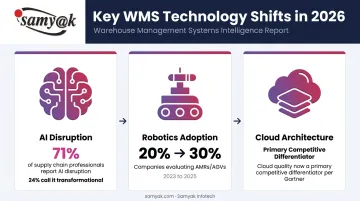
The five platforms reviewed below were evaluated against all three of these criteria.
Best Warehouse Management Systems in 2026
These five platforms were selected based on:
- Market recognition (Gartner Magic Quadrant placements)
- Technological capability and native AI features
- Scalability across mid-market and enterprise operations
- ERP integration depth and deployment flexibility
Blue Yonder Warehouse Management
Blue Yonder is a supply chain execution platform with approximately 6,000 employees and 3,000+ customers spanning global retailers, manufacturers, and distributors. It was named a Leader in the 2026 Gartner Magic Quadrant for WMS.
What sets it apart is the depth of its execution scope — from yard management and inbound receiving through micro-fulfillment and outbound shipping, all within a single AI-embedded platform. Blue Yonder's official WMS page claims 100% inventory visibility and accuracy, a 50% throughput increase, and a 50% reduction in fulfillment, storage, and handling costs.
| Dimension | Detail |
|---|---|
| Key Features | System-directed activities, embedded AI intelligence, yard and inbound management, outbound optimization, unified labor and automation management |
| Deployment | Cloud-native SaaS; integrates with ERP, TMS, and automation systems |
| Best For | Large enterprises and global distribution networks requiring end-to-end supply chain execution |
SAP Extended Warehouse Management (EWM)
SAP, founded in 1972 with over 111,000 employees worldwide, built EWM as the warehouse execution module within its broader supply chain portfolio. It serves multinational manufacturers, distributors, and logistics providers already running the SAP ecosystem.
The core advantage is integration depth. SAP EWM connects directly with SAP S/4HANA, creating a single source of truth across finance, procurement, and logistics without data translation layers. SAP's official EWM page confirms benefits including reduced inventory and labor costs, improved process and stock transparency, and better space utilization — though SAP does not publish specific percentage benchmarks publicly.
EWM also supports advanced put-away strategies, slotting optimization, RFID, voice-directed workflows, and digital process automation.
| Dimension | Detail |
|---|---|
| Key Features | Advanced put-away and picking strategies, slotting optimization, labor management, yard management, RFID and voice support, digital process automation |
| Deployment | Cloud (SAP Business Technology Platform) and on-premise; tightly integrated with SAP ERP |
| Best For | Enterprises already running SAP ERP seeking deep WMS-ERP unification and high-volume, complex logistics |
Oracle Warehouse Management Cloud
Oracle, founded in 1977 with approximately 162,000 employees, delivers its WMS as part of Oracle Fusion Cloud — serving retail, manufacturing, and third-party logistics providers globally. Oracle was named a Leader in the 2024 Gartner Magic Quadrant for WMS for the ninth consecutive year.
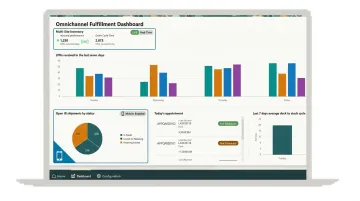
Oracle WMS Cloud's practical strength is its ability to turn any site into a fulfillment hub. It provides complete inventory visibility from distribution centers down to individual store shelves — critical for omnichannel retailers managing inventory across dozens of locations.
Its mobile-enabled workflows, real-time analytics, and complex order management make it a strong fit for businesses where fulfillment complexity is the primary challenge.
| Dimension | Detail |
|---|---|
| Key Features | Omnichannel fulfillment, complex order management, material and inventory tracking for manufacturing, mobile-enabled workflows, real-time analytics |
| Deployment | Cloud-first (Oracle Fusion Cloud); integrates with Oracle ERP and third-party systems |
| Best For | Mid-to-large retailers, manufacturers, and 3PLs managing multi-site or omnichannel fulfillment complexity |
Manhattan Active Warehouse Management
Manhattan Associates, founded in 1990 with approximately 4,370 employees, has been named a Leader in the 2026 Gartner Magic Quadrant for WMS — its 18th consecutive recognition in that ranking.
Manhattan Active WMS takes a different architectural approach from most competitors: it unifies labor management and warehouse execution in a single application rather than integrating two separate systems. Workers receive real-time performance feedback and task direction within the same tool supervisors use for operational visibility. The continuous cloud delivery model means the software updates automatically — no versioned upgrades, no scheduled downtime for releases.
| Dimension | Detail |
|---|---|
| Key Features | Unified labor and WMS in one app, demand-driven replenishment, real-time supervisor visibility, task interleaving, embedded performance feedback |
| Deployment | Cloud-native with continuous delivery; no versioned upgrade cycle |
| Best For | Enterprises prioritising workforce productivity, real-time operational control, and seamless labor-WMS unification |
Infor WMS
Infor, founded in 2002 with 17,000+ employees, positions its WMS as a tier-1 cloud system with native AI capabilities and 3D warehouse visualization. It was named a Leader in the 2026 Gartner Magic Quadrant for WMS.
The standout capability is accuracy. Infor's official WMS page states users can achieve over 99% order accuracy at bin level, supported by native voice processing for hands-free workflows and 3D warehouse visualization for layout planning and slotting decisions. All three capabilities are built into the core platform, which reduces integration complexity for mid-market teams without large IT departments.
| Dimension | Detail |
|---|---|
| Key Features | AI-powered analytics, 3D warehouse visualization, voice processing, receiving/put-away/pick/pack/ship workflows, dynamic replenishment, labor productivity tools |
| Deployment | Cloud-based SaaS; integrates with ERPs and supply chain platforms |
| Best For | Mid-to-large distribution and manufacturing operations seeking AI-embedded execution with strong labor management tools |
How We Chose the Best Warehouse Management Systems
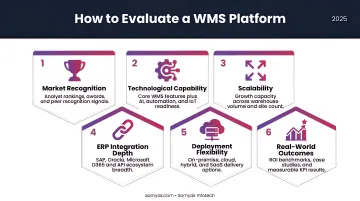
These systems were evaluated across six dimensions:
- Market recognition — Gartner Magic Quadrant and Critical Capabilities positioning
- Technological capability — AI features, automation support, mobile-first design
- Scalability — single-site to global multi-warehouse operations
- ERP and supply chain integration depth — native connectors vs. custom middleware requirements
- Deployment flexibility — cloud, on-premise, and hybrid options
- Real-world customer outcomes — published results and independent reviews
One mistake buyers consistently make: selecting a WMS based on brand reputation or the longest feature list rather than operational fit. A platform that's excellent for a global retailer with 50 DCs may be over-engineered and costly to implement for a manufacturer running two sites.
When Off-the-Shelf Isn't the Right Answer
The right WMS depends on warehouse scale, existing tech stack, automation roadmap, and budget. Standard platforms fall short for businesses with highly specialized workflows, industry-specific compliance requirements, or integration environments that packaged software can't accommodate without costly customization.
For those situations, a custom-built WMS is worth serious consideration. Samyak Infotech has over 20 years of experience building real-time logistics and warehouse software — including WareManage and EaseLogix, which handle guided picking workflows, real-time inventory visibility, multi-location management, and supply chain integrations. The result is a system built around your operations, not the other way around.
Conclusion
The best WMS in 2026 is the one that fits your warehouse scale, integration environment, workforce model, and growth trajectory — not simply the most feature-rich option on the market. Choosing based on brand alone often produces over-engineered deployments that teams never fully adopt.
Before shortlisting any platform, pressure-test it against your real requirements:
- Does it integrate with your existing ERP without heavy custom development?
- Can it scale to your next warehouse, channel, or geography within 18–24 months?
- What does the full three-year total cost of ownership look like, including implementation and training?
If none of the leading platforms match your operational reality, or if you're dealing with specialized logistics requirements, unique compliance workflows, or integration environments that packaged solutions can't address, Samyak Infotech builds custom warehouse management software tailored to your specific workflows. With over 20 years of experience developing logistics software for Fortune 100 companies, the team designs and delivers WMS solutions built around how your operation actually runs.
Reach out to discuss your requirements
Frequently Asked Questions
Which software is best for warehouse management?
The right choice depends on your scale and integration needs. Blue Yonder and Manhattan Active lead for large enterprises, Oracle and SAP EWM suit complex multi-site operations, and Infor WMS fits mid-market teams wanting AI-embedded workflows. Businesses with unique requirements may get better long-term value from a custom-built system.
What is the difference between a WMS and an ERP system?
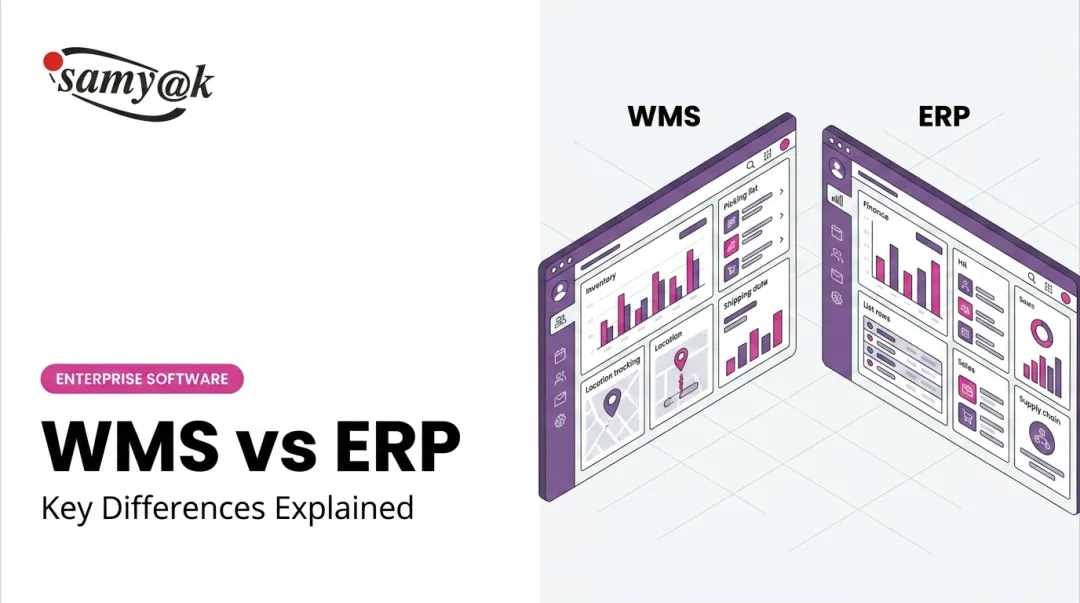
A WMS controls physical warehouse execution in real time — directing picking, packing, put-away, and shipping. An ERP manages broader business processes like finance, procurement, and HR. Most enterprises run both in an integrated setup, where the WMS handles floor-level operations and feeds transactional data back into the ERP.
How much does a warehouse management system cost?
Cloud WMS pricing varies widely by scale. Basic packages start around $100–$300/month for small operations; enterprise systems range from $50,000 to over $2 million in the first year, depending on complexity and user count. Implementation services typically add significant cost on top of licensing fees.
What is the difference between cloud-based and on-premise WMS?
Cloud WMS offers lower upfront costs, automatic updates, and minimal IT overhead — making it the default choice for most new deployments. On-premise WMS gives organizations greater control over data and deeper customization options, but requires internal infrastructure investment and ongoing maintenance resources.
What are the most important WMS features to look for in 2026?
Focus on real-time inventory visibility, mobile barcode scanning, AI-powered picking and labour management, ERP and TMS integration, and support for robotics and automation. In 2026, AI-augmented labour planning and omnichannel fulfillment capabilities have shifted from differentiators to baseline expectations for competitive warehouse operations.
When should a business consider a custom WMS instead of an off-the-shelf solution?
Custom WMS development makes sense when standard platforms require extensive modification to fit your workflows, compliance requirements, or integration environment — and that customization cost rivals the build cost. Custom builds also suit businesses that want full system ownership and long-term flexibility without vendor lock-in or dependency on a platform's release cycle.