Introduction
Startups face a hiring paradox: you need senior technical talent now, but you can't commit to a $133,080 median salary, a 60–90 day recruitment cycle, or a headcount that survives your next funding round. Every week a critical role sits vacant, your sprint slips.
Every bad hire costs you at least 30% of that developer's first-year earnings, according to U.S. Department of Labor estimates cited by Forbes — plus the runway you burned while they ramped up.
IT staff augmentation solves this directly. Instead of hiring, you plug pre-vetted developers into your existing workflows on flexible contracts, while the vendor handles recruitment, compliance, and payroll. Top vendors can reduce time-to-placement from the 47–49 day median reported by CIO Dive for engineering roles down to 48 hours to two weeks.
The model is growing fast. According to QYResearch, the global IT staff augmentation market was valued at $992M in 2023 and is projected to reach $1.398B by 2030 — a 5.1% CAGR. This guide evaluates five vendors across criteria that matter most to startups: placement speed, contract flexibility, talent vetting depth, and pricing transparency.
Key Takeaways
- IT staff augmentation lets startups add external developers under their own management — faster and cheaper than traditional hiring.
- Top vendors place pre-vetted developers in 48 hours to 2 weeks; traditional engineering hiring takes 47–49 days on average.
- Evaluate vendors on vetting rigor, time-to-placement, contract flexibility, and startup-relevant track record — hourly rate alone is a poor filter.
- Samyak Infotech, Toptal, X-Team, Turing, and BairesDev each suit different startup budgets and technical needs.
- Rigid long-term contracts and missing replacement guarantees are red flags, particularly for seed and Series A teams.
Why IT Staff Augmentation Works Especially Well for Startups
IT staff augmentation means adding external developers directly to your existing team on a contract basis — you manage the work, the vendor manages the employment. It's distinct from project outsourcing, where a vendor owns delivery, and from full-time hiring, where you own the overhead.
Why the Model Fits the Startup Context
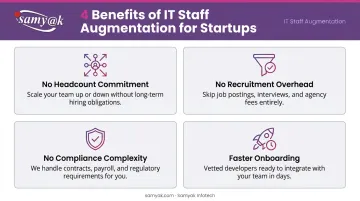
Startups don't operate on predictable hiring cycles. A product pivot might mean you need two React developers next week and none the month after. An MVP deadline doesn't wait for a 90-day recruitment process. Staff augmentation matches that reality:
- No long-term headcount commitment — scale up for a sprint, scale down after launch
- No recruitment overhead — the vendor screens, interviews, and background-checks candidates before you see them
- No compliance complexity — payroll, taxes, and employment law stay on the vendor's side
- Faster onboarding — pre-vetted developers integrate more quickly than new hires
Speed is where this model earns its place. Engineering roles take nearly 50 days to fill through traditional hiring — a staff augmentation vendor that delivers in under two weeks lets you ship on schedule instead of burning another month of runway.
The shortlist below evaluates vendors on the criteria that matter most to startups: onboarding speed, contract flexibility, technical depth, and experience with lean, fast-moving teams.
Best IT Staff Augmentation Vendors for Startups in 2026
These vendors were evaluated for startup relevance — specifically their onboarding speed, pricing transparency, technical depth, contract flexibility, and track record with smaller, fast-moving teams.
Samyak Infotech
Founded in 2001 and headquartered in Ahmedabad, India, Samyak Infotech is a Microsoft Silver Certified Partner (top 5%) and ISO 9001-certified firm with over 25 years of experience serving 150+ clients globally — including Fortune 100 companies. Their staff augmentation service gives startups access to pre-vetted developers across custom software, AI/ML, IoT, mobile, and full-stack development.
For early-to-growth-stage startups, the case for Samyak comes down to institutional stability paired with offshore cost efficiency. Unlike newer staffing agencies, Samyak brings two decades of delivery process maturity — which reduces onboarding friction and lowers the risk of miscommunication across time zones.
Their 100% Job Success rating on Upwork and 5-star ratings on Clutch and GoodFirms reflect consistent outcomes across fintech, healthcare, logistics, and retail. Augmented developers follow your sprint cadence — joining planning sessions and daily standups — rather than functioning as disconnected outside hires.
| Criteria | Details |
|---|---|
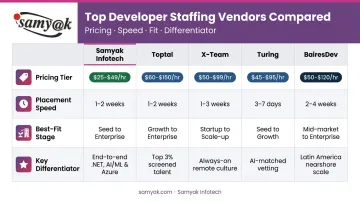
| Key Tech Specializations | Custom software, AI/ML, IoT, Blockchain, mobile app development, logistics software, full-stack web development |
| Engagement Model & Pricing | Flexible hourly and monthly models; startup-friendly contract terms; competitive India-based offshore pricing |
| Best Fit For | Early-to-growth-stage startups in fintech, healthcare, retail, logistics, or manufacturing needing a reliable, certified development partner |

Toptal
Founded in 2010, Toptal is a global freelance talent network that accepts fewer than 3% of applicants — screening more than 100,000 candidates per year through a multi-stage technical funnel. Startups use it to access senior developers, designers, and product managers on demand.
Toptal's main differentiator is screening depth. Their vetting process runs four stages with progressively tighter pass rates, meaning whoever you hire has cleared a genuinely rigorous bar. Clients report matching with candidates in under 48 hours, and a no-risk trial period reduces the cost of a poor fit. The tradeoff is price — Clutch lists Toptal at $100–$149/hr with a $50,000+ minimum project size, which prices out pre-seed teams.
| Criteria | Details |
|---|---|
| Key Tech Specializations | Full-stack development, React, Node.js, Python, Java, product management, UX/UI design |
| Engagement Model & Pricing | $100–$149/hr (Clutch); flexible project-based or monthly engagements; no-risk trial period |
| Best Fit For | Well-funded startups that need elite, immediately productive senior developers for high-stakes product work |
X-Team
X-Team was founded in 2006 as a fully remote staff augmentation company. Their model embeds developers long-term into client teams, with each developer working exclusively on one client engagement at a time. X-Team reports a 98% developer retention rate, corroborated by a Slack customer case study.
For startups building complex, long-running products, developer continuity matters more than most people realize. When a developer who knows your codebase leaves, the cost isn't just recruiting — it's weeks of knowledge transfer and context-rebuilding for their replacement. X-Team's single-client focus per developer and strong retention rate directly reduce that risk. Their developers follow your sprint cadence and participate in team rituals, operating more like embedded team members than contractors.
| Criteria | Details |
|---|---|
| Key Tech Specializations | Full-stack, mobile, DevOps, cloud, React, Node.js, Python; strong in gaming, fintech, media, SaaS |
| Engagement Model & Pricing | $50–$99/hr (Clutch); long-term embedded model; minimum engagement periods apply |
| Best Fit For | Startups building complex, long-running products where developer continuity and cultural fit are critical |
Turing
Turing is a US-based AI-powered talent platform founded in 2018. They maintain a network of 4M+ pre-vetted engineers globally and advertise developer placement within 3–5 days. Clutch lists them at $50–$99/hr with a 5.0/5 rating across four reviews.
Turing's growing focus on AI/ML and agentic engineering roles sets them apart from most staffing vendors in this space. Their vetting covers both technical skills and async communication ability — a practical screen for distributed teams. The $50,000+ minimum budget reported on Clutch may exclude very early-stage teams, but for Series A startups running AI-integrated products, Turing's talent pool is worth the threshold.
| Criteria | Details |
|---|---|
| Key Tech Specializations | Python, TypeScript, Java, C#, React, Node.js, AI/ML, cloud infrastructure, LLM integration |
| Engagement Model & Pricing | $50–$99/hr (Clutch); full-time and part-time models; minimum budget $50,000+ |
| Best Fit For | Tech-forward startups needing AI-capable developers or rapid team deployment for product sprints |
BairesDev
BairesDev was founded in 2009 in Buenos Aires and fields 4,000+ engineers across Latin America. They vet 2.5M+ candidates per year to identify what they describe as the top 1% of tech talent — and their real-time timezone overlap with US-based teams solves the async collaboration problem that offshore vendors often create.
The Pinterest case study is the most concrete evidence of their startup-to-scale capability: BairesDev placed 5 developers into Pinterest's in-house team in under two weeks, eventually scaling that engagement to 233 engineers.
That range — from a 5-person augmentation to a full squad — reflects genuine flexibility. For US-based startups where daily standups and real-time code reviews are non-negotiable, the nearshore model removes the friction that makes offshore augmentation difficult to sustain.
| Criteria | Details |
|---|---|
| Key Tech Specializations | Full-stack, mobile, AI, data engineering, React, Node.js, Python, Java; strong in digital transformation |
| Engagement Model & Pricing | $50–$99/hr (Clutch); dedicated team and staff augmentation models; scalable from single developer to full squads |
| Best Fit For | US-based startups that need real-time collaboration with cost savings, especially for product launches and scaling sprints |
How to Evaluate IT Staff Augmentation Vendors as a Startup
Most startups make one of three mistakes: choosing on price alone, ignoring contract lock-in terms, or picking vendors with no experience in their industry vertical. Here's what actually matters.
Vetting Rigor and Time-to-Placement
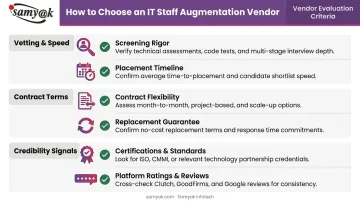
The gap between vendors is wide. Toptal runs a multi-stage technical funnel with a sub-3% acceptance rate. Turing matches in 3–5 days using AI-driven screening that assesses async communication alongside technical skills. Compare that to vendors who do little more than CV reviews — and it's clear why screening depth matters more than raw placement speed.
For startups, time-to-placement often determines whether a sprint ships or slips. Ask vendors to walk you through their screening process — not just describe it in a sales deck.
Contract Flexibility
Rigid, multi-year contracts are a red flag for any startup. The vendors worth working with offer:
- Rolling monthly contracts with no long-term lock-in
- The ability to scale headcount up or down without penalty
- A trial period or replacement guarantee if the initial match isn't right
- Clear terms on what happens if a developer becomes unavailable mid-engagement
Certifications and Platform Ratings
Flashy marketing doesn't translate to reliable delivery. When evaluating credentials, focus on signals that are harder to fake:
- Verified platform ratings on Clutch, GoodFirms, or Upwork
- Industry certifications such as ISO 9001 (quality management) or CMMI (process maturity)
- Client testimonials from companies at a comparable stage to yours
A vendor with 25 years of delivery history, ISO certification, and a 100% Upwork Job Success score is a lower-risk choice than a newer entrant competing on price alone.
Conclusion
Choosing the right IT staff augmentation vendor directly affects how fast your team ships, how well the work holds up, and how smoothly new engineers plug into your existing stack. Ground that choice in your current stage, technical requirements, budget, and how much management bandwidth you can realistically give to onboarding and oversight.
Don't optimize purely for the lowest hourly rate. A vendor with verifiable client outcomes, relevant certifications, and cross-industry delivery experience will reliably outperform a cheaper alternative — especially once onboarding friction and rework costs factor in. Treat scalability and startup fit as first-class evaluation criteria, not afterthoughts.
Samyak Infotech has spent over 25 years helping businesses ranging from early-stage startups to Fortune 100 companies build scalable software with flexible, ISO 9001-certified development teams. If you're looking to extend your engineering capacity without committing to full-time headcount, reach out to Samyak Infotech to explore how their staff augmentation model fits your roadmap.
Frequently Asked Questions
What is IT staff augmentation and how does it work for startups?
Staff augmentation lets startups add external developers to their existing team on a contract basis, keeping project control in-house while the vendor manages hiring, payroll, and compliance. It's faster and more flexible than traditional hiring: vendors handle recruitment, and you direct the work from day one.
How much does IT staff augmentation cost for startups?
Rates vary by region and vendor. Offshore India-based vendors are typically the most affordable, nearshore LATAM providers fall in the middle, and US-based onshore talent costs the most. Compare total engagement cost, not just the hourly rate, since timeline and management overhead matter too.
What is the difference between IT staff augmentation and outsourcing?
With staff augmentation, external developers join your team and work under your direction. With outsourcing, a vendor owns the delivery and manages the outcome independently. Startups with a defined tech stack and clear requirements benefit more from augmentation, which preserves control while removing hiring overhead.
How quickly can a startup onboard augmented IT staff?
Top vendors like Toptal place candidates in under 48 hours; Turing advertises 3–5 days; BairesDev integrated developers into Pinterest's team in under two weeks. Traditional engineering hiring takes 47–49 days by comparison. Onboarding speed depends heavily on how precisely you define the role requirements upfront.
What should startups look for when choosing an IT staff augmentation vendor?
Prioritize these five criteria when evaluating vendors:
- Developer vetting rigor and screening depth
- Time-to-placement and availability of matching talent
- Contract flexibility with no long-term lock-ins
- Replacement guarantees if a placement underperforms
- Startup or industry-vertical experience
Verified ratings on Clutch, GoodFirms, or Upwork are more reliable signals than marketing claims.
Is IT staff augmentation better than hiring full-time developers for startups?
For most startups in uncertain or high-growth phases, yes — augmentation reduces overhead, eliminates recruitment delays, and lets you scale without permanent headcount risk. That said, core team members and long-term architectural roles are still best filled with full-time hires who have equity-level commitment to the product.