A Transportation Management System (TMS) solves this by centralising everything: planning, execution, carrier management, and visibility — in one platform. This article explains what a TMS is, how it works, which features matter most, who benefits from it, and how to decide between off-the-shelf and custom solutions.
Key Takeaways
- A TMS centralises the planning, execution, and visibility of freight movement across all transport modes
- It reduces freight costs through load consolidation, carrier rate optimisation, and automated billing
- TMS integrates with ERP and WMS systems to form a complete logistics technology stack
- Cloud-based SaaS models have made TMS accessible to mid-size businesses, not just large enterprises
- AI, IoT, and machine learning are reshaping what modern TMS platforms can do
What Is a Transportation Management System?
A Transportation Management System is a logistics software platform that helps businesses plan, execute, and optimize the physical movement of goods — inbound and outbound — across land, air, and sea. It automates tasks like carrier selection and freight billing, provides real-time shipment visibility, and keeps compliance documentation accurate and audit-ready.
TMS doesn't operate in isolation. It sits within a broader supply chain technology ecosystem:
- ERP handles accounting, order management, and business financials
- WMS manages inventory, fulfillment, and warehouse operations
- TMS manages everything that happens between facilities — carrier selection, routing, freight tracking, and delivery
Together, these three systems form a complete logistics infrastructure. In practice, most enterprise logistics operations rely on all three running in parallel, with TMS serving as the connective layer between warehouse and final delivery.
From Enterprise-Only to Broadly Accessible
Historically, TMS was only viable for large enterprises spending over $100 million annually on freight. The technology was expensive, demanded significant IT infrastructure investment, and implementations often stretched across many months. Cloud-based SaaS models changed that — today, businesses spending as little as $5–10 million per year on freight can justify and afford a TMS.
The market reflects this broader adoption. According to MarketsandMarkets, the global TMS market was valued at $15.92 billion in 2024 and is forecast to reach $37.04 billion by 2030, growing at a 14.9% CAGR.
Deployment Models
| Model | Key Characteristics |
|---|---|
| Cloud-based (SaaS) | Faster deployment, lower upfront cost, automatic updates, remote access |
| On-premises | Greater IT control, higher infrastructure overhead, longer implementation timeline |
Most new deployments today are cloud-based. On-premises implementations remain common in large enterprises with strict data governance requirements or deeply customised workflows.
How Does a TMS Work?
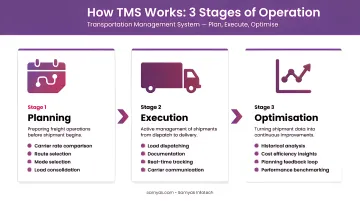
A TMS operates across three stages:
- Planning — Compares carrier rates, selects optimal routes, chooses the right transport mode (truck, rail, air, ocean), and consolidates loads where possible
- Execution — Dispatches loads, generates shipping documentation, tracks shipments in real time, and manages carrier communications
- Optimisation — Analyses historical performance data, identifies cost and service inefficiencies, and feeds insights back into future planning cycles
Core Features of a Transportation Management System
TMS platforms vary in complexity, but certain capabilities are standard across any system worth evaluating.
Transportation Planning and Route Optimisation
This is where a TMS delivers some of its most direct value. The system automatically compares carrier rates and selects the most cost-effective, time-efficient routing for each shipment — accounting for:
- Real-time traffic and transit-time data
- Multi-leg and multi-stop route configurations
- Load consolidation opportunities to reduce underutilised truck space
- Mode selection (for example, switching from air to ocean freight when lead times allow)
ARC Advisory research found that more than one-third of TMS users achieved freight savings exceeding 12%, with load consolidation, mode selection, and multi-stop optimisation as the primary drivers.
Freight and Carrier Management
A TMS maintains a structured database of carrier information — rates, service areas, transit history, and performance scores. When a shipment needs to be tendered, the system matches it to the best available carrier automatically rather than relying on a dispatcher's memory or a rate sheet PDF.
Additional features typically include:
- Automated freight billing and invoice matching
- Contract and rate agreement management
- Carrier scorecarding and performance benchmarking
- Electronic tendering and acceptance workflows
Real-Time Tracking and Visibility
20% of shippers currently have visibility across all regions and transport modes, according to research from project44. That gap is costly — the same research showed 47% of respondents experiencing monthly cargo losses of $5,000 or more.
A TMS addresses this directly by providing continuous track-and-trace across every shipment, every carrier, and every mode. That visibility serves two audiences:
- Internal teams — logistics managers can spot delays before they escalate and re-route proactively
- Customers — real-time delivery status updates reduce inbound enquiries and improve experience
Reporting, Analytics, and Dashboards
TMS dashboards surface the metrics that logistics managers actually need: on-time delivery rates, freight cost per shipment, carrier performance scores, and route efficiency trends. Rather than pulling data from multiple carrier portals and spreadsheets, everything pulls together in one view.
These insights help identify chronic bottlenecks — a carrier that consistently runs late on a specific lane, for example — and enable faster, data-backed decisions on carrier strategy.
Compliance and Documentation Management
For businesses managing cross-border shipments, compliance is a genuine operational risk. A TMS automates trade documentation — import/export records, customs forms, certificates of origin, freight audit trails — reducing the chance of regulatory penalties or shipment holds at customs.
With customs rules tightening across major trade corridors, errors in documentation carry real costs: delayed freight, fines, and damaged supplier relationships.
Benefits of Using a Transportation Management System
Cost Reduction
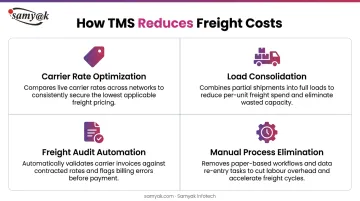
Freight costs are typically one of the largest variable expenses in a supply chain. A TMS attacks those costs from multiple angles:
- Carrier rate optimization — automatically selecting the lowest qualifying rate for each shipment
- Load consolidation — combining smaller shipments to avoid sending trucks out partially loaded
- Freight audit automation — catching billing errors and duplicate charges before payment
- Manual process elimination — reducing the administrative hours spent on booking, invoicing, and carrier communication
Oracle's benchmarks indicate companies can achieve 8% or more in freight cost savings through TMS adoption. In managed transportation arrangements with TMS, ARC Advisory found 32% of respondents achieved savings of 12% or greater.
Improved Visibility and Fewer Surprises
The difference between a TMS and a spreadsheet-based operation becomes clearest during disruptions. When a carrier runs late, a TMS surfaces the issue early — before the delivery window is missed — giving logistics teams time to re-route or communicate proactively with customers. Instead of fielding "where is my shipment?" calls, teams are resolving exceptions before customers notice them.
Higher Customer Satisfaction
Customer expectations around delivery have shifted permanently. Average US parcel delivery times dropped from 6.6 days in 2020 to 4.2 days in 2023 — a 40% acceleration, according to McKinsey research. That pace has reset expectations across B2B logistics, not just consumer e-commerce.
A TMS supports that expectation directly: accurate ETAs, proactive delay notifications, and real-time tracking reduce friction at every delivery touchpoint.
Operational Efficiency and Scalability
Automated workflows — load tendering, dispatch scheduling, invoice processing, carrier communication — free logistics teams from administrative overhead. The practical result: a business can handle higher shipment volumes without proportionally increasing headcount.
Key operational gains include:
- Faster load tendering through automated carrier matching
- Reduced invoice processing time with straight-through payment workflows
- Lower error rates in dispatch scheduling versus manual coordination
For growing companies, that scalability is the most compelling argument for TMS investment.
Who Uses a Transportation Management System?
TMS serves a broad range of businesses and internal roles.
Business types that commonly deploy TMS:
- Manufacturers managing inbound raw materials and outbound finished goods
- Retailers and ecommerce companies coordinating last-mile and middle-mile logistics
- Third-party logistics (3PL) providers managing freight on behalf of multiple clients
- Freight brokers and logistics service providers
- Distributors managing regional or national delivery networks
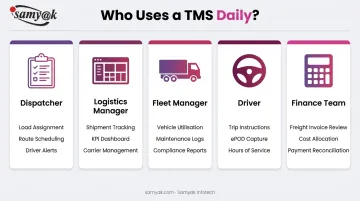
Internal stakeholders who use TMS daily:
- Dispatchers: handle load planning and carrier tendering modules
- Logistics managers: monitor KPI dashboards and carrier performance
- Fleet managers: track vehicle utilization and route adherence
- Drivers: access route guidance and documentation through mobile apps
- Finance teams: manage billing through freight audit and settlement features
Gartner notes that TMS is deployed across industries including automotive, consumer packaged goods, retail, food and beverage, chemicals, life sciences, and aerospace. The 3PL segment represents the largest end-user category by market share.
Cloud-based SaaS models have also brought TMS within reach of small and mid-size businesses, making it far more accessible than it was even a decade ago.
Custom TMS vs. Off-the-Shelf: Finding the Right Fit
There are two main paths when adopting a TMS.
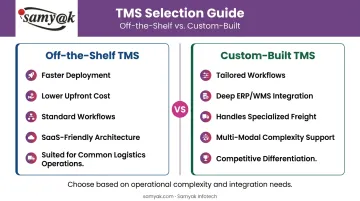
Off-the-shelf platforms like SAP Transportation Management, Oracle OTM, and Blue Yonder TMS offer comprehensive feature sets out of the box. They're well-suited for businesses with relatively standard logistics workflows that align with the platform's existing configuration options. Implementation is faster and IT overhead is lower — particularly with SaaS deployments.
Custom-built TMS solutions are developed to match a company's exact operational workflows, carrier relationships, compliance requirements, and integration architecture. They take longer and cost more upfront, but eliminate the process compromises that often come with adapting operations to fit a generic platform.
When Custom Makes More Sense
A custom TMS is worth serious consideration when:
- Your logistics workflows involve specialized freight types (temperature-controlled, liquid bulk, hazardous materials)
- You need deep integration with a proprietary ERP or WMS that off-the-shelf connectors don't fully support
- Multi-modal, multi-region, or multi-currency complexity exceeds what packaged solutions handle cleanly
- Competitive differentiation through proprietary technology is part of your strategy
Samyak Infotech has over 20 years of experience building custom logistics and transportation software for clients including Carisbrooke Shipping, MNX, and Ship Network. The team's work spans route optimization, freight management, fleet tracking, and supply chain automation — with documented outcomes including a $10 million profit increase within six months for one global shipping client through logistics automation and reduced manual intervention.
For businesses whose operations don't fit neatly into an off-the-shelf platform, a custom-built solution designed around your specific workflows delivers stronger long-term ROI.
How Emerging Technologies Are Evolving TMS
AI and Machine Learning
AI is changing what TMS can do beyond rule-based automation. Oracle Transportation Management uses machine learning for transit-time prediction and ETA accuracy. Blue Yonder's TMS includes a Logistics Ops Agent that automates carrier sourcing and planning decisions. Broader applications include:
- Carrier selection based on historical performance, not just posted rates
- Predictive exception management — flagging likely delays before they occur
- Demand forecasting to align transportation capacity with shipment volumes
- Automated freight auditing that catches billing discrepancies without manual review
IoT and Real-Time Sensor Data
IoT adoption in shipment tracking more than doubled — from 25% in 2023 to 53% in 2024 — reflecting rapid investment in real-time cargo monitoring. IoT sensors on vehicles and containers enable continuous visibility into location, temperature, and equipment condition. For cold chain logistics, pharmaceuticals, and high-value freight, in-transit environmental monitoring is shifting from a nice-to-have to an operational requirement.
Advanced Analytics and Blockchain
Advanced analytics allow logistics teams to run predictive simulations, modeling how a weather event, port disruption, or fuel price spike would affect their delivery network. Blockchain creates tamper-proof, transparent records of shipment handoffs across multi-party supply chains, though enterprise-scale TMS adoption remains early-stage.
Frequently Asked Questions
What is a TMS system?
A TMS (Transportation Management System) is software that helps businesses plan, execute, and optimize the physical movement of goods. It automates carrier selection, route planning, freight billing, and shipment tracking — replacing manual processes with a centralised, data-driven platform.
How much do TMS systems cost?
Cloud-based SaaS TMS platforms for smaller businesses start from roughly $70–$150 per user per month, while team-based plans from providers like Descartes Aljex begin around $699/month. Enterprise platforms like SAP TM and Oracle OTM don't publish pricing publicly — costs scale with shipment volume, modules, and customization requirements.
What is the difference between a TMS and a WMS?
A TMS manages the movement of goods between locations — carrier selection, routing, and freight tracking. A WMS manages operations inside a warehouse — inventory, storage, and order fulfillment. Both systems are complementary and frequently integrated.
Is a TMS the same as an ERP?
No. An ERP handles broad business functions including finance, HR, and order management. A TMS focuses specifically on transportation and logistics operations. Most businesses integrate TMS with their existing ERP rather than treating them as alternatives.
Who benefits most from a transportation management system?
Any business that ships or receives goods regularly benefits — manufacturers, retailers, ecommerce companies, 3PLs, and freight brokers. Internally, dispatchers, logistics managers, fleet managers, and drivers all rely on different TMS modules as part of their daily workflow.
Can a TMS be customised to fit a specific business's needs?
Yes. Custom TMS solutions can be built to match unique workflows, carrier relationships, compliance requirements, and integration needs. Businesses with complex logistics — multi-modal freight, temperature-controlled supply chains, or specialized carrier agreements — often find a purpose-built platform fits far better than forcing processes into an off-the-shelf product.