
Introduction
E-commerce order volumes aren't slowing down. U.S. retail e-commerce hit $326.7 billion in Q1 2026 alone, representing 16.9% of total retail sales — and warehouses are absorbing every bit of that pressure. Shorter delivery windows, higher SKU counts, and manual scanning processes that simply can't keep pace are creating real financial exposure.
The cost of poor inventory accuracy is measurable. IHL Group projected worldwide inventory distortion at $1.7 trillion in 2024, driven by $1.2 trillion in out-of-stocks and $554 billion in overstocks. Much of that distortion traces directly back to inaccurate, point-in-time data from manual processes.
RFID warehouse management addresses this by replacing periodic, manual scanning with continuous, automated item tracking. This article covers how RFID works end-to-end, how it compares to barcodes, its core operational benefits, tag types, implementation challenges, and a practical rollout plan.
Key Takeaways
- RFID reads hundreds of items simultaneously without line-of-sight, while barcodes require one-at-a-time manual scanning
- RFID raises item-level inventory accuracy from ~63% to over 95% (GS1 US)
- Cuts cycle count time from days to ~2 hours for 10,000 items
- UHF passive tags are the warehouse standard: long read range, bulk scanning capability, and cost-effective at scale
- The integration layer — connecting RFID data to your WMS or ERP — is where most implementation complexity lives
What Is RFID Warehouse Management and How Does It Work?
RFID (Radio Frequency Identification) uses radio waves to automatically identify and capture data from tagged items — no direct line-of-sight required. Compare that to barcode scanning, where a worker must physically aim a scanner at each label individually. In a warehouse processing thousands of items per shift, that gap translates directly into labour hours saved and errors avoided.
The end-to-end workflow runs like this:
- Tagged item enters the facility — every item carries an RFID tag with a unique identifier encoded on its microchip
- RFID readers detect the signal — fixed readers at dock doors or handheld units in pick zones emit radio waves that trigger nearby tags to respond
- Reader sends data to a central system — the captured tag ID routes instantly to the WMS or database
- Inventory records refresh in real time — stock levels, locations, and movement history update automatically, with no manual entry
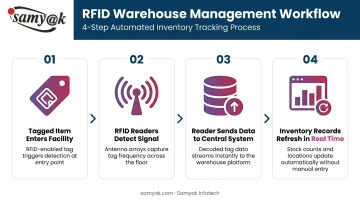
The entire cycle happens in milliseconds, continuously, across every tagged item in range.
Core Components of an RFID Warehouse System
Four hardware and software layers work together to make this possible:
| Component | Function |
|---|---|
| RFID Tags | Microchip + antenna storing unique item data |
| RFID Readers | Fixed (dock doors, pick zones) or handheld; emit radio waves to interrogate tags |
| Antennas | Extend read range, enabling bulk scanning from meters away |
| Middleware/Software | Syncs with the WMS, generates alerts, and powers real-time dashboards |
Readers continuously emit radio waves. Tags within range respond with their encoded data. The software layer processes that data and routes it to the correct inventory records — which means inventory accuracy no longer depends on scheduled counts or manual scans.
RFID vs. Traditional Barcode Systems
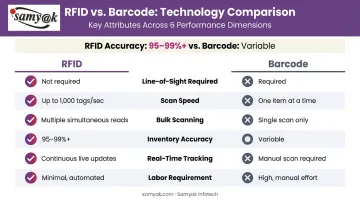
The operational gap between RFID and barcodes becomes most visible at scale. Three differences drive most of the performance contrast:
- RFID reads through packaging, around corners, and across pallets — no line-of-sight needed. Barcodes require direct scanner contact with each visible label.
- A single RFID reader pass captures hundreds of items simultaneously. Barcodes are scanned one at a time.
- RFID updates inventory continuously as items move. Barcodes only capture data at the moment of scanning.
| Feature | RFID | Barcode |
|---|---|---|
| Line-of-sight required | No | Yes |
| Scan speed | Hundreds simultaneously | One at a time |
| Bulk scanning | Yes | No |
| Inventory accuracy | 95–99%+ | Variable, manual-dependent |
| Real-time tracking | Continuous | Point-in-time |
| Labor requirement | Low (automated) | High (manual) |
The Accuracy Gap
According to GS1 US, RFID can raise item-level inventory accuracy from an average of 63% to over 95%. A retail supply chain study from the Auburn University RFID Lab and GS1 US found that without RFID, 69% of inbound orders contained errors in picking, shipping, or receiving — and RFID-enabled reconciliation brought order accuracy to 99.9%.
In a high-volume warehouse processing thousands of transactions daily, even a small per-scan error rate compounds quickly. The accuracy gap isn't just a quality issue; it feeds into customer complaints, demand forecasting errors, and costly rework.
The Cost Trade-Off
RFID carries a higher upfront investment than barcodes. The return comes from labor savings, fewer errors, reduced shrinkage, and faster throughput — making it more cost-effective at scale. For smaller warehouses with low SKU counts and simple workflows, barcodes remain the pragmatic choice. For operations handling high volumes across multiple zones, RFID typically pays for itself.
Key Benefits of RFID in Warehouse Management
Real-Time Inventory Visibility
RFID gives managers a continuously updated view of what's in stock, where every item sits, and what's moving. That eliminates the blind spots that cause both stockouts and overstock accumulation. GS1 US reports RFID can reduce retail out-of-stocks by up to 50% — a direct result of having accurate, current data driving replenishment decisions rather than stale cycle count snapshots.
Dramatic Accuracy Improvements
Automated scanning removes the human error variable. With inventory accuracy climbing from the 63% baseline to 95%+, the downstream effects are significant:
- Fewer order fulfillment errors and customer complaints
- Cleaner data for demand forecasting and purchasing decisions
- Reduced returns processing costs
- More reliable safety stock calculations
Faster Cycle Counts and Picking
A University of Arkansas study on Bloomingdale's item-level RFID implementation found that scanning 10,000 items took just 2 hours — a 96% reduction in cycle-counting time compared to conventional methods. Modern Materials Handling reported that Christie Lights cut a warehouse check-in task from 32 man-hours to just 2 after deploying RFID.
RFID-guided location data accelerates picking as well. Workers see exact item locations on their devices rather than searching aisles by memory or paper lists.
Labor Cost Reduction
Check-ins, check-outs, cycle counts, and zone tracking all become largely automatic with RFID in place. UPS scaled this across more than 1,000 distribution sites, eliminating 20 million manual scans per day. The same team can process higher volumes without adding headcount.
Shrinkage Control and Security
Every item movement is traceable. Unauthorized exits from a zone trigger immediate system alerts, making theft and misplacement far harder to hide. A study in the International Journal of Production Economics found RFID reduced shrinkage by 67% at the manufacturer level and 47% at the retailer level.
Types of RFID Tags for Warehouses
The Three Primary Tag Types
Passive tags — powered entirely by the reader's electromagnetic field. No internal battery, shorter read range, lower cost. The standard choice for high-volume inventory tracking where tags are applied to every item.
Active tags — battery-powered, with read ranges exceeding 100 meters. The higher cost is justified when tracking large or high-value assets like forklifts, equipment, or returnable containers.
Semi-passive (battery-assisted) tags — carry an internal battery but still require reader activation to transmit. Moderate cost with better performance in harsh conditions — well-suited for temperature-sensitive goods or environments with metal and liquid interference.
Frequency Ranges and Warehouse Relevance
| Frequency | Range | Warehouse Use Case |
|---|---|---|
| LF (125–134 kHz) | Short | Resistant to metal/liquid; animal tracking, access control |
| HF (13.56 MHz) | Medium | Contactless cards, pharmaceutical tracking |
| UHF (860–960 MHz) | Long (10m+) | Inventory tracking, bulk scanning, dock doors |
UHF passive tags — also known as RAIN RFID — are the dominant standard for warehouse inventory. The RAIN Alliance reported 52.8 billion RAIN tag chips shipped globally in 2024, reflecting just how broadly this format has been adopted across supply chains. GS1 confirms UHF passive tags support unique item identification at distances exceeding 10 meters with simultaneous multi-tag reading.
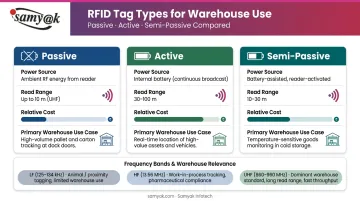
Choosing the right tag comes down to four factors: warehouse environment (metal shelving, liquids, temperature extremes), product type, required read range, and budget. For general warehouse inventory, UHF passive tags are the right default choice for most operations.
Challenges of RFID Warehouse Management (and How to Address Them)
Upfront Cost and ROI Timeline
RFID infrastructure — hardware, software, tags, installation, and system integration — represents a real initial investment. UHF RFID readers alone run from $500 to $2,000 per unit, with antennas adding $200 or more each. A full warehouse deployment covering multiple dock doors and pick zones will involve hardware, software licensing, tag costs (multiplied by SKU count), and integration development.
The ROI case is built on labor savings, accuracy gains, and shrinkage reduction accumulating over time. Starting with a pilot — one zone, one dock door, or one product category — limits initial spend while validating the system before full commitment.
Technical and Environmental Interference
Metal shelving, liquids, and dense packaging can disrupt RFID signal read rates. This is not a dealbreaker, but it requires planning:
- Conduct a site survey before deployment to map interference sources
- Select on-metal or specialized tags for metal-heavy environments
- Position readers and antennas strategically to compensate for signal gaps
Integration and Change Management
Connecting RFID hardware to an existing WMS or ERP is where most implementation complexity lives. Legacy systems often lack native RFID connectors, requiring custom middleware or API development to bridge the gap. Staff also need training on new scanning workflows, dashboards, and exception handling procedures.
A development partner with logistics software experience can shorten this process considerably. Samyak Infotech has spent over 20 years building end-to-end logistics and warehouse software for clients including Fortune 100 companies. Their integration work covers IoT device connectivity, real-time data processing, and ERP/CRM/TMS connectivity — built to fit existing systems rather than replace them.
How to Implement an RFID Warehouse Management System
Step 1 — Assess and Plan
Start with an operational audit. Map current inventory flows, identify high-error zones, and define success metrics upfront: inventory accuracy targets, cycle count time reductions, and labor savings goals. Without clear benchmarks, measuring ROI later becomes difficult.
Step 2 — Select Hardware and Tags
Let your warehouse environment and product types drive tag selection. Key decisions:
- Passive vs. active tags based on item value and required read range
- UHF frequency readers for general inventory
- Fixed readers at dock doors and high-traffic zones, supplemented by handhelds for flexibility
- Antenna placement to achieve full zone coverage
Step 3 — Integrate With Your WMS or ERP
RFID data only creates value when it flows into your management systems — updating inventory records, triggering replenishment alerts, and feeding dashboards in real time. For operations running legacy WMS or ERP platforms, this integration layer often requires custom middleware and data pipeline development.
Samyak Infotech builds exactly this kind of integration: connecting RFID reader output to backend WMS and ERP systems through real-time sync architecture and custom APIs. With over 20 years of logistics software experience serving clients like Carisbrooke Shipping, MNX, and Ship Network, the team understands the data flow complexity these environments demand.
Step 4 — Pilot, Test, and Train
Deploy in one zone first. Validate read accuracy rates, confirm inventory record updates are correct, and identify any interference issues before expanding. Train staff on:
- New scanning procedures and exception workflows
- Dashboard navigation and alert handling
- How to flag and resolve read discrepancies
Step 5 — Scale and Optimize
Once the pilot is validated, expand zone by zone. Monitor read rates and accuracy metrics continuously. System performance tends to improve as antenna placement is refined and staff becomes comfortable with new workflows. The long-term ROI compounds as the system absorbs higher volumes without proportional labor increases.
Frequently Asked Questions
How much does an RFID warehouse management system cost?
Hardware costs alone — readers at $500–$2,000 each, antennas at $200+, plus tags — range from tens of thousands for a small setup to well over $100,000 for a large multi-zone facility. Total cost depends on warehouse size, read zone count, tag volume, and integration complexity. Starting with a single-zone or dock-door pilot is the most practical way to manage upfront spend.
How do you implement an RFID warehouse management system?
Implementation typically follows five phases: operations assessment, hardware selection, WMS/ERP integration, pilot testing with staff training, and zone-by-zone rollout. The integration phase is usually the most complex step, often requiring custom development work — particularly when connecting to legacy systems.
Can an RFID warehouse management system be used for inventory management?
Yes — inventory management is its primary purpose. RFID enables real-time stock visibility, automated cycle counts, and accurate location tracking across all inventory movements, replacing periodic manual counts with continuous automated updates.
Which type of RFID tags are best for warehouses?
UHF passive tags are the most widely used for general warehouse inventory. They offer long read ranges (10+ meters), support bulk simultaneous scanning, and are cost-effective at high volumes. Active tags suit high-value asset tracking; semi-passive tags work best in harsh or temperature-variable environments.
What is the difference between RFID and barcodes in warehouse management?
RFID requires no line-of-sight, reads hundreds of tags simultaneously, and provides continuous real-time tracking. Barcodes require one-at-a-time manual scanning and capture only point-in-time data at the moment of scan.
What are the biggest challenges of implementing RFID in a warehouse?
The three main challenges are upfront investment cost, signal interference from metal shelving and liquids, and the complexity of integrating RFID with existing WMS or ERP systems. All three are manageable with proper site planning, correct tag selection, and an experienced implementation partner.