Introduction: Why Manufacturing Plants Can't Afford to Ignore Predictive Maintenance
Unplanned equipment failures don't just halt production — they erode margins, disrupt delivery schedules, and burn out maintenance teams scrambling to respond. For most manufacturing facilities, this is still the daily reality.
According to NIST, preventable maintenance issues cost U.S. discrete manufacturers an estimated $119.1 billion in 2016 alone — including $18.1 billion from downtime and over $100 billion in lost sales from production delays and defects. Facilities relying heavily on reactive maintenance experienced 3.3 times more downtime and 16 times more defects than those using predictive approaches.
Closing that gap doesn't require more headcount or larger maintenance budgets — it requires software that acts on equipment condition data before failures occur.
This guide covers what predictive maintenance software is, how it works at a technical level, the core benefits manufacturers can realistically expect, the features that matter most, and how to choose between off-the-shelf and custom-built solutions — including a practical four-step implementation framework.
TLDR: Quick Takeaways
- PdM software combines IoT sensor data, AI/ML analytics, and CMMS workflows to predict failures before they interrupt production
- It outperforms both reactive (fix-on-failure) and time-based preventive maintenance by acting on actual asset condition
- Core sensor inputs include vibration, thermal, and acoustic data — analyzed continuously, not periodically
- Manufacturers using PdM report 15% less downtime, 87% lower defect rates, and 66% fewer inventory increases from unplanned maintenance (NIST)
- Choosing between off-the-shelf and custom-built PdM software depends on your equipment complexity and integration needs
What Is Predictive Maintenance Software for Manufacturing?
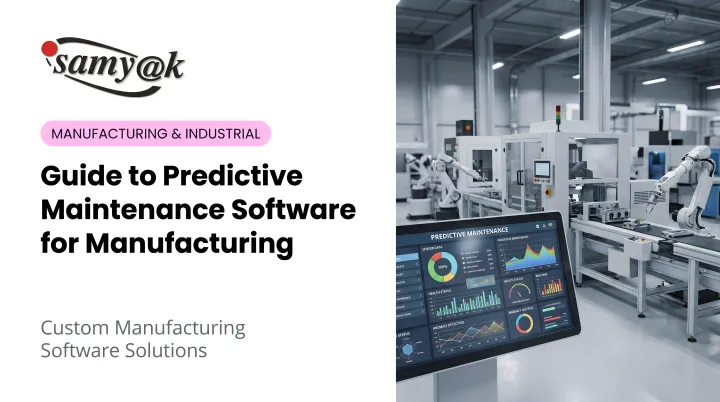
Predictive maintenance (PdM) software is a system that combines continuous condition monitoring — powered by industrial IoT sensors — with maintenance management workflows. It detects developing equipment faults — often weeks before failure — and issues corrective action automatically, before production is interrupted.
That last part matters. A basic CMMS manages work orders and maintenance schedules, but it requires humans to interpret data and decide when to act. PdM software closes that gap: it interprets the signals, prioritizes the response, and delivers a structured work order to the right technician automatically.
Maintenance Types at a Glance: TBM, CBM, and PdM
Understanding where PdM sits within the broader maintenance strategy spectrum clarifies why it delivers better outcomes than the alternatives:
| Strategy | How It Works | Core Limitation |
|---|---|---|
| Reactive (Run-to-Failure) | Fix equipment after it breaks | Maximum disruption; highest emergency repair costs |
| Time-Based Maintenance (TBM) | Service on fixed intervals regardless of condition | Over-maintenance wastes resources; failures can still occur between intervals |
| Condition-Based Maintenance (CBM) | Maintain when sensor readings cross a threshold | Reactive to threshold breaches, not predictive of when failure will occur |
| Predictive Maintenance (PdM) | AI forecasts when failure is likely; triggers action in advance | Highest implementation complexity, but highest return |
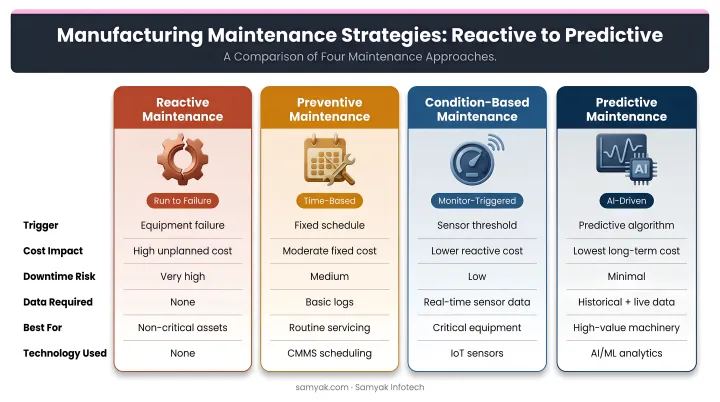
Where CBM reacts when a sensor crosses a threshold, PdM forecasts the trajectory of asset degradation and schedules maintenance during a planned window — before the failure materializes. The difference is the shift from alarm-response to advance planning.
A NIST manufacturing survey found that facilities using predictive maintenance for just 17.3% of their maintenance activity reported measurably lower unplanned downtime and repair costs compared to plants dominated by reactive approaches. Most manufacturing operations fall well below that threshold — which is precisely where the ROI case for PdM begins.
How Predictive Maintenance Software Works: Core Technologies
PdM software draws from three primary data sources:
- Sensor/condition data — real-time readings from IoT-connected equipment
- Operational data — runtime hours, cycle counts, load profiles
- Historical maintenance records — past failures, repair outcomes, parts consumption
The strongest systems unify all three rather than analyzing them in isolation. Condition data without historical context produces too many false alerts. Historical records without real-time monitoring miss developing faults entirely.
Sensor Technologies That Feed PdM Systems
The main sensor types used in manufacturing PdM environments:
- Vibration analysis — detects imbalance, misalignment, and bearing wear in rotating equipment by measuring frequency, displacement, velocity, and acceleration (using piezoelectric sensors)
- Infrared/thermal imaging — identifies abnormal heat signatures indicating friction, airflow problems, overloaded breakers, or faulty insulation in process pipes
- Acoustic/ultrasonic analysis — captures sound frequencies above 20 kHz, detecting lubrication deficiencies, developing bearing faults, and compressed air leaks invisible to standard inspection
- Motor current signature analysis — monitors electrical current and voltage patterns in induction motors to detect winding faults and rotor bar issues without physical contact
IoT connectivity enables these sensors to stream data continuously to a centralized cloud or on-premise platform — replacing periodic manual inspections with always-on monitoring. Deloitte's 2025 Smart Manufacturing survey found 46% of manufacturers have already deployed IIoT solutions, with adoption continuing to accelerate.
That scale of sensor deployment generates enormous volumes of data — more than any team can manually review. This is where AI and machine learning become essential.
The Role of AI and Machine Learning in PdM
Raw sensor data means little without interpretation. AI/ML algorithms turn that data into actionable alerts:
- Baseline learning — models establish what "normal" looks like for each specific asset under its typical operating conditions
- Anomaly detection — statistical deviations from baseline trigger alerts, using supervised, unsupervised, or semi-supervised methods depending on available labeled failure data
- Failure mode identification — the system doesn't just flag "something is wrong" — it identifies the probable failure mode (early bearing degradation, misalignment signature, thermal runaway pattern) and assigns a severity ranking
- Closed-loop execution — confirmed faults automatically generate a structured CMMS work order with diagnostic context, recommended procedures, and parts requirements, routed directly to the right technician
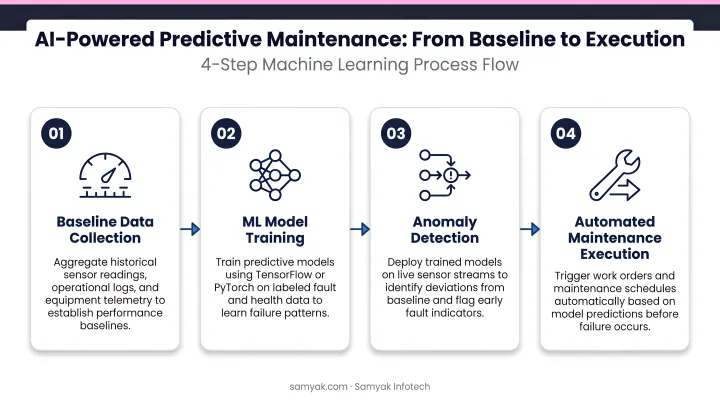
That final step is what separates true PdM software from monitoring dashboards. Without automated execution, detection still requires manual handoffs — and those delays eat into the efficiency gains predictive maintenance is designed to deliver.
Benefits of Predictive Maintenance Software for Manufacturing
Reduced Unplanned Downtime
PdM creates an intervention window between early fault detection and actual failure. Maintenance can be scheduled during planned production pauses rather than emergency shutdowns. NIST data shows that higher PdM adoption correlates with 15% less downtime and an 87% lower defect rate compared to facilities dominated by reactive maintenance.
Deloitte's benchmarks confirm this: PdM implementations typically deliver a 5–15% reduction in facility downtime across industrial manufacturers.
Lower Maintenance Costs and Better Resource Allocation
PdM cuts costs from two directions simultaneously:
- Eliminates emergency repair premiums — planned interventions cost significantly less than crisis-mode repairs requiring expedited parts and overtime labor
- Reduces over-maintenance — time-based schedules replace components on fixed intervals regardless of actual wear; PdM replaces them when condition data indicates it's actually needed
NIST found that higher PdM use was also associated with 66% fewer inventory increases caused by unplanned maintenance events — meaning spare parts procurement becomes predictable rather than reactive. Deloitte reports PdM can produce a 5–20% increase in labour productivity as technicians spend time on planned, prepared work rather than reactive troubleshooting.
Extended Equipment Lifetime and Improved Safety
Minor faults that go undetected often cascade. Consider a common example: an unlubricated bearing generates heat, which degrades seals, which causes shaft wear. What starts as a minor lubrication issue ends as a full drivetrain replacement. Catching faults early breaks that chain before it starts.
The safety case is equally concrete. NIST estimated 16 injuries and 0.05 deaths per million employees were tied to maintenance-related incidents in discrete manufacturing. Predicting failures on high-risk assets reduces that exposure significantly. Equipment categories where this matters most:
- Compressors: pressure failures can be violent and sudden
- Conveyors: unexpected stops or jams create entanglement hazards
- Motors: electrical faults and thermal runaway are difficult to detect visually
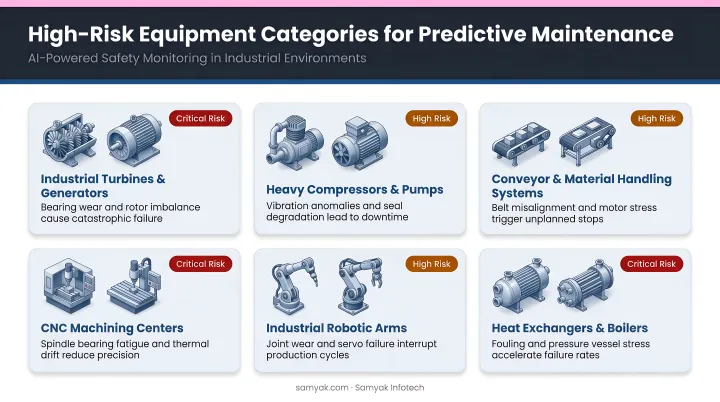
Early detection on any of these reduces the probability of catastrophic breakdowns and limits worker exposure to uncontrolled failure events.
Must-Have Features of Predictive Maintenance Software
The label "predictive maintenance software" covers a wide range of tools — from basic threshold alerting to full AI-driven diagnostics with automated work order execution. These three features separate platforms that genuinely reduce downtime from those that just add complexity:
AI-Powered Diagnostics — Not Just Alerts
The system should identify what is failing, the probable failure mode, severity level, and recommended corrective action. Look for platforms where AI-generated diagnostic context is embedded directly in work orders — not buried in a separate analytics dashboard that requires expert interpretation before anyone can act.
Native CMMS Integration and Automated Work Order Generation
A detected fault that sits in an analytics queue until someone manually acts on it defeats the purpose of predictive maintenance. The software must automatically convert condition alerts into structured, prioritised work orders — with asset history, SOPs, and parts requirements attached. Standalone monitoring tools that require a human to translate alerts into work orders bring back the same response delays PdM is built to remove.
Mobile-First Technician Access
Maintenance happens on the plant floor. The system must support:
- Full work order access on handheld devices, including diagnostic context and step-by-step procedure guidance
- Offline functionality for low-connectivity areas common in industrial facilities
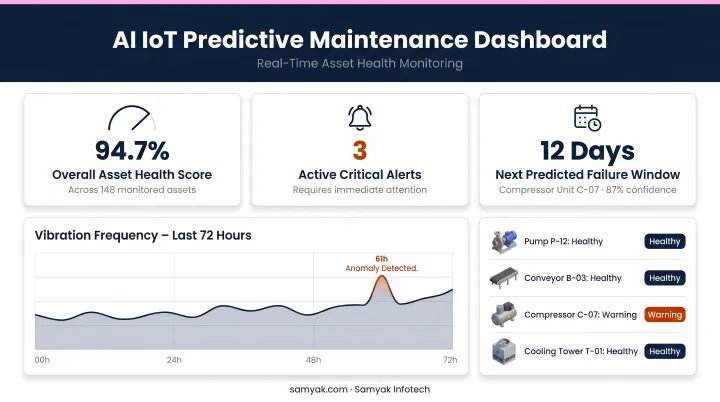
- Real-time dashboards for managers tracking MTTR, MTBF, backlog health, and asset health scores
Choosing the Right PdM Solution: Custom-Built vs. Off-the-Shelf
The right platform depends on the complexity of your equipment, existing workflows, and how deeply the solution needs to integrate with your systems.
Off-the-Shelf Platforms
Enterprise platforms like IBM Maximo, Fiix, Augury, and Tractian offer faster initial deployment, pre-built sensor integrations, and established support ecosystems. They're well-suited for manufacturers with standard equipment types and workflows that fit within the platform's configuration options.
IBM Maximo, for instance, publishes outcomes including 47% unplanned downtime reduction and 17% asset lifespan extension from its APM module. Augury cites a Forrester-calculated 310% ROI across its customer base.
Evaluate these solutions on: sensor compatibility, CMMS integration depth, scalability from pilot to plant-wide, mobile usability, and total cost of ownership — not just license fees.
Custom-Built Solutions
Custom-built predictive maintenance software is the better choice when:
- Equipment configurations are proprietary or non-standard
- Integration with existing ERP/MES systems requires bespoke connectors (for example, SAP RFC/BAPI integrations for production confirmation workflows)
- Multi-site deployments require unified data architectures that generic platforms can't accommodate
- Industry-specific compliance requirements — such as USFDA 21 CFR Part 11 in pharmaceutical manufacturing — impose data integrity constraints that off-the-shelf tools don't satisfy out of the box
Samyak Infotech builds tailored AI and IoT-powered manufacturing software that integrates sensor data pipelines, ML-based anomaly detection, and CMMS workflows into a single system aligned to specific operational requirements. For one manufacturing client, their ML-driven predictive analytics solution delivered a 40% reduction in unplanned downtime and a 25% increase in productivity — outcomes that generic, pre-configured tools frequently can't match in complex environments.
Key Evaluation Criteria — Regardless of Approach
| Criterion | What to Assess |
|---|---|
| Data integration flexibility | Can it connect to your existing sensors and enterprise systems? |
| AI/ML diagnostic depth | Does it identify failure modes, or just flag anomalies? |
| Mobile usability | Can technicians access and complete work orders on the floor? |
| Scalability | Does it support expansion from a pilot asset group to plant-wide coverage? |
| Vendor support quality | What implementation support, SLAs, and model retraining assistance is included? |
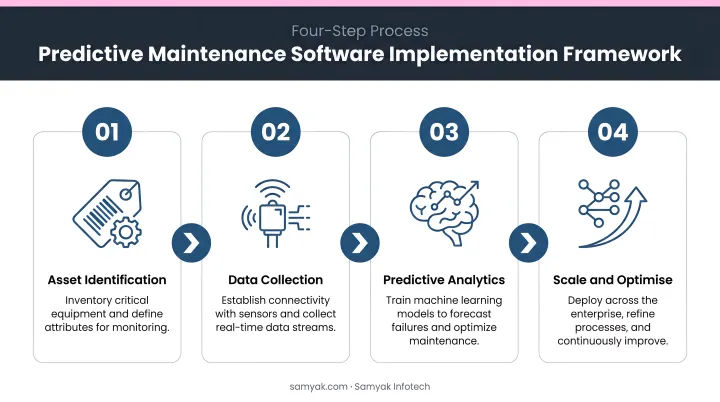
4 Steps to Implement Predictive Maintenance Software in Manufacturing
Step 1: Identify Critical Assets and Establish Baselines
Don't start with every asset. Prioritize equipment whose failure carries the highest production, safety, or cost impact. Document current failure patterns, average repair times, and maintenance costs.
Define the KPIs you'll track so you have a clean baseline to measure improvement against:
- Mean Time to Repair (MTTR)
- Mean Time Between Failures (MTBF)
- Unplanned downtime hours
- PM compliance rate
- Maintenance cost as a percentage of asset replacement value
Step 2: Deploy IoT Sensors and Connect Condition Data
Match sensor types to each asset's likely failure modes:
- Vibration sensors for rotating equipment
- Thermal cameras for electrical systems
- Ultrasonic sensors for bearing and lubrication monitoring
Configure data flows so sensor readings route directly into your PdM platform and CMMS — not into a separate monitoring dashboard requiring manual review. Condition insights only have value when they automatically trigger work orders.
Step 3: Enable Technician Adoption and Workflow Integration
Technology adoption fails when technicians aren't equipped to use it confidently. Train teams on mobile work order execution and on interpreting AI-generated diagnostic guidance. Ensure embedded SOPs are available within each work order so technicians arrive at the job prepared — not troubleshooting from scratch. Plant floor areas with inconsistent connectivity require offline capability as a baseline requirement.
Step 4: Measure Results, Refine, and Scale
Track KPIs against your pre-implementation baseline at regular intervals — monthly for the first six months. Use completion data, false alert rates, and technician feedback to refine alert thresholds and improve work order quality. McKinsey reports that nearly 70% of maintenance transformations fail to deliver desired outcomes — most because they skip the measurement and iteration phase. Document your pilot results rigorously, then use them to build the business case for plant-wide expansion.
Frequently Asked Questions
What is predictive maintenance in manufacturing?
Predictive maintenance is a data-driven approach that uses real-time sensor data and AI analytics to detect developing equipment faults and schedule maintenance before failures occur. Unlike reactive or time-based approaches, it acts on actual asset condition to prevent unplanned production stoppages.
What does predictive maintenance use to predict equipment failures?
PdM systems draw from three data inputs: IoT sensor data (vibration, thermal, acoustic, electrical), operational data (runtime hours, cycle counts), and historical maintenance records. AI/ML models analyze these together to identify patterns that precede specific failure modes.
Can AI be used for predictive maintenance?
AI is central to modern PdM. Machine learning models learn each asset's normal operating baseline, flag anomalies, and pinpoint specific failure signatures — then generate prescriptive work orders automatically. Maintenance teams can act on these insights without needing dedicated data scientists on staff.
What is a CMMS system in manufacturing?
A Computerized Maintenance Management System (CMMS) is software that manages work orders, asset records, maintenance schedules, and spare parts inventory. In a PdM context, the CMMS serves as the execution layer — receiving condition alerts and converting them into structured, actionable maintenance tasks.
What is TBM and CBM in TPM?
In Total Productive Maintenance (TPM), Time-Based Maintenance (TBM) schedules servicing at fixed intervals regardless of actual equipment condition, while Condition-Based Maintenance (CBM) triggers maintenance when sensor readings cross a defined threshold. Predictive maintenance is the AI-enhanced evolution of CBM — it forecasts when failure will occur rather than simply reacting to threshold breaches.
Which tool is commonly used for predictive maintenance?
Common platforms include IBM Maximo for large-scale asset management, Fiix and similar CMMS tools with PdM modules, and dedicated industrial platforms like Augury and Tractian. Manufacturers with proprietary equipment, specific ERP requirements, or compliance constraints often choose custom-built solutions that unify IoT sensors, AI diagnostics, and CMMS workflows in a single system.
A Final Note on Data Capture
None of the above matters if the underlying machine data isn't actually being captured in the first place. Vibration, temperature, and current signals need to be monitored continuously, not just checked periodically, for any AI model to catch a developing fault before it turns into unplanned downtime. See how our Remote Monitoring System works to get that condition data flowing reliably into your predictive maintenance systems.