
Introduction
US businesses are caught between two uncomfortable realities: local software engineering talent is expensive and hard to find, while the pressure to ship faster keeps intensifying. The median US software developer salary hit $133,080 in May 2024, and that figure doesn't include benefits, recruiting costs, or turnover. Offshore development emerged as a direct response to this pressure — a structural shift in how companies build and scale software teams.
The scale of adoption reflects that shift. The global IT services outsourcing market stood at $744.6 billion in 2024 and is projected to reach $1.22 trillion by 2030 at an 8.6% CAGR. At that trajectory, offshore development is now a standard operating model — not an exception.
This guide covers what decision-makers need to evaluate offshore development seriously:
- What offshore development is and how it works
- How it differs from nearshore and onshore models
- The real benefits and common challenges
- Engagement models and how to choose one
- How to vet and select the right partner
- What's shifting in the market right now
Key Takeaways
- Offshore development gives businesses access to global engineering talent at a fraction of local hiring costs
- India leads as the top offshore destination based on talent density, English proficiency, and mature IT infrastructure
- The right engagement model depends on project scope, timeline, and whether you have an existing in-house tech team
- Clear communication protocols, security agreements, and defined KPIs are what separate successful offshore partnerships from costly ones
- Vet certifications, client history, and domain expertise before signing to reduce partnership risk
What Is Offshore Software Development?
Offshore software development means partnering with engineering teams in another country to design, build, test, and maintain software. These teams are typically based in regions with lower labor costs, strong technical education systems, and mature IT sectors — India being one of the most established examples.
Offshore development is not simply outsourcing a one-off task. Offshore teams often function as long-term extensions of a client's internal organization—embedded in workflows, sprint cycles, and product roadmaps—rather than vendors brought in for a single project.
Offshore vs. Nearshore vs. Onshore
The three models differ primarily on geography, cost, and collaboration dynamics:
| Model | Geography | Cost Level | Time Zone Overlap | Example |
|---|---|---|---|---|
| Onshore | Same country | Highest | Full | US company hiring US developers |
| Nearshore | Neighboring/similar time zone | Mid-range | Partial to full | US company working with a team in Mexico |
| Offshore | Distant country | Lowest | Limited, requires planning | US company partnering with a firm in India |
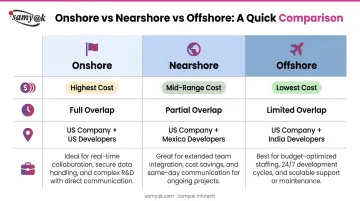
As Deloitte notes, nearshore hubs like Mexico, Colombia, and Brazil offer US companies real-time collaboration with reduced time-zone fatigue. Offshore destinations like India offer broader talent access and deeper cost advantages, but require deliberate communication planning to compensate for the time gap.
Those tradeoffs make the choice less about which model is objectively better and more about fit. Your budget, the complexity of what you're building, and how much real-time collaboration your team needs will point you toward the right answer.
Key Benefits of Offshore Software Development
Cost Efficiency That Goes Beyond Hourly Rates
The salary gap between US and India-based developers is substantial. The US Bureau of Labor Statistics reports the median annual wage for US software developers at $133,080 in May 2024. PayScale data puts the average Indian software engineer salary at approximately ₹815,133—roughly $8,600 at current exchange rates. That's a directional labor cost differential of over 15x.
In practice, you won't capture 15x savings—vendor margins, project management overhead, and tooling add cost. But even accounting for those factors, the savings potential for most US businesses is significant.
Access to Specialized Talent at Scale
India's technology sector generated $254 billion in revenue in FY2024, capturing 57-58% of the global sourcing market. That scale reflects a talent ecosystem mature enough to support niche expertise in AI, machine learning, cloud infrastructure, IoT, and blockchain. These are areas where US hiring pipelines are often thin and expensive.
For businesses that need deep specialization in a specific technology stack, offshore markets frequently offer better options than what's available domestically.
Faster Time-to-Market Through Time Zone Differences
When US teams finish their day, offshore teams in India are starting theirs. Done well, this follow-the-sun approach compresses delivery cycles.
Research on global software development models shows calendar efficiency can rise from roughly 24% in a standard 40-hour week to over 70% in well-structured multi-timezone configurations. That improvement depends heavily on handoff discipline and documentation quality — but the upside is real: faster feature releases and shorter time-to-launch when communication is built to support it.
Scalability Without Permanent Overhead
Hiring domestically means fixed costs: salaries, benefits, office space, and the time investment required to recruit and onboard. Offshore models let you scale capacity up during intensive development phases and down once they're complete, without restructuring your organization.
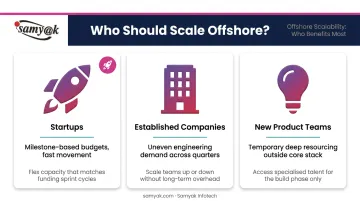
This flexibility matters most for:
- Startups running on milestone-based budgets that need to move fast without locking in headcount
- Established companies managing product roadmaps with uneven engineering demand across quarters
- Teams launching new product lines that require temporary deep resourcing outside their core stack
Internal Teams Stay Focused on Core Priorities
When an offshore partner manages end-to-end development, testing, and maintenance, leadership attention doesn't get pulled into engineering execution. Product strategy, sales, and customer relationships get the focus they need.
Companies with strong in-house teams often choose offshore partners precisely for this reason: offloading execution on a specific product area lets their best people concentrate on the work that drives competitive advantage.
Common Challenges and How to Address Them
Offshore development creates real friction points. Most are manageable with the right structures in place.
Communication and time zone gaps Misalignment compounds quickly when teams operate 8-12 hours apart. Fix this by establishing overlapping work windows, using tools like Slack, Jira, and Zoom, maintaining a shared project wiki, and setting clear async communication norms from the start.
Quality control across distributed teams Code standards vary without strong oversight. Require Agile with regular sprint reviews, enforce code review processes through GitHub or equivalent, and define QA checkpoints before work begins. Ask any prospective partner to describe their dedicated QA team structure before signing.
IP protection and data security IP ownership, data handling, and regulatory compliance (GDPR, HIPAA, CCPA) need explicit legal frameworks—not assumptions. Use NDAs with clearly defined IP ownership clauses, implement role-based access controls, and verify that any partner holds relevant security certifications such as ISO 27001 and SOC 2.
Cultural friction Different expectations around deadlines, communication styles, and feedback can create misunderstandings. Establish shared norms early and invest in occasional team-building—virtual or in-person. Review a partner's existing client testimonials and case studies to gauge how they handle feedback, deadlines, and communication with global teams.
Hidden costs The base development rate is not the total cost. Onboarding, knowledge transfer, rework, and project management overhead all add up. Budget an additional 20–30% above base rates to cover these factors. Always negotiate a detailed Statement of Work (SOW) upfront so scope and cost expectations are locked in before work begins.
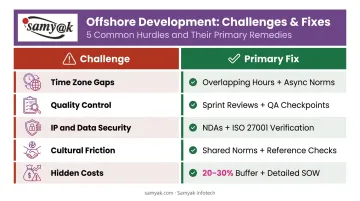
Here's a quick reference for the most common challenges and their primary fixes:
| Challenge | Primary Fix |
|---|---|
| Time zone gaps | Set overlapping hours; use async communication norms |
| Quality control | Sprint reviews, code reviews, defined QA checkpoints |
| IP & data security | NDAs, role-based access, ISO 27001 / SOC 2 verification |
| Cultural friction | Shared norms, team-building, reference checks on past clients |
| Hidden costs | +20–30% budget buffer, detailed SOW before work starts |
Offshore Software Development Engagement Models
Three models cover most offshore arrangements. Choosing the right one depends on your project scope, timeline, and existing team structure.
Dedicated Development Team
A full-time team exclusively assigned to your project for the long term. The offshore partner handles recruitment, HR, and infrastructure.
This model works well when you need consistent team knowledge and continuity across a project. Best suited for:
- Ongoing product development with evolving requirements
- Complex, multi-phase builds that need stable team context
- Businesses that want deep integration with their existing workflows
Project-Based (Fixed Scope) Outsourcing
You define deliverables, timeline, and budget. The offshore vendor owns end-to-end execution. Best suited for well-scoped, bounded projects: building a specific module, delivering an MVP, or completing a defined integration.
The risk here is scope creep. A detailed Statement of Work is what makes this model function — without one, cost and timeline overruns are almost guaranteed.
Staff Augmentation
Individual offshore developers or specialists are embedded into your existing team to fill skill gaps or add capacity temporarily. Ideal for companies with an in-house tech team that needs to scale quickly without restructuring.
The key difference from a dedicated team model: you manage these individuals directly within your own workflow, rather than delegating to an offshore team lead.
How to Choose the Right Offshore Software Development Partner
Evaluate Technical Depth and Domain Experience
Generic capability claims are easy to make. Ask for case studies in your industry, assess experience with your specific tech stack, and request references from past clients in similar sectors. Platforms like Clutch, GoodFirms, and Upwork provide verified client reviews that help validate claims independently.
Check Credentials and Quality Standards
Certifications signal process maturity. Prioritize partners with ISO 9001 (quality management) and ISO 27001 (information security). Technology partnerships—like Microsoft Silver or Gold certification—indicate validated technical competency in specific platforms.
Samyak Infotech, for example, has maintained ISO 9001 certification since 2004, holds Microsoft Silver Certified Partner status (Top 5%), and carries verified recognition from Clutch, GoodFirms, and Upwork. With over 150 clients across logistics, healthcare, manufacturing, and fintech—including Fortune 100 companies—that credential stack reflects what 25 years of consistent delivery actually looks like.
Assess Communication and Project Management Maturity
Ask these questions before signing anything:
- What development methodology do you use?
- What tools manage sprint tracking and progress reporting?
- Who is the dedicated point of contact when issues escalate?
Partners who provide proactive transparency into sprint progress are significantly lower risk than those who only communicate when problems surface.
Start With a Pilot Project
Before committing to a large engagement, assign a well-defined, self-contained task representative of your main project. Use it to assess code quality, communication responsiveness, deadline adherence, and cultural fit. A pilot is inexpensive relative to the cost of discovering problems six months into a full engagement.
Define Legal Protections Before Work Starts
Ensure the contract explicitly covers:
- Scope definition and milestones
- Payment terms and invoicing schedule
- IP ownership (especially for custom-built code)
- NDA clauses and data protection obligations
- Dispute resolution mechanism
Also confirm the partner's jurisdiction and what cross-border enforcement looks like if something goes wrong.
Emerging Trends in Offshore Software Development
Gartner forecasts that 75% of enterprise software engineers will use AI code assistants by 2028, up from less than 10% in early 2023. McKinsey research found developers completed some coding tasks up to twice as fast with generative AI support. Offshore teams integrating these tools are already delivering faster output and lower defect rates—and this advantage will compound as adoption scales.
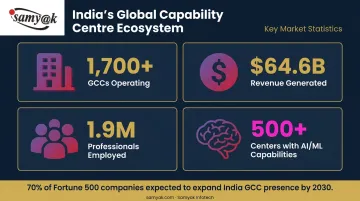
Modern offshore partnerships have also moved well beyond labor cost reduction. India's Global Capability Centre (GCC) ecosystem illustrates this shift directly:
- 1,700+ GCCs operating in India, generating $64.6 billion in revenue
- 1.9 million professionals employed across these centers
- 500+ centers with dedicated AI/ML capabilities
- 70% of Fortune 500 companies expected to expand their India GCC presence by 2030
The goal for most isn't cost-cutting anymore. It's driving core product strategy and R&D from an offshore base.
As data regulations tighten across jurisdictions, offshore vendors are investing in compliance frameworks to meet GDPR, HIPAA, and SOC 2 requirements. For clients, security certifications have moved from "nice to have" to mandatory vetting criteria. Verify your partner's certifications. Don't assume them.
Frequently Asked Questions
What is an offshore software development company?
An offshore software development company is a firm in a different country that partners with businesses to design, build, and maintain software. These companies typically offer cost advantages, access to specialized engineering talent, and scalable engagement models ranging from full project delivery to embedded staff augmentation.
What is the difference between nearshore and offshore software development?
Nearshore means working with teams in neighboring or time-zone-adjacent countries—for US companies, that's typically Mexico, Colombia, or Costa Rica. Offshore refers to more distant regions like India or Eastern Europe. Offshore generally offers greater cost savings, while nearshore offers easier real-time collaboration.
What are the main benefits of offshore software development?
The core benefits are cost efficiency, access to a larger and more specialized global talent pool, faster development through time zone coverage, and the flexibility to scale team size up or down without permanent hiring overhead.
How much does offshore software development typically cost?
India-based developers typically range from $25–$49/hour at the vendor level, according to Clutch's 2024 pricing data. Accelerance research places Asia-based junior developers at $24–$31/hour and senior developers at $31–$41/hour. Factor in project management, QA, and knowledge transfer—these typically add 20–30% above base rates.
How do I protect my intellectual property when working with an offshore team?
Use NDAs, define IP ownership explicitly in the contract, and implement role-based access controls limiting sensitive code exposure. Verify your partner holds recognized security certifications like ISO 27001 or SOC 2, and prioritize vendors in countries with established IP protection frameworks.
Which industries benefit most from offshore software development?
Offshore development is widely used across logistics, healthcare, fintech, retail and e-commerce, manufacturing, and SaaS—any industry with complex software needs and an interest in controlling development costs. Vendors with deep domain experience in your specific sector will consistently outperform generalist shops.