Introduction
Running a freight forwarding operation means coordinating carriers, customs filings, multi-currency billing, and real-time shipment visibility — across time zones. When those workflows depend on spreadsheets, disconnected email threads, and siloed tools, the cracks show quickly: missed filings, delayed documentation, and customers who can't get a straight answer on where their cargo is.
The stakes are real. Only 20% of shippers report satisfaction with the shipment visibility their logistics providers deliver. That gap doesn't just frustrate customers — it drives them to competitors.
The freight forwarding software market reflects this urgency. Global Market Insights valued it at USD 1.5 billion in 2023, projecting growth to USD 3.5 billion by 2032 at roughly 10% CAGR. In 2026, choosing the right platform is a core infrastructure decision with direct consequences for operational capacity and client retention.
This article covers what freight forwarding software actually does, the five leading solutions worth evaluating this year, and the criteria that help you identify the right fit for your operation.
Key Takeaways
- Freight forwarding software centralizes booking, tracking, customs, and billing — replacing disconnected manual workflows.
- The most critical 2026 capabilities: real-time multimodal tracking, automated customs compliance, integrated accounting, and API-based carrier connectivity.
- Top platforms range from enterprise-grade (CargoWise, Descartes) to SMB-friendly SaaS (GoFreight, Logistaas), with the right fit depending on company size and workflow complexity.
- Total cost of ownership matters more than headline pricing: factor in implementation, training, and integration costs.
- Businesses with highly specific workflows often get better long-term ROI from custom-built software than from adapting a generic platform.
What Is Freight Forwarding Software?
Freight forwarding software is a digital platform that consolidates the end-to-end logistics workflow — quoting, booking, shipment tracking, customs documentation, and financial reconciliation — into one unified system. The goal is to eliminate the reliance on spreadsheets, disconnected email chains, and tools that don't talk to each other.
The operational problems it solves are concrete:
- Manual data re-entry across systems creates errors that cascade into billing disputes and compliance gaps
- Lack of real-time visibility across air, ocean, and road shipments leaves customer service teams guessing
- Slow document generation delays customs clearance and increases dwell time costs
- Scaling headcount proportionally with operational volume becomes unsustainable without automation
The category has expanded well beyond its origins as basic transportation management tools. Modern platforms now incorporate AI-driven automation, live carrier integrations via EDI and API, self-service customer portals, and analytics dashboards.
The shift is measurable: eBL users grew from 33% in 2022 to 49.2% by 2024, reflecting an industry actively moving away from paper-based processes.
The practical implication: in 2026, choosing freight forwarding software means choosing between platforms that differ significantly in architecture, compliance depth, and long-term scalability — not just feature lists.
Top Freight Forwarding Software Solutions for 2026
Top Freight Forwarding Software Solutions for 2026
The five platforms below were selected based on market presence, feature depth, scalability, and relevance across different operator sizes — from lean SMBs to multinational 3PLs.
CargoWise
CargoWise is the flagship logistics execution platform from WiseTech Global, and by most measures the dominant choice for large-scale freight forwarding. WiseTech reports serving 17,000+ logistics organizations across 193 countries, including 24 of the top 25 global freight forwarders and 47 of the top 50 3PLs.
Its defining architectural feature is a single global database — one system managing multi-office, multi-country, multi-currency operations without fragmenting data across branches. For multinationals dealing with customs compliance across multiple trade lanes, that consolidation eliminates a class of operational problems that bolt-on tools can't solve.
| Attribute | Detail |
|---|---|
| Key Features | Integrated global compliance management, automated documentation (AWB, BoL), advanced workflow automation, supply chain visibility, multi-entity financial management |
| Best Suited For | Large freight forwarders and 3PLs managing complex multinational operations across multiple transport modes |
| Notable Strength | Single-database global platform eliminating data silos across branches, countries, and currencies |
Third-party ratings: 4.3/5 on G2 (35 reviews), 3.5/5 on Gartner Peer Insights
Magaya Supply Chain
Magaya is a US-based logistics software company offering an integrated suite that spans freight forwarding, warehousing, and trade compliance. It's particularly well-suited for operators who manage both cargo movement and physical inventory — a combination that typically requires two separate systems stitched together with middleware.
What sets Magaya apart is its native WMS module. Receiving, put-away, inventory management, scanning, and warehouse billing are built into the same platform as freight forwarding operations. For mid-to-large forwarders who've outgrown disconnected warehouse tools, that native integration removes a significant source of reconciliation overhead. Magaya reports 2,300+ customers across 100 countries.
| Attribute | Detail |
|---|---|
| Key Features | Automated customs compliance, integrated freight + warehouse management, accounting and billing, mobile WMS app, TMS integration |
| Best Suited For | Mid-to-large freight forwarders that also manage warehousing operations and require deep supply chain automation |
| Notable Strength | One of the few platforms that natively bridges freight forwarding and warehouse management without third-party middleware |
Third-party ratings: 4.4/5 on Capterra (51 reviews)
GoFreight
GoFreight is an AI-powered, cloud-based platform built specifically for freight forwarders and NVOCCs, with usability treated as a core design requirement from the start. It targets small to mid-sized operators who need professional-grade functionality without enterprise-level complexity or implementation timelines.
The practical differentiators: a clean modern interface that reduces onboarding time, integrated security filing for ISF, AMS, AES, and ICS2/ENS workflows directly within the platform, and EDI-based shipment data transmission for ocean import. Vendor-reported implementation typically runs 4 to 8 weeks including configuration, data migration, and training — a meaningful advantage for teams without dedicated IT resources.
| Attribute | Detail |
|---|---|
| Key Features | Import/export shipment management, customer portal with automated status updates, security and customs filing, ocean tracking via EDI, invoicing and reporting |
| Best Suited For | Small to mid-size freight forwarders prioritizing ease of use, fast onboarding, and simplified billing workflows |
| Notable Strength | Intuitive UI with strong automation in billing and customs filing, reducing manual workload for lean teams |
Third-party ratings: 4.6/5 on Capterra (25 reviews)
Logistaas
Logistaas is a cloud-based SaaS TMS with users across 75+ countries, positioned at the intersection of operational depth and genuine usability. It's designed for SMEs scaling their digital operations — companies that need more than a basic system but aren't ready for (or don't need) the complexity of an enterprise platform.
Three differentiators stand out:
- White-label customer portal giving clients real-time shipment visibility without staff fielding status emails
- Direct carrier integrations with CargoFive, WebCargo (real-time air cargo spot rates), and INTTRA (access to 60+ ocean carriers)
- Finance module with local tax compliance in 30+ countries and native integrations with SAP Business One, QuickBooks, and Microsoft Dynamics
Multi-currency and multi-language support make it operationally viable for geographically distributed teams.
| Attribute | Detail |
|---|---|
| Key Features | Quoting and booking, real-time shipment tracking, white-label customer portal, integrated accounting, multi-currency and multi-language support, API-based carrier integrations |
| Best Suited For | SMEs and growing forwarders seeking an agile SaaS platform with fast onboarding and global scalability |
| Notable Strength | White-label customer portal and carrier integrations that reduce administrative communication overhead |
Third-party ratings: 4.5/5 on Software Advice, 4.5/5 on G2
Descartes Systems Group
Descartes is a global logistics technology leader with a particularly strong position in trade compliance and regulatory network connectivity. It serves freight forwarders, transportation providers, and distribution-intensive companies across North America, Europe, the Middle East, Africa, Asia Pacific, and South America.
The platform's Global Logistics Network manages connections, data flow, and inter-enterprise transactions — including regulatory compliance filings across 180+ countries.
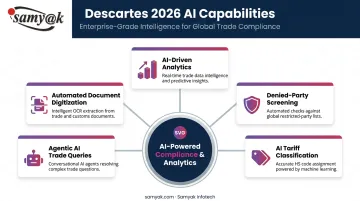
In 2026, Descartes has expanded its AI capabilities meaningfully: AI-driven analytics, denied-party screening with reduced false positives, AI-enabled tariff classification, agentic AI trade queries, and automated conversion of trade documents into digitized customs and security filings. For large enterprises where compliance risk and strategic analytics carry real financial weight, that capability set goes well beyond operational management.
| Attribute | Detail |
|---|---|
| Key Features | Global customs and trade compliance, AI-driven analytics, freight booking and route optimization, carrier and partner connectivity network, transportation management |
| Best Suited For | Large enterprises and multinational freight forwarders requiring robust regulatory compliance and data-driven decision-making at scale |
| Notable Strength | Extensive global compliance network and AI analytics that surface strategic intelligence, not just operational data |
Third-party ratings: Not publicly listed on major review platforms at time of publication
Key Features to Look for in Freight Forwarding Software
Not every platform covers every capability with equal depth. When evaluating options, focus on three areas: operational core functionality, integration depth, and scalability with compliance readiness.
Operational Core
These features directly affect client retention and daily throughput:
- Real-time multimodal tracking across air, ocean, road, and rail — customers expect live visibility, not status emails
- Automated document generation for bills of lading, air waybills, and customs invoices — manual doc prep is a bottleneck at volume
- Self-service customer portal that reduces inbound status inquiries and builds client trust without adding support overhead
Integration Capabilities
A platform's integration depth determines whether it actually eliminates manual work or just moves it:
- Carrier connectivity via EDI and API for automated shipment updates and booking confirmation
- ERP and accounting sync (QuickBooks, SAP, Microsoft Dynamics) to close the gap between operational and financial data
- Customs filing system integration — direct connectivity to filing platforms, not manual CSV exports that require rework
When integrations are fragmented, data re-entry fills the gaps — and that manual overhead compounds quickly at scale.
Scalability and Compliance Readiness
- Multi-branch, multi-currency, multi-language support for operations with growth ambitions beyond a single market
- Regulatory currency — the platform must stay current with international trade regulation changes, not require manual workarounds each time rules shift
- US-specific compliance for transpacific and transatlantic lanes — ISF-10/ISF-5 filings must be submitted electronically through ABI or ACE per CBP requirements
How to Choose the Right Freight Forwarding Software
The Four Evaluation Dimensions
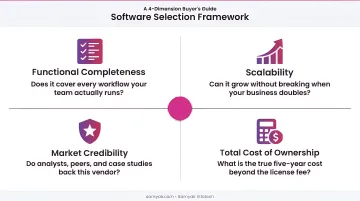
Effective software selection goes beyond feature comparison:
- Functional completeness — Does the platform cover the full freight forwarding lifecycle, or does it require bolt-on tools to fill gaps?
- Scalability — Can it grow from a 5-person team to a multi-branch operation without a platform migration?
- Market credibility — Third-party reviews, real-world adoption signals, and certifications tell you more than vendor marketing
- Total cost of ownership — Implementation, data migration, API/EDI integration, training, and ongoing support costs often dwarf the headline subscription fee
Common Pitfalls to Avoid
Buyers frequently stumble on the same mistakes:
- Choosing based on feature lists without assessing integration depth with their specific carrier and ERP ecosystem
- Underestimating migration complexity when moving from legacy systems or spreadsheets
- Skipping reference checks with customers on similar trade lanes or operational profiles
- Assuming the subscription price reflects actual deployment cost
When Custom-Built Software Makes More Sense
Most SaaS platforms are designed around common workflows. If your operation involves non-standard trade lanes, proprietary carrier relationships, unique compliance requirements, or specialized financial workflows, you may spend more adapting an off-the-shelf tool than building something purpose-built.
That's where purpose-built development changes the equation. Samyak Infotech brings over 20 years of logistics software experience, with clients including Carisbrooke Shipping, MNX, and Ship Network across the freight and maritime sector.
Their custom platform work covers fleet management, real-time tracking, and ERP-integrated workflow automation — built for operations where off-the-shelf products leave critical gaps. For freight businesses with non-standard requirements, a build-vs-buy assessment with a team that knows the sector is a practical starting point.
Conclusion
The right freight forwarding software in 2026 isn't just about digitizing existing processes — it's about building operational advantage through visibility, automation, and the customer experience your clients expect. CargoWise and Descartes serve enterprises with complex multinational needs. GoFreight and Logistaas are strong choices for SMBs that need professional-grade tools without multi-month implementation timelines. Magaya sits in the middle ground for operators managing both freight and warehousing under one roof.
Matching the platform to your company's size, trade lanes, integration ecosystem, and growth roadmap matters more than any individual feature. Before committing, pressure-test vendor support quality, map out the real migration pathway from your current system, and ask how the platform handles regulatory changes and emerging AI capabilities.
Sometimes that evaluation process reveals gaps no packaged solution can close. For logistics businesses whose workflows don't map cleanly onto any off-the-shelf platform — or those building proprietary modules on top of existing infrastructure — Samyak Infotech brings 20+ years of logistics software development experience to that problem. Get in touch for a consultation to explore what a custom-built freight forwarding platform could look like for your specific operations.
Frequently Asked Questions
What is freight forwarding software and what does it do?
Freight forwarding software is a digital platform that manages the end-to-end shipment process : booking, tracking, documentation, customs compliance, and billing — in one system. It replaces manual workflows and siloed tools, reducing errors and giving operations teams and their customers real-time visibility.
What features should I look for in freight forwarding software in 2026?
Focus on real-time multimodal tracking, automated document generation (BoL, AWB, customs invoices), a self-service customer portal, and carrier EDI/API integrations. Customs compliance tools and multi-currency/multi-branch support round out the core requirements. Integration depth with your existing ERP or accounting platform matters as much as the feature list itself.
How much does freight forwarding software cost in 2026?
Pricing ranges from around $35–$55 per user per month for SMB SaaS tools (like Logistaas) to several thousand dollars monthly for enterprise platforms. Total cost should factor in implementation, data migration, API integrations, and training — these costs frequently exceed the annual subscription on larger deployments.
What is the best freight forwarding software for small businesses?
GoFreight and Logistaas are the strongest SMB options. Both offer fast onboarding, customs filing, customer portals, and lower total cost of ownership than enterprise platforms. GoFreight's vendor-reported implementation runs 4–8 weeks, making it a practical choice for lean teams.
Can freight forwarding software be customized to fit specific business needs?
SaaS platforms allow configuration within a fixed architecture, but that has limits. For businesses with non-standard trade lanes, unique compliance workflows, or specific carrier integrations, custom-built software offers full alignment with operational requirements that packaged tools can't match. Firms like Samyak Infotech, with over 20 years building logistics software for global clients, specialize in exactly these scenarios.
How long does it take to implement freight forwarding software?
Lightweight SaaS tools like GoFreight can be live in 4–8 weeks. Enterprise platforms with complex data migrations, multi-branch configurations, and ERP integrations can take several months. Vendors with dedicated onboarding teams significantly reduce time-to-productivity regardless of platform complexity.