Introduction
Most enterprise digital transformation programs begin with ambition and end with disappointment. Gartner's 2024 survey of over 3,000 CIOs and CxOs found that only 48% of digital initiatives meet or exceed their business outcome targets. That means just over half of all enterprise transformation investments fail to deliver what was promised.
The gap rarely comes down to technology. More often, failures trace back to:
- Unclear or shifting strategy before implementation begins
- Underestimated cultural resistance across teams and leadership
- Treating transformation as a one-time project rather than an ongoing capability
This article covers what enterprise digital transformation actually requires: the five pillars that determine whether it succeeds, a phased implementation roadmap, and the most common failure points worth avoiding.
Key Takeaways
- Enterprise digital transformation is a full-business rethink — integrating technology across every function, not just swapping software.
- Five pillars drive success: data-driven insights, tech-enabled operations, digital products, change-positive culture, and clear strategic direction.
- Most transformations fail due to unclear vision, weak leadership, and poor change management — not technology gaps.
- AI, ML, and IoT are the primary accelerators enabling intelligent, adaptive operations at enterprise scale.
- A phased roadmap — from current-state assessment through continuous iteration — measurably improves the odds of sustained success.
What Is Enterprise Digital Transformation?
Enterprise digital transformation is the comprehensive integration of digital technology into every area of a large organization — fundamentally reshaping how it operates, delivers value, and competes. Buying a new CRM or migrating to cloud storage is not transformation. It happens when an organisation redesigns its core processes, decision-making structures, and customer experiences around digital capabilities.
True transformation has two inseparable components:
| Dimension | What It Involves |
|---|---|
| Technical | New systems, automation, AI/ML, cloud infrastructure, and data architecture |
| Organizational | Changed behaviors, workflows, decision-making habits, and cultural norms |
| Strategic | Realigned business models, governance structures, and digital-first priorities |
Enterprise-scale transformation is categorically different from what a startup undertakes. It means coordinating across multiple departments, geographies, hundreds or thousands of employees, and deeply embedded legacy systems. That complexity makes structured methodology non-negotiable. Improvised approaches break down fast in organizations of that scale.
Key Business Benefits of Enterprise Digital Transformation
Operational Efficiency
Automation is where most enterprises see the fastest, most measurable returns. Deloitte's 2022 intelligent automation research found that organizations beyond the piloting stage achieved an average 32% cost reduction — up from 24% just two years earlier. The tools driving these gains include robotic process automation (RPA), ERP systems, and cloud infrastructure that eliminates manual handoffs and reduces human error at scale.
Samyak Infotech's work with a global logistics provider illustrates this concretely: their MuleSoft integration solution produced a 45% improvement in real-time shipment tracking and a 30% reduction in inventory discrepancies — outcomes tied directly to connecting previously siloed legacy systems.
Customer Experience
Digital transformation gives organizations the data infrastructure to stop guessing what customers want. McKinsey research shows that holistic customer-experience transformations can generate a 20% to 30% uplift in customer satisfaction. AI-enabled personalization — real-time next-best-action models, intelligent support routing, behavioural analytics — pushes results further by acting on customer signals the moment they occur.
When organizations connect data across every touchpoint, service gets faster and more relevant — and that directly feeds competitive positioning.
Competitive Positioning
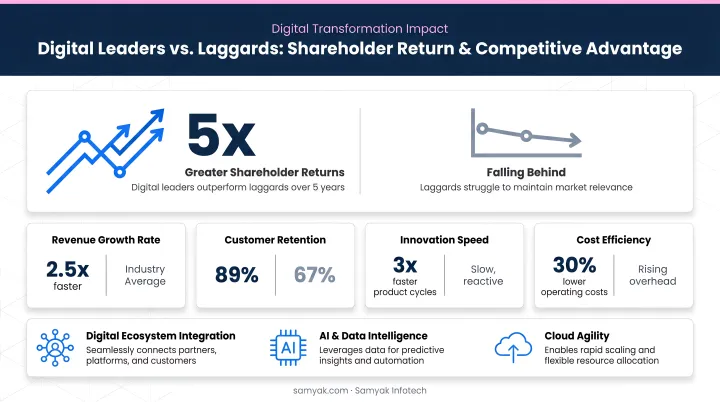
Enterprises that transform build a structural advantage over those that don't. In global banking from 2018 to 2022, digital leaders achieved 8.1% average annual total shareholder return compared to 4.9% for laggards — a compounding gap that widens every year.
The same dynamic plays out in logistics, manufacturing, and healthcare. Digitally mature organizations tend to:
- Scale operations on demand without proportional cost increases
- Respond to market shifts weeks faster than competitors still on legacy systems
- Adopt AI and automation at lower cost, given the integration groundwork already in place
The Five Pillars of Successful Enterprise Digital Transformation
Pillar 1 — Data-Driven Insights
Without a data strategy, automation runs blind. This pillar means integrating data across departments into a single source of truth, establishing North Star KPIs, and building the analytics and AI layers that turn raw information into actionable decisions.
Samyak Infotech approaches this through end-to-end data services: intelligent data pipelines that continuously learn from source systems, data warehousing and ETL processes, and visualization dashboards that surface real-time insights for operational and strategic decisions.
Pillar 2 — Tech-Enabled Operations
This is the operational backbone — re-engineering core business processes through automation, cloud migration, and systems integration. The key word is re-engineering. Buying new software and layering it over broken processes produces expensive broken processes. The work is redesigning how work gets done.
Samyak's process starts with a structured discovery phase: mapping end-to-end workflows, identifying the highest-impact automation opportunities, and engaging stakeholders before a single line of code is written.
Their standard technology stack for enterprise engagements includes:
- Azure DevOps for CI/CD pipelines
- MuleSoft for API-led integration
- Custom AI/ML models built on deep learning frameworks
Each is selected based on the client's specific operational context — not applied as a default template.
Pillar 3 — Digital Products and Services
Customer-facing digital offerings need continuous evolution. Portals, platforms, and mobile applications that felt modern three years ago may already lag competitors. Organizations that treat digital product development as a one-time launch — rather than an ongoing discipline — find themselves falling behind on features, UX, and customer expectations. Each iteration should carry measurable value targets, not just a release date.
Pillar 4 — Change-Positive Culture
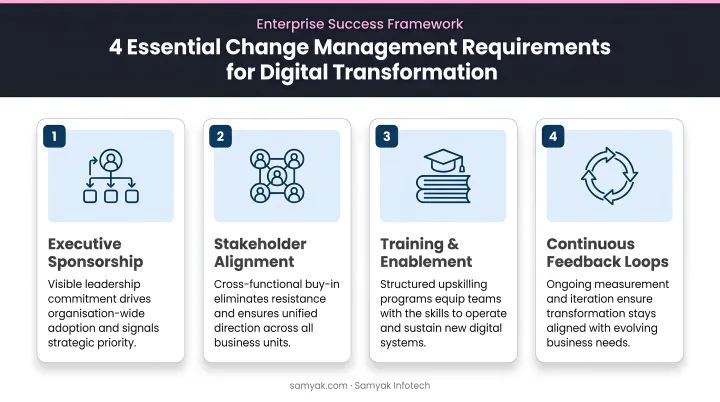
Sustaining that pace of product evolution requires people who are ready and willing to change. Culture is where most transformations fall apart. BCG research found that 90% of unsuccessful digital transformations lacked effective agile leadership, while more than two out of three winning transformations had it. The technology was rarely the differentiator.
Employees resist change when they don't understand why it's happening or lack the skills to operate in a new environment. Overcoming this requires:
- Early stakeholder engagement before decisions are finalised
- Transparent, consistent communication from senior leadership
- Hands-on training tied to specific roles and workflows
- Visible sponsorship from executives throughout the rollout
Pillar 5 — Strategic Direction
All five pillars need a documented strategy tying technology investments to business outcomes. Without one, individual initiatives drift, budgets get spent without coherent progress, and executive confidence erodes.
Strategic direction means selecting an appropriate framework — McKinsey 7S, TOGAF, or a custom architecture — establishing a living roadmap that evolves with the organization, and maintaining executive-level alignment on priorities as conditions change.
Building Your Enterprise Digital Transformation Roadmap
Step 1 — Assess Current State and Define Vision
Before building a roadmap, audit what exists: technology infrastructure, business processes, integration points, and cultural readiness for change. Document the gap between current state and desired future state in specific terms. "We want to be more digital" is not a vision. "We want to reduce order processing time from 48 hours to 4 hours within 18 months" is.
Step 2 — Set KPIs and Prioritize Initiatives
McKinsey groups transformation KPIs into three categories: value creation (operational and financial outcomes), team health (capability and staffing), and change-management progress (adoption rates and tool usage). Establish metrics in all three before any implementation begins. Then prioritize initiatives by impact and feasibility — not by enthusiasm or political visibility.
Step 3 — Select Technologies and Build the Architecture
Technology selection should follow strategy, not precede it. Evaluation criteria to apply consistently:
- Scalability and compatibility with existing legacy systems
- Vendor support quality and long-term roadmap
- Total cost of ownership, not just licensing fees
- Security architecture and compliance requirements
Applying these criteria consistently is harder than listing them — especially when vendor demos are compelling and internal stakeholders push for familiar tools. This is where external guidance pays for itself.
Samyak Infotech begins every engagement with structured discovery sessions to define the business problem before recommending a technology direction. With 25+ years of deployments across logistics, healthcare, manufacturing, and fintech, and Microsoft Silver Certified Partner status, their architecture recommendations reflect what has actually worked in production — not generic frameworks.
Step 4 — Implement in Phases with Change Management
Phased rollouts reduce risk and create early wins that build organizational momentum. Pilot in one department or use case. Measure outcomes. Fix problems before scaling. Each phase should include:
- Clear communication — what's changing, why, and what employees can expect
- Role-specific training — not generic system walkthroughs, but workflows tied to actual jobs
- Active sponsor involvement — visible leadership participation, not delegated to project managers
- User acceptance testing — stakeholders validate solutions against real-world scenarios before go-live
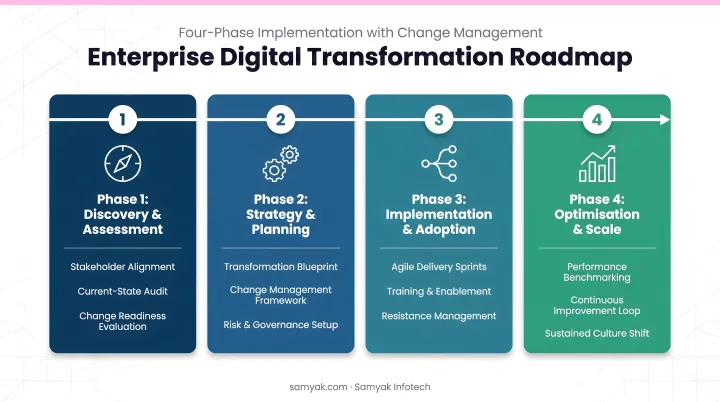
Samyak provides structured change management support, including user training, post-deployment documentation, and feedback loops that track adoption and surface gaps early.
Step 5 — Monitor, Reinforce, and Iterate
Transformation doesn't end at go-live. Top-quartile organisations realise 74% of transformation value within the first 12 months — but only by actively closing adoption gaps and iterating on what's working. Track KPIs against baselines, gather user feedback systematically, and treat every deployment as a learning opportunity.
Post-launch, Samyak's support structure includes performance monitoring, continuous improvement cycles based on operational metrics, and ongoing system enhancements aligned to evolving business needs.
Common Challenges and How to Overcome Them
Resistance to Change and Poor Adoption
BCG found that 70% of digital transformations fall short of objectives — and cultural factors consistently appear among the leading causes. Resistance is rarely irrational. Employees resist when they haven't been included in the conversation, when training is insufficient for their actual role, or when leadership commitment disappears after the launch announcement.
The fix is front-loading stakeholder engagement — not bolting it on after technology decisions are already made. Get people involved before the platform is chosen, not after it's deployed.
Legacy System Integration Complexity
Once people are aligned, the next obstacle is technical: IDC identifies legacy modernization as the number one digital transformation challenge for CIOs. Enterprises carry decades of tightly coupled systems that don't expose clean APIs, don't support modern data formats, and weren't designed for today's integration demands.
A phased integration strategy avoids the disruption of full rip-and-replace. Key approaches include:
- Middleware layers that buffer data locally during outages and sync in order once connectivity restores, eliminating loss risk during migration windows
- API gateways that expose legacy functionality to modern services without rewriting core systems
- Sequenced data migration that moves workloads incrementally, validating integrity at each stage before proceeding
Undefined Success Metrics and Unclear Vision
When there's no shared definition of success, teams pursue conflicting priorities and executive confidence erodes fast. The solution is establishing KPIs before implementation begins — then reporting against them consistently. That means:
- Defining measurable outcomes tied to business goals (cost reduction, cycle time, error rate)
- Setting reporting cadences for both the transformation team and executive sponsors
- Revisiting and adjusting metrics as scope evolves, rather than abandoning them
How AI and Emerging Technologies Accelerate Enterprise Transformation
McKinsey's 2025 AI survey found 88% of organisations now use AI regularly in at least one function — but nearly two-thirds had not yet begun scaling it across the enterprise. That gap between pilots and scale is where most enterprises are stuck.
AI and ML enable a different category of operations than traditional automation:
- Predictive analytics for demand forecasting and supply chain optimisation
- AI-powered decision workflows that adapt based on real-time data rather than fixed rules
- Intelligent customer support with context-aware routing and resolution
- Anomaly detection in financial transactions, manufacturing equipment, and logistics operations
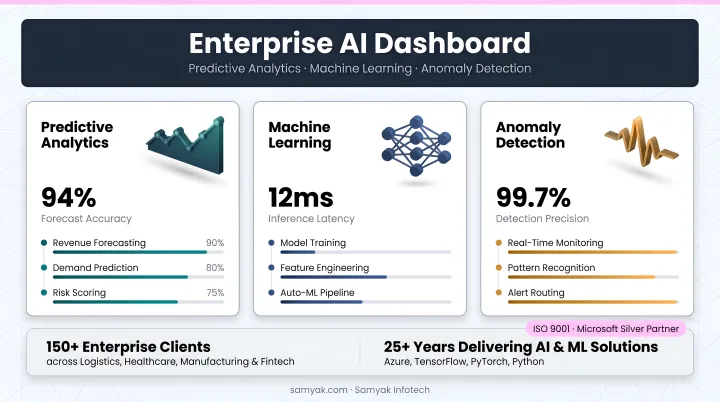
Samyak's predictive maintenance implementation for a manufacturing client demonstrates this practically: their ML solution analysed historical equipment performance data and sensor readings to predict failures before they occurred, producing a 40% reduction in unplanned downtime and a 25% increase in productivity.
IoT extends this intelligence to physical operations. McKinsey projects IoT could generate $5.5 trillion to $12.6 trillion in global economic value by 2030, with B2B applications representing 62–65% of that total. For enterprises in manufacturing, logistics, and field operations, connected devices create operational data streams that turn physical processes into real-time digital intelligence.
Capturing that value, however, depends on more than selecting the right technology. It requires implementation experience across the full stack — from sensor integration and ML model training to enterprise system connectivity. Samyak Infotech's work across AI, ML, and IoT spans 25+ years of enterprise engagements, backed by ISO 9001 certification since 2004 and Microsoft Silver Certified Partner status.
Frequently Asked Questions
What is enterprise digital transformation?
Enterprise digital transformation is the integration of digital technologies into all areas of a large organization to fundamentally change how it operates, delivers value to customers, and competes. It encompasses simultaneous change across process, culture, and technology — not just IT modernisation.
What does an enterprise transformation office do?
An enterprise transformation office (ETO) is a centralised function that governs, coordinates, and accelerates digital transformation initiatives across the organization. It ensures alignment between strategy and execution, manages portfolio priorities, and builds transformation capability company-wide.
How long does enterprise digital transformation typically take?
Meaningful progress in specific departments typically appears within 6–12 months. Comprehensive enterprise-wide transformation spans 2–5 years through iterative phases, though top-performing organizations often realize the bulk of measurable value within the first 12–18 months by staying disciplined around priorities and adoption.
What are the biggest reasons enterprise digital transformations fail?
The leading failure factors are lack of clear vision, insufficient leadership commitment, poor change management, and attempting to transform too many functions simultaneously. Technology limitations are rarely the primary cause.
How do you measure the success of a digital transformation initiative?
Success is tracked through pre-defined KPIs covering value creation (cost reduction, revenue impact, cycle times), workforce readiness (capabilities, staffing), and adoption progress (tool usage, employee proficiency). Establish baselines before implementation so gains are measurable from day one.
How does AI fit into enterprise digital transformation?
AI automates complex workflows, surfaces real-time insights, and powers personalised customer experiences at scale. It allows enterprises to grow operations without proportional headcount increases, shifting decision-making from periodic reporting to continuous, data-driven action.