Introduction
Picture a logistics manager staring at a map with 80 delivery stops, six vehicles, and a mix of time-sensitive orders. The real challenge isn't completing the deliveries — it's completing them in the most efficient sequence possible. That's the Vehicle Routing Problem in its simplest form, and it plays out daily across every industry that moves goods or deploys field teams.
The challenge isn't trivial. According to a 2024 McKinsey analysis, inefficient mid- and last-mile logistics handovers account for 13–19% of total logistics costs. Meanwhile, Capgemini Research Institute found that last-mile delivery alone represents 41% of total supply chain costs in retail and consumer products.
Poor routing chips away at margins — excess fuel burns, missed delivery windows, overtime labor, and vehicles running half-empty all compound into losses that are easy to overlook until they're not.
This guide covers everything you need to make sense of VRP: a precise definition, the most common variants, why it's computationally hard to solve, the algorithmic approaches used today, and what to look for in any VRP software — off-the-shelf or custom-built.
Key Takeaways
- VRP is an NP-hard optimization problem — route combinations grow exponentially with each added stop, making manual planning statistically far from optimal
- Real-world variants (CVRP, VRPTW, VRPPD, MDVRP) add constraints that require purpose-built, not generic, routing logic
- Modern solvers use metaheuristics and AI/ML to generate near-optimal routes within seconds, even across fleets of 100+ vehicles
- Custom VRP software beats off-the-shelf tools for complex, large-scale, or ERP-integrated operations
What Is the Vehicle Routing Problem?
VRP is a combinatorial optimization problem — one where possible solutions multiply exponentially as stops are added — first formalized by Dantzig and Ramser in their 1959 paper "The Truck Dispatching Problem", published in Management Science. The original problem was practical: route gasoline delivery trucks from a bulk terminal to service stations as efficiently as possible.
The core question hasn't changed: given a fleet of vehicles based at one or more depots and a set of customer locations, what is the optimal set of routes to serve all customers while minimizing total cost?
VRP vs. the Traveling Salesman Problem
VRP is often confused with the Traveling Salesman Problem (TSP). The distinction matters:
- TSP: One vehicle, visit all stops, find the shortest route
- VRP: Multiple vehicles, each serving a subset of stops — a generalization of TSP
When there's only one vehicle, VRP reduces to TSP. Because TSP is NP-hard, VRP is also NP-hard. Computational complexity doesn't just increase linearly as stops are added — it explodes.
What "Optimal" Actually Means
"Optimal" isn't always the shortest distance. Different operations optimize for different objectives:
- Minimum total travel time
- Lowest fuel consumption or emissions
- Maximum on-time delivery rate
- Fewest vehicles deployed
- Highest profit per route
The right objective depends on the operation. A pharmaceutical cold-chain operator prioritizes time compliance; a municipal waste fleet prioritizes fuel efficiency.
A VRP system that can't handle custom objective functions will optimize for the wrong goal — producing routes that look clean on paper but fail in the field.
Basic VRP Structure
Every VRP setup shares the same building blocks:
- Depot(s): Starting and ending point(s) for vehicles
- Fleet: Vehicles with defined capacities, speeds, and constraints
- Customer nodes: Locations with specific demands or service requirements
- Cost matrix: Distances or travel times between all node pairs
Most routes start and end at the depot. Real-world operations, however, rarely fit this base model — which is why VRP has spawned dozens of variants built to handle specific constraints.
Key VRP Variants That Businesses Encounter
Real-world routing rarely fits the textbook "basic VRP" mold. Most operations involve at least one (often several) of the following variants. Identifying which applies to your business is the first step toward choosing the right solution.
Capacitated VRP (CVRP)
The most common variant. Each vehicle has a maximum load capacity; customer demands must be fully assigned without exceeding that limit.
Where it appears: Package delivery, grocery distribution, fuel truck routing, waste collection.
The core tradeoff is between consolidating more stops per vehicle (efficiency) and not exceeding load limits (feasibility). CVRP is where most businesses start, and it's also where many off-the-shelf tools reach their limit.
VRP with Time Windows (VRPTW)
Each customer has a specific time window during which service must occur.
- Hard time windows: Late arrivals not permitted
- Soft time windows: Violations allowed but penalized in the objective function
VRPTW dramatically increases complexity because route order must now account for both geography and scheduling simultaneously. Industries like courier services, healthcare home visits, and food delivery all require VRPTW-capable solutions. A benchmark study using real US grocery delivery data modeled VRPTW instances with 200–900 customers per scenario — illustrating the scale at which this variant operates in practice.
VRP with Pickup and Delivery (VRPPD)
Vehicles must pick up items at certain locations and deliver them to others in a paired fashion. Sequencing matters here: a vehicle can't deliver to stop C and then backtrack to pick up from stop A without cost penalties. A related variant, VRP with Backhauling (VRPB), separates delivery customers from pickup customers entirely and requires all deliveries to complete before any pickups begin.
Where it appears: Reverse logistics, hospital supply chains, retail redistribution, rental equipment returns.
Other Notable Variants
| Variant | Description | Typical Use Case |
|---|---|---|
| Multi-Depot VRP (MDVRP) | Vehicles originate from multiple warehouses | Regional distribution networks |
| Open VRP (OVRP) | Vehicles don't return to the depot | Field service, one-way delivery |
| Dynamic VRP | Routes adapt in real-time to new requests or cancellations | On-demand delivery, emergency dispatch |
A 2025 study published in Computers & Industrial Engineering applied MDVRP to a UK retail logistics network with 11 distribution centres, 21 customer delivery hubs, and 400+ shops — a concrete example of how MDVRP maps to real enterprise complexity.
Why VRP Is Difficult to Solve
The NP-hard classification has a practical meaning: the number of possible route orderings grows factorially with each new stop.
- 10 stops: 10! = 3,628,800 possible orderings
- 20 stops: 20! = approximately 2.43 × 10¹⁸
- 50 stops: 50! = approximately 3.04 × 10⁶⁴
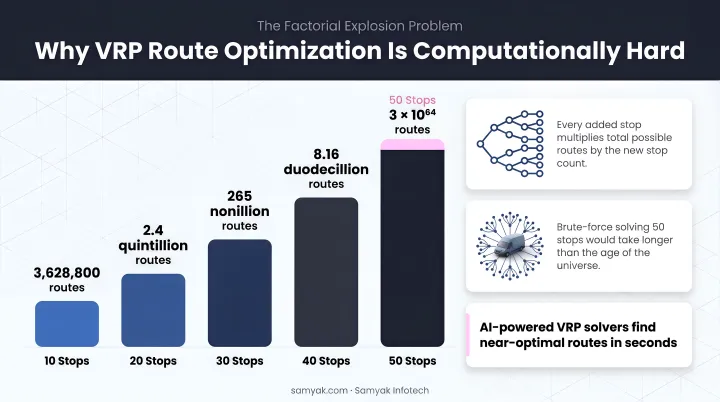
These figures represent TSP-style permutations. Actual VRP solution spaces are larger still, because vehicle assignment, depot assignment, and constraint satisfaction must all be resolved simultaneously. No dispatcher can evaluate even a fraction of that space manually.
Constraints That Compound the Problem
Each real-world constraint narrows the feasible solution space while making the search harder:
- Vehicle load capacities
- Customer time windows
- Driver shift and hours-of-service limits
- Road restrictions by vehicle type or weight
- Traffic variability throughout the day
- Priority customers who must be served first
- Last-minute order additions or cancellations
The interaction between constraints is where the real complexity lives. A capacity limit combined with a tight time window can produce direct conflicts — resolving them requires tradeoff logic, not just arithmetic.
Those tradeoffs, made poorly at scale, translate directly into measurable cost.
The Cost of Getting It Wrong
Beyond fuel waste, poor routing creates cascading operational damage:
- Inefficient stop sequences that push drivers into overtime
- SLA penalties triggered by missed delivery windows
- Customer satisfaction losses from inaccurate ETAs
- Fleet underutilization caused by poor load balancing
The World Economic Forum reported that last-mile delivery costs reached 53% of total shipping expenses in 2023 — making routing efficiency one of the highest-leverage levers available to logistics operators.
Approaches to Solving VRP: Algorithms and Technology
Three categories of solution methods exist. The right choice depends on problem size, available computation time, and how close to optimal the solution must be.
Exact Methods
Exact methods — integer programming, branch-and-bound, branch-and-cut, dynamic programming — guarantee the mathematically optimal solution.
The catch: they're only practical for smaller problem instances (roughly 50–100 orders, depending on the variant, constraints, and response-time requirements). For enterprise-scale logistics with hundreds of stops and multiple vehicles, they're too slow.
Exact methods are used primarily in academic research or as performance benchmarks against which faster solvers are evaluated.
Heuristic and Metaheuristic Methods
Heuristics like the Clarke-Wright Savings Algorithm take a constructive approach: start with individual routes and merge them when doing so saves distance. Fast to implement, they produce good-enough solutions quickly — and a modified Clarke-Wright variant has achieved best-known solutions on 97% of tested Open VRP benchmark instances.
Metaheuristics go further. Rather than constructing a single solution, they systematically explore the solution space:
- Genetic Algorithms: Evolve populations of solutions through selection and mutation
- Simulated Annealing: Accepts occasional worse solutions to escape local optima
- Ant Colony Optimization: Models pheromone-based pathfinding from ant behavior
- Tabu Search: Maintains a memory of recently visited solutions to avoid cycling
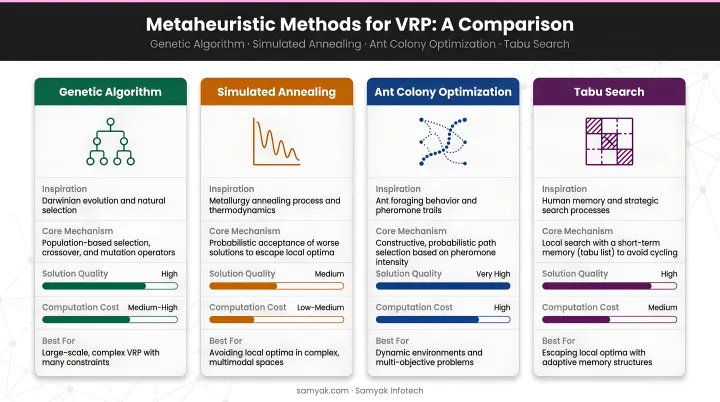
Vidal's Hybrid Genetic Search (HGS-CVRP), one of the leading metaheuristic approaches, reported an average optimality gap of just 0.11% in published benchmarks — near-optimal performance at enterprise scale.
AI and Machine Learning in Modern VRP
Classical algorithms optimize routes based on conditions known at solve time. AI and ML extend this by learning from data and adapting as conditions change:
- Predictive traffic modeling: Learn from historical data to anticipate congestion before it happens
- Demand forecasting: Predict order volumes and locations to pre-position vehicles
- Real-time dynamic re-routing: Adjust active routes as conditions change mid-day
- Reinforcement learning: An ACM 2024 study showed RL-based approaches improving performance by up to 11.7% versus RL baselines on multi-vehicle routing tasks
Those benchmark gains translate directly into operational savings. In Samyak Infotech's logistics engagements, AI-powered routing has delivered measurable outcomes: One engagement with a logistics operator achieved a 30% reduction in delivery time and 20% reduction in operational expenses through AI-driven route optimization combined with real-time fleet tracking. A separate global shipping client saw a $3 million profit increase within six months of implementing ML-based delivery partner selection and real-time transit time calculation via Google Maps API integration.
Build vs. Buy Considerations
Off-the-shelf VRP software is sufficient when:
- Operations involve standard delivery with limited constraint complexity
- Fleet size is small to medium
- No deep ERP/TMS integration is required
- Time windows and capacity are the only active constraints
Custom development becomes the better investment when:
- Constraints are industry-specific (temperature-controlled cargo, hazmat regulations, organ transport)
- Multi-depot networks require coordinated optimization across locations
- Real-time dynamic routing is required at scale
- Tight integration with existing ERP, WMS, or TMS systems is non-negotiable
- Proprietary optimization objectives can't be replicated in generic tools
The math often tips toward custom: integrations, workarounds, per-seat licensing, and vendor lock-in accumulate quickly. That cumulative cost frequently exceeds what purpose-built development would have cost from the start.
Must-Have Features in VRP Software
Whether evaluating off-the-shelf tools or scoping a custom build, these capabilities separate functional routing software from routing software that performs.
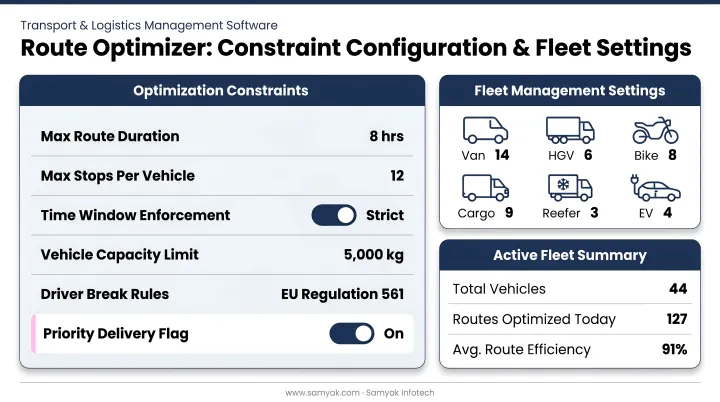
Constraint Handling and Configurability
The software must support the specific VRP variant(s) relevant to your operations. Generic route planners that only handle basic TSP will break down quickly once real-world constraints enter the picture. Before committing to a vendor, run a demo using your actual data and constraints — not a sanitized demo dataset.
Key constraint capabilities to verify:
- Capacity limits per vehicle
- Hard and soft time windows
- Pickup-and-delivery pairing
- Multi-depot origin support
- Priority customer handling
- Driver hours-of-service limits
Real-Time Data Integration
Static route optimization run once at the start of the day becomes obsolete quickly. Effective VRP software must:
- Ingest live traffic data and update routes dynamically
- Handle last-minute order additions and cancellations with automated recalculation
- Integrate GPS and telematics for driver tracking and ETA updates
- Alert dispatchers immediately when routes deviate from plan
Samyak Infotech's Route Optimizer covers this directly: it integrates Google Maps API for live traffic data, supports fast re-ordering for last-minute stops, and automatically recalculates routes when manual changes are applied — a combination that many off-the-shelf tools still don't handle reliably.
Analytics and Performance Monitoring
The software should provide:
- KPI dashboards tracking on-time delivery rate, route utilization, cost per stop, and idle time
- Planned vs. actual route comparison
- Historical trend analysis to identify recurring inefficiencies
- Data feeds back into the optimization model over time
Samyak Infotech's logistics platform includes 50+ reports and operational BI dashboards, giving fleet managers the data needed to act on inefficiencies rather than discover them weeks later.
Scalability and API Integration
The solution must scale with fleet growth and connect cleanly with existing order management, warehouse management, or ERP systems. Open APIs reduce data silos and allow routing decisions to trigger automatically from order placement through to dispatch, eliminating the manual handoffs between systems that consistently inflate logistics operating costs.
VRP Applications and ROI Across Industries
VRP optimization delivers measurable returns across a wide range of sectors:
| Industry | Primary VRP Variant | Key Benefit |
|---|---|---|
| E-commerce & last-mile delivery | VRPTW, CVRP | Lower cost-per-delivery, accurate ETAs |
| Field service management | Open VRP, Dynamic VRP | More jobs completed per technician per day |
| Healthcare & pharmaceuticals | VRPTW, VRPPD | Time-critical compliance for organ transport, home care |
| Waste management & utilities | CVRP | Reduced mileage and fuel across recurring routes |
| Retail & grocery distribution | CVRP, VRPPD | Efficient multi-store replenishment |
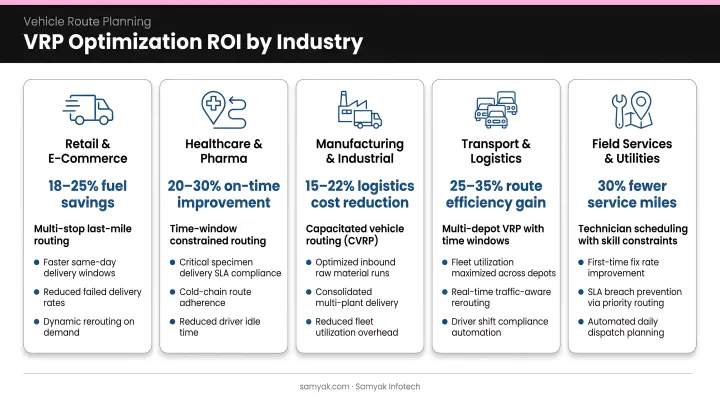
A Sydney fleet case study found that optimized routing produced a 10% reduction in distance traveled, 11% reduction in fuel consumption, and 10% reduction in GHG emissions per month — all from a single operational change with no added vehicles or staff.
ROI scales with operational complexity. A 20-vehicle carrier sees moderate savings. A regional distribution network running 500+ daily routes can unlock millions in annual savings from even marginal efficiency gains — the larger the fleet, the faster the payback period.
Those gains are consistent with what custom-built solutions deliver in practice. Samyak Infotech's clients across logistics, postal, and e-commerce sectors have recorded a 50% increase in on-time deliveries, 20% reduction in transit time, and 30% decrease in customer complaints after implementing tailored route optimization software.
Frequently Asked Questions
What does route optimization mean?
Route optimization determines the most efficient sequence and vehicle assignment for a set of delivery or service stops. It minimizes objectives like distance, time, or fuel while satisfying operational constraints such as capacity limits and time windows.
What is the purpose of VRP?
VRP determines the optimal set of routes for a fleet of vehicles to serve all required customer locations from one or more depots. The goal is to minimize total transportation cost while respecting vehicle, customer, and operational constraints.
What is the difference between VRP and the Traveling Salesman Problem?
TSP involves a single vehicle visiting all locations in the shortest possible route. VRP generalizes this to multiple vehicles, each serving a subset of locations, which makes it far more complex and representative of how real fleets actually operate.
What are the most common types of Vehicle Routing Problem?
The most common variants include:
- CVRP — capacity-constrained routing
- VRPTW — time window-constrained routing
- VRPPD — pickup and delivery routing
- Multi-Depot VRP — routing across multiple origin points
- Dynamic VRP — real-time, adaptive routing
Most real-world operations involve combinations of these, not a single clean variant.
Can VRP software be customized for specific business needs?
Yes. While off-the-shelf tools handle standard cases, businesses with unique constraints — specialized cargo, complex depot structures, tight ERP integrations — typically benefit from custom-developed routing software built to their exact operational requirements.
How does AI improve Vehicle Routing Problem solutions?
AI and machine learning enhance VRP solving in ways classical algorithms cannot match:
- Predictive traffic modeling based on real-time and historical data
- Continuous learning from past route performance
- Dynamic re-routing when conditions change mid-delivery
- Multi-objective optimization across cost, time, and service levels simultaneously