Introduction
Every startup founder eventually hits the same wall: the tools that got you to product-market fit start holding you back. Your CRM wasn't built for your sales motion. Your project management tool can't handle your workflow. And stitching five SaaS subscriptions together feels more like a workaround than a strategy.
Off-the-shelf tools are fast to adopt but rarely built around how your startup actually operates. Deciding to invest in custom software is ultimately a strategic call — one that shapes how your company scales, competes, and operates.
This guide covers what custom software development means for startups, the benefits and trade-offs, the development process, costs, and how to find the right partner — written specifically for non-technical founders making their first serious software investment.
Key Takeaways
- Custom software is built around your workflows and owned outright — no vendor lock-in, no licensing fees
- Off-the-shelf wins on speed; custom wins on long-term fit, scalability, and full IP ownership
- Most startups should start with a lean MVP, not a full product
- Poor requirements gathering is behind 47% of failed software projects, per PMI research
- Offshore development partners (particularly in India) can cut build costs by 40–60% for startups in high-cost markets
Custom Software vs. Off-the-Shelf: What Startups Actually Need to Know
Custom software is software designed and built specifically around your startup's workflows, users, and business goals. The architecture, features, and data model are built from scratch to reflect your specific problem — nothing pre-packaged, nothing retrofitted.
Off-the-shelf (COTS) tools — think generic CRMs, project management platforms, or accounting software — serve broad audiences. They're built to work reasonably well for most businesses, not exceptionally well for any particular one.
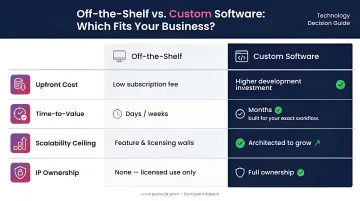
Here's how the two stack up on the dimensions that matter most to startups:
| Dimension | Off-the-Shelf | Custom Software |
|---|---|---|
| Upfront cost | Low (subscription-based) | Higher (development investment) |
| Time-to-value | Fast (days or weeks) | Slower (months) |
| Scalability ceiling | Hit feature/licensing walls | Architected to grow with you |
| IP ownership | None — you license it | Full ownership of code and data |
When Off-the-Shelf Is the Right Call
Not every stage warrants a custom build. Off-the-shelf makes sense when:
- You're pre-validation and still testing core assumptions
- You need speed above everything else for an early MVP
- Standard tools cover your workflows without painful workarounds
- Your budget is genuinely constrained at a very early stage
When Custom Development Becomes the Right Investment
The math changes once you've validated your model. Custom software makes sense when:
- You have proven workflows that generic tools can't replicate
- You operate in a regulated industry (fintech, healthcare, legal tech) with specific compliance requirements
- Your competitive advantage depends on the software itself
- SaaS licensing costs are compounding as your team scales
Choosing the wrong option carries real costs. The 2024 Capterra Tech Trends Report found that 58% of US software buyers regretted at least one purchase in the prior 12 to 18 months — with 35% citing cost overruns and 34% citing difficult onboarding. For newer businesses (1–5 years old), regret jumped to 74%. Off-the-shelf software is often sold to startups before they're ready to evaluate fit properly.
Key Benefits of Custom Software Development for Startups
Scalability Without Ceilings
Custom software is architected around your growth trajectory from day one. You can add new user roles, handle higher traffic volumes, and expand into new markets without hitting the feature walls or per-seat pricing cliffs that come with SaaS tools.
SaaS waste is a real and growing problem at scale. According to Zylo's 2024 SaaS Management Index, companies use only 49% of provisioned SaaS licenses, with an average of $18M in annual wasted SaaS spend. Custom software eliminates that waste entirely — you pay to build what you use, and nothing else.
Competitive Differentiation
When every competitor in your market uses the same off-the-shelf CRM or operations platform, your workflows look identical to theirs. Custom software lets you build processes, UX patterns, and automation that can't be replicated by a competitor who just signs up for the same subscription.
This matters most when software is your product — or when it's the primary delivery mechanism for your service.
Security and Compliance Control
For startups in regulated sectors, compliance isn't optional. Custom-built software gives you full control over:
- Encryption standards and data storage configuration
- Role-based access controls and audit trails
- HIPAA, GDPR, and SOC 2 compliance requirements
The stakes are significant. IBM's 2025 Cost of a Data Breach Report puts the global average breach cost at $4.4M, rising to $7.42M in healthcare. GDPR fines can reach up to €20M or 4% of global annual turnover under Article 83. Building compliance into the architecture from day one is far cheaper than retrofitting it later.
Long-Term Cost Efficiency and Full IP Ownership
The upfront investment in custom software is higher — but the total cost of ownership tells a different story over a 3–5 year horizon. SaaS licensing fees compound annually, you pay for features you never use, and you have no leverage when a vendor raises prices or drops a product entirely.
With custom software, ownership is absolute. That means:
- Full codebase and IP rights with no vendor dependencies
- No exposure to third-party pricing changes or product discontinuation
- Complete control over your data and system architecture
- No workflow disruptions from unexpected terms-of-service updates
The Custom Software Development Process for Startups: Step-by-Step
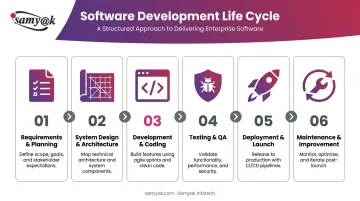
Most experienced development teams follow a version of the Software Development Life Cycle (SDLC). The names of phases vary, but the structure is consistent. Understanding it helps you set realistic expectations and know where your input matters most.
Stage 1: Requirement Gathering and Planning
This is the most critical phase for startups — and the most commonly skipped.
Translating your business problem and product vision into a documented Software Requirements Specification (SRS) takes time. It feels like a delay. It isn't. PMI research found that 47% of unsuccessful projects failed due to poor requirements management, with inaccurate requirements gathering wasting the equivalent of $51M per $1B spent.
A proper SRS defines scope, reduces mid-project pivots, and gives both sides a shared reference point when disagreements arise.
Stage 2: System Design and Architecture
Before a line of code is written, the technical team designs the software's architecture, database structure, technology stack, and integration points. Tech stack decisions made here (React, Angular, Python, Java, Azure, among others) carry long-term consequences for scalability, maintenance, and future hiring.
This is also where domain context matters. A logistics startup, for example, needs a fundamentally different architecture than a healthcare SaaS — different compliance requirements, data models, and integration points. At Samyak Infotech, domain-specific experts are assigned at this stage to ensure the architecture fits the actual business problem, not a reused template.
Stage 3: Development and Coding
Modern development teams use Agile methodology — typically structured in 2-week sprint cycles, with working increments of the software delivered and demonstrated regularly. Agile projects have a 39% success rate versus 11% for traditional waterfall approaches, according to the Standish Group's CHAOS Report.
As a founder, you should expect regular sprint demos and the ability to provide feedback throughout — not just at the end.
Stage 4: Testing and Quality Assurance
QA covers functional testing, performance testing, security testing, and User Acceptance Testing (UAT). This phase exists to catch problems before your early users do. Shipping broken software to your first cohort of users is hard to recover from — trust, once lost, is rarely rebuilt quickly.
Stage 5: Deployment and Launch
Your team deploys the product from staging to production — typically on cloud infrastructure. Post-launch monitoring is critical in the first 48–72 hours to catch performance issues before they compound.
Stage 6: Maintenance and Continuous Improvement
Software development doesn't end at launch. Post-launch support, bug fixes, performance tuning, and iterative feature additions are part of the ongoing lifecycle. Budget for this from day one — industry estimates consistently put maintenance costs at 60–90% of total software lifecycle costs across a product's lifespan.
Before signing with any development partner, confirm their approach to each stage:
- Requirements: Do they produce a formal SRS, or do they start coding from a brief?
- Architecture: Are domain experts involved, or does one architect handle every project type?
- Development: How are sprint demos structured? Can you request changes mid-sprint?
- QA: What testing types are included — and what's out of scope?
- Post-launch: Is maintenance included, or quoted separately?
How Much Does Custom Software Development Cost for Startups?
Cost is the question every founder asks first. The honest answer: it depends on several variables.
Primary Cost Drivers
- Project complexity — number of features, integrations, and user roles
- Team composition — frontend, backend, QA, project management
- Geographic location of the development team
- Engagement model — fixed bid, time-and-materials, or dedicated team
- MVP vs. full product scope
Current Ballpark Ranges
According to GoodFirms' 2026 Custom Software Development Cost Survey:
- Small to midsized projects: $30,000 to $100,000
- Larger, more complex projects: $100,000+
Clutch's pricing data shows experienced development firms quoting $10,000 to $49,000 per project, with hourly rates typically in the $25 to $49 range for providers concentrated in Asia, Eastern Europe, and Latin America.
The Three Engagement Models
| Model | How It Works | Best For |
|---|---|---|
| Fixed Bid | Set price, fixed scope | MVPs with well-defined requirements |
| Time & Materials | Hourly billing, flexible scope | Ongoing or evolving development |
| Dedicated Team | Monthly retainer, embedded team | Longer-term product development |
The 80/20 Rule for MVPs
Approximately 80% of the value your software delivers comes from 20% of its features. This principle is why lean MVP development — building only the core features first — is the most reliable cost-control strategy available to startups.
The Standish Group's CHAOS Report found that most software features go unused — and that adding more increases cost, risk, and quality burden without proportional value. Build the core, validate it with real users, then expand from there.
Offshore Development: What the Cost Difference Actually Looks Like
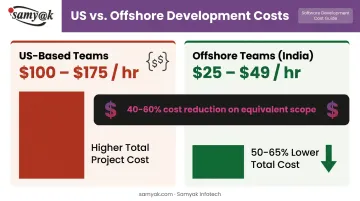
Indian development firms typically bill at $25–$49/hour compared to $100–$175/hour for US-based teams — a gap that can reduce total project costs by 50–65% on equivalent scope. The quality differential depends almost entirely on the partner you choose, not the geography.
Samyak Infotech, for example, has built logistics and enterprise software for Fortune 100 companies over 25 years. Their ISO 9001 certification (held since 2004) and 100% Job Success rate on Upwork reflect what consistent delivery looks like at that scale — useful benchmarks when evaluating any offshore partner.
How to Choose the Right Custom Software Development Partner
Choosing the wrong development partner is one of the most expensive mistakes a startup can make. Before you sign anything, run every candidate through this structured evaluation.
Four Core Evaluation Criteria
- Relevant technical expertise — do they know your required stack?
- Startup-specific portfolio — have they built MVPs, not just enterprise systems?
- Independent reviews — check Clutch, GoodFirms, and Upwork, not just the company website
- Engagement model flexibility — can they scale the team as your needs change?
Red Flags to Watch For
- They say yes to everything without questioning scope
- They push for more features rather than a leaner MVP
- They have no structured discovery or SRS process
- Communication is reactive rather than proactive
Vetting a Partner Before You Sign
Before committing to a full engagement, give the candidate a small, well-defined deliverable. This tests their communication, quality, ability to hit deadlines, and how they respond to feedback.
Once that trial confirms fit, review the contract carefully for:
- IP ownership clauses — the startup should own 100% of the code and all materials
- Confidentiality provisions — NDAs should be mutual and comprehensive
- Acceptance testing procedures — define what "done" looks like before work begins
- Contract type alignment — Fixed Bid suits well-defined scopes; Time-and-Materials works better when requirements are still evolving
What an Experienced Partner Looks Like
Samyak Infotech is one example worth considering for startups evaluating offshore development. Founded in 2001 and ISO 9001-certified since 2004, they carry the startup-relevant combination of deep technical range (AI, ML, IoT, and Blockchain alongside traditional custom development) and the credentials — Clutch recognition, Microsoft Silver Partner status, 100% Job Success on Upwork — that independent verification demands. That kind of track record is exactly what the evaluation criteria above are designed to surface.
Common Mistakes Startups Make When Building Custom Software
Skipping the Discovery and Planning Phase
Many founders rush into development without a clear SRS or architecture plan. The result: costly mid-project pivots, feature bloat, and missed deadlines. Proper planning adds time upfront but consistently costs less than rebuilding after a wrong turn.
Choosing a Partner Based on Price Alone
The cheapest providers often skip coding standards and documentation. When the project ends, you're left with a codebase no other developer can maintain or build upon. You then pay more to rebuild than you would have spent doing it correctly the first time.
Underestimating Post-Launch Costs
Poor partner choices often surface after launch — and that's exactly when a second, underestimated cost centre hits.
First-time founders frequently budget for development but not for what comes after:
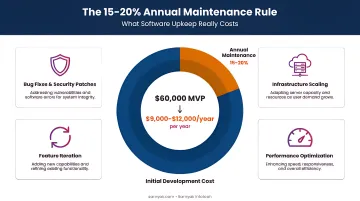
- Bug fixes and security patches
- Infrastructure scaling as traffic grows
- Feature iteration based on user feedback
- Performance optimization over time
A practical guideline: budget 15–20% of your initial development cost annually for maintenance and ongoing improvements. If you built an MVP for $60,000, plan for $9,000–$12,000 per year in post-launch costs. Founders who skip this step often face a funding gap right when user growth demands the most from their infrastructure.
Frequently Asked Questions
How much does custom software development cost for startups?
Startup MVPs typically range from $10,000 to $100,000 depending on complexity, scope, and team location. Full custom products can exceed $100,000. Partnering with established Indian development firms — where senior developer rates run 40–60% lower than US equivalents — can meaningfully reduce your budget without compromising delivery standards.
What are the 7 phases of the SDLC?
The seven phases are: discovery/planning, requirement gathering, system design, implementation, testing, deployment, and maintenance. Agile teams run several of these iteratively — revisiting requirements and design as the product evolves rather than following a strict sequence.
What is the 80/20 rule in software development?
80% of user value typically comes from 20% of a product's features. In MVP development, this principle guides startups to identify and build only the most critical features first — validating the core product before investing in a full feature set.
What is the difference between custom software and off-the-shelf software?
Custom software is purpose-built for one business's specific workflows and owned outright by that business. Off-the-shelf solutions are pre-built for general use, require licensing fees, and may not fit a startup's specific processes or regulatory requirements.
How long does it take to develop custom software for a startup?
A lean MVP typically takes 2–4 months. A more complete custom product can take 6–12 months or longer, depending on scope, team size, and how clearly requirements are defined before development begins.
Should startups build an MVP or go straight to full custom software?
Start with an MVP. Validate your core value proposition with real users before investing in full-scale development. A well-built custom MVP is designed to scale iteratively — it's not a throwaway prototype but a foundation you build on.