What is LTL freight consolidation software?
LTL freight consolidation software helps transportation teams combine compatible less-than-truckload shipments into more efficient loads. It centralizes shipment information and supports planning, routing, carrier or fleet coordination, tracking, documentation, and reporting. By giving teams a clearer view of available freight and movement plans, the software can reduce manual coordination and improve operational control across complex delivery networks.
How can FreightFraction support freight consolidation operations?
FreightFraction can be tailored to support the workflows behind LTL consolidation, including shipment intake, load planning, vehicle assignment, route optimization, real-time tracking, billing, document handling, and performance reporting. Samyak Infotech's logistics software capabilities also support integration with ERP, CRM, TMS, warehouse, and other business systems, helping teams work from connected and current operational data. In production deployments, consolidating partial loads through FreightFraction has cut freight costs by 20 to 30 percent.
Can the software integrate with our existing logistics systems?
Yes. Samyak Infotech develops custom logistics platforms with integration requirements in mind. Depending on your environment, FreightFraction-related workflows can connect with ERP, CRM, TMS, warehouse management, accounting, e-commerce, and tracking systems through appropriate APIs or data interfaces. Integration planning should identify required data fields, update frequency, ownership, security needs, and exception-handling procedures before development begins.
What features should LTL consolidation software include?
Useful LTL consolidation software should provide centralized shipment management, configurable workflows, load and route planning, capacity-aware vehicle assignment, live tracking, documentation, billing support, dashboards, and analytics. The right feature set depends on your operating model. Businesses with multi-stop delivery, return pickups, warehouse handoffs, or strict reporting needs should prioritize configurable rules, integration capability, and real-time operational visibility.
Can FreightFraction be customized for our business workflows?
Yes. Samyak Infotech specializes in custom software development, so the platform can be shaped around your shipment lifecycle, approval paths, user roles, reporting requirements, and integration landscape. A tailored solution can accommodate how your team manages consolidated freight rather than forcing a generic process. Discovery and workflow mapping help define the highest-value capabilities before development starts.
How long does it take to implement freight consolidation software?
Implementation timing depends on the solution scope, existing system integrations, data readiness, workflow complexity, and testing requirements. A focused initial release may prioritize core shipment workflows, tracking, and dashboards, while a broader platform may add billing, carrier connections, warehouse functions, and advanced analytics in phases. A discovery process defines milestones, dependencies, acceptance criteria, and a realistic delivery roadmap.
How does the software improve freight visibility?
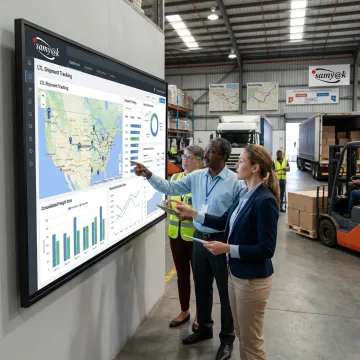
The software improves visibility by bringing shipment status, route activity, operational workflows, and performance data into a centralized dashboard. Real-time tracking and analytics can help teams monitor progress, identify delays or exceptions, and act on current information rather than relying on disconnected spreadsheets or manual updates. Configurable reporting also gives stakeholders a clearer view of operational performance and trends.
How is logistics software data kept secure?
Data security should be designed into the platform through controlled access, secure integrations, appropriate authentication, monitoring, and defined data-handling practices. Samyak Infotech holds ISO/IEC 27001:2022 certification for information security management and ISO 9001:2015 certification. Specific controls are determined during solution design based on your data types, users, integrations, compliance obligations, and deployment environment.