Introduction
AI development is no longer a competitive differentiator for a handful of well-funded tech companies. It's now operational infrastructure — embedded in logistics platforms, clinical decision tools, fraud detection pipelines, and manufacturing systems that run daily operations across every major industry.
The stakes of choosing the wrong partner have grown proportionally. Wasted budgets, delayed launches, and models that degrade in production are the predictable outcomes of selecting vendors based on pitch decks rather than proven delivery records.
According to Gartner, 30% of generative AI projects will be abandoned after proof of concept by end of 2025 — largely due to poor data quality, inadequate risk controls, and unclear business value. For anyone shortlisting vendors right now, that failure rate is the most useful benchmark available.
This list was built to help decision-makers move past vendor noise. Every company here was evaluated on production deployment experience, domain expertise, and the technical depth to build AI that holds up beyond the demo.
Key Takeaways
- AI software development companies build custom ML, generative AI, and automation solutions that off-the-shelf tools cannot replicate for specific business challenges.
- Top companies stand out through production deployment history, verified client outcomes, quality certifications, and post-launch model support.
- Evaluate vendors on AI stack depth (LLMs, MLOps, NLP), domain experience, verified Clutch or GoodFirms reviews, and a clear proof-of-concept process.
- Samyak Infotech, InData Labs, Master of Code Global, Azilen Technologies, and Scopic are among the strongest options to evaluate.
- Clutch's 2026 pricing guide puts the average AI project at $120,594 with a 10-month timeline.
Overview of AI Software Development in 2026
AI software development companies do something distinctly different from SaaS vendors: they design, train, and deploy custom AI systems — machine learning models, NLP pipelines, generative AI applications, autonomous agents — built around your specific data and operational context.
The market backdrop reflects how much demand has shifted. Grand View Research projects the global AI market will reach $3,497.26 billion by 2033, growing at 30.6% CAGR, with North America accounting for 35.5% of AI market revenue in 2025.
Market size alone doesn't explain the urgency for specialized partners. McKinsey reports that 92% of companies plan to increase AI investments, yet only 1% of leaders say their organizations have reached AI maturity.
Demand has outpaced internal readiness, and genuinely capable development firms remain scarce. The companies listed below stand out because they have a proven record of taking AI from concept to production — not just building prototypes.
Top AI Software Development Companies in 2026
These companies were selected based on verified delivery experience, technical breadth, domain expertise, recognized certifications, and client trust signals from platforms like Clutch, GoodFirms, and Upwork.
Samyak Infotech
Samyak Infotech is an ISO 9001-certified custom AI and software development company founded in 2001 and headquartered in Ahmedabad, India. With over 25 years of experience, the company has served Fortune 100 companies and 150+ clients worldwide across logistics, healthcare, fintech, and manufacturing — and was recognized as a Leading Indian Software Development Company by Clutch in 2022.
Their Microsoft Silver Certified Partner status (Top 5%), 100% Job Success badge on Upwork, and 5-star ratings across B2B review platforms reflect consistent delivery quality over decades — not recent rebranding.
Samyak's AI stack covers a broad range of production capabilities:
- LLM development using GPT-4, Llama, and PaLM-2
- AI agent development (goal-based, reactive, proactive, and conversational types)
- NLP pipelines for chatbots, sentiment analysis, and intelligent search
- Computer vision for quality inspection and visual analytics
- MLOps with continuous monitoring, model retraining, and drift management
Their technology stack — TensorFlow, PyTorch, LangChain, LlamaIndex, Hugging Face, and MLflow — points to in-house data science depth beyond API wrapping.
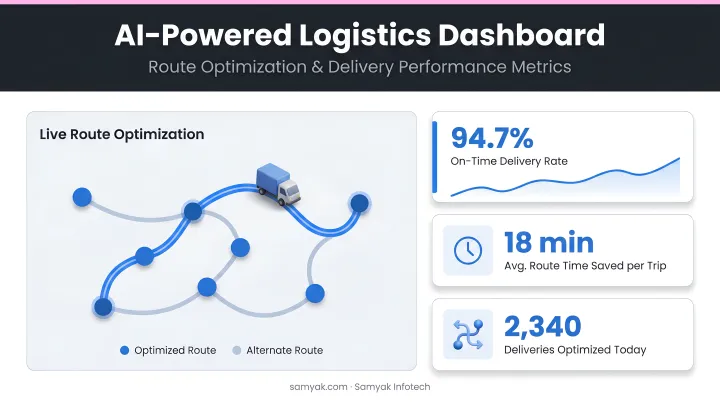
Their logistics AI work is particularly well-documented. For one client, AI-driven route optimization and predictive tracking delivered a 25% reduction in delivery times, 15% decrease in fuel consumption, and 20% increase in customer satisfaction. A hyperautomation engagement for a shipping company saved 200+ manual work hours per day with quarterly cost savings exceeding $250,000.
Samyak also serves startups and SMBs with MVP-first engagement models, free AI readiness consultations, and pilot projects designed to validate fit before full-scale investment.
| Founded / Experience | Established 2001; 25+ years in AI and custom software; ISO 9001 certified since 2004 |
| Core AI Services | Custom AI/ML, LLM development, AI agents, NLP, computer vision, predictive analytics, IoT, logistics AI |
| Certifications & Recognition | ISO 9001, Microsoft Silver Partner (Top 5%), Clutch Top Company 2022, GoodFirms Top Company, Upwork Top Rated 100% JSS |
InData Labs
InData Labs is a Cyprus-based AI development company founded in 2014, with offices in Lithuania and the US. They specialize in generative AI, machine learning, NLP, computer vision, Big Data, and predictive analytics, with 150+ successful projects across logistics, e-commerce, healthcare, and finance.
Their client outcomes are measurable. A freight-rate prediction solution for a logistics firm improved prediction accuracy 2x. An OCR logistics automation system saved 15,000 man-hours annually while processing 300,000+ documents per year. InData Labs holds a Clutch Premier Verified profile with a 4.9/5 rating across 20 verified reviews.
| Founded / Location | Founded 2014; HQ Cyprus with US and Lithuanian offices |
| Core AI Services | Generative AI, NLP, computer vision, Big Data analytics, ML consulting, predictive analytics, AI mobile apps |
| Certifications & Recognition | Clutch Premier Verified (4.9/5); 150+ projects delivered globally |
Master of Code Global
Master of Code Global was founded in 2004 and has delivered 1,000+ projects reaching over a billion users globally. The company specializes in conversational AI, generative AI, LLM development, AI agents, and enterprise-grade chatbot and voice experiences for clients in e-commerce, finance, healthcare, and travel.
Their Zipify Agent Assist deployment stands out: the project delivered 65% faster response times and 30% lower operating costs — concrete numbers from a named production case study, not a service page estimate.
The company holds ISO 27001:2022 certification and ranks as a Clutch Top 10 Chatbot Development Company for 2025. Their agile delivery model covers end-to-end support from initial consulting through continuous optimization.
| Founded / Location | Founded 2004; HQ Redwood City, CA, USA |
| Core AI Services | Conversational AI, generative AI, LLM development, AI agent development, NLP, ML, enterprise chatbots |
| Certifications & Recognition | ISO 27001:2022; Clutch Top 10 Chatbot Development Company 2025 |
Azilen Technologies
Azilen Technologies is an Irving, Texas-based enterprise AI development firm focused on production-grade AI systems. Their specializations include Agentic AI, Generative AI, LLM-based automation, RAG implementation, and multi-agent orchestration for clients in FinTech, HRTech, RetailTech, and HealthTech.
Their finance AI work shows specific operational metrics: 70% faster loan decision cycles, 75% reduction in manual data processing, and 60% faster claim settlements. Their ISO 27001 and ISO 27701 certifications signal both security and privacy governance discipline — important for regulated industry clients.
Azilen's delivery approach combines product thinking with AI architecture, with a track record of taking organizations from PoC through to scalable enterprise deployment.
| Founded / Location | HQ Irving, Texas, USA; engineering presence in India |
| Core AI Services | GenAI product development, Agentic AI, LLM integration, RAG pipelines, MLOps, multi-agent orchestration |
| Certifications & Recognition | ISO 27001; ISO 27701; Best AI Development Services USA 2025 (World Business Achievers) |
Scopic
Scopic is a globally distributed AI and software development company founded in 2006, with 1,000+ completed projects across healthcare, fintech, and enterprise sectors. Their 250+ specialists operate across six continents with a US-focused client base.
Their MedCAD MLOps case study is one of the most technically credible examples in this list: the engagement delivered 50–60% faster model iteration cycles with full audit traceability for healthcare compliance. Scopic holds SOC 2 Type 1 compliance certification (announced 2025), is HIPAA compliant, and maintains AWS and Google Cloud partner status. Their AI capability stack covers NLP, computer vision, deep learning, and predictive analytics within a cloud-native delivery model.
| Founded / Location | Founded 2006; globally distributed with US client base |
| Core AI Services | Machine learning, deep learning, NLP, computer vision, predictive analytics, AI strategy consulting, cloud ML deployment |
| Certifications & Recognition | HIPAA compliant; SOC 2 Type 1 certified; AWS Partner; Google Cloud Partner |
How We Chose the Best AI Software Development Companies
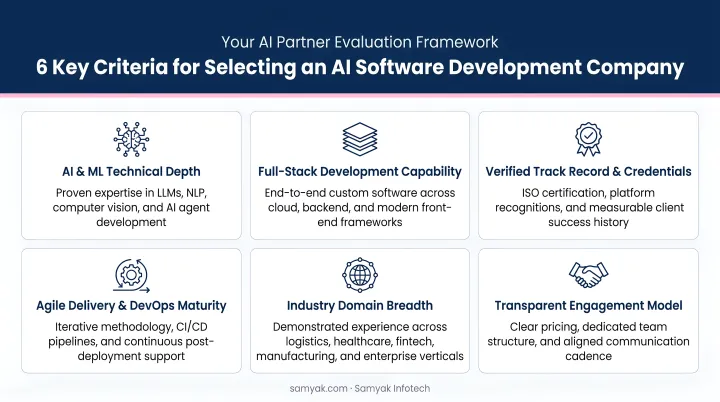
Each company on this list was assessed against six criteria:
- Production deployment experience — live systems, not just proof-of-concept demos
- Technical depth across the full AI stack: ML, LLMs, MLOps, and NLP
- Industry-specific case studies with measurable, named outcomes
- Third-party certifications from recognized bodies
- Verified client reviews on Clutch and GoodFirms
- Post-launch support including model monitoring and retraining
The most common buyer mistake is selecting vendors based on price or brand recognition alone, without verifying actual production AI experience. Vendors who only demo pre-built models rarely survive the complexity of real production pipelines.
What the Criteria Mean in Practice
- ISO 9001 signals quality process discipline across the development lifecycle. HIPAA and SOC 2 are non-negotiable for healthcare and fintech. ISO 27001 covers security governance.
- A vendor who has already built logistics AI for five clients brings domain context that cuts ramp-up time and delivery risk.
- "Great to work with" is not a signal. "25% reduction in delivery times" is.
Red Flags to Avoid
Watch for these patterns when evaluating vendors:
- Wrapping existing LLM APIs without in-house data science capability
- Vague project outcomes with no metrics or named clients
- No defined PoC or discovery process before full engagement
- No post-deployment model monitoring or retraining support
- Awards from organizations with no verifiable independent methodology
Conclusion
The best AI software development partner in 2026 is not necessarily the largest or most decorated brand. It's the one that aligns technically and operationally with your specific challenge, has documented outcomes in your industry, and applies the same rigor to post-deployment performance as to the initial build.
Before committing to any engagement, evaluate partners against the criteria covered here : certifications, domain case studies, AI stack depth, and lifecycle support. Starting with a defined PoC phase is the lowest-risk way to validate fit before full-scale development.
If you're looking for a partner that meets those criteria, Samyak Infotech brings 25+ years of custom AI and software development experience, ISO 9001 certification since 2004, and a client portfolio spanning Fortune 100 companies across logistics, healthcare, fintech, and manufacturing. From AI concept to production-ready deployment, the team offers end-to-end support with a track record across 150+ clients worldwide. Reach out for a consultation to discuss your specific AI development needs.
Frequently Asked Questions
What should I look for when choosing an AI software development company?
Prioritize five things: a portfolio of production-deployed AI (not just prototypes), domain expertise in your specific industry, a transparent tech stack covering LLMs, MLOps, and cloud platforms, a defined PoC or discovery process, and verified client reviews on Clutch or GoodFirms with specific outcome metrics.
How much does it cost to hire an AI software development company?
According to Clutch's 2026 pricing guide, the average AI development project costs $120,594 with a typical 10-month timeline. Scope, data readiness, compliance requirements, and model complexity are the primary cost drivers. Offshore and nearshore firms typically deliver comparable quality at significantly lower rates than US or Western European counterparts.
How long does it take to build a custom AI solution?
Timelines vary considerably by scope:
- Prototypes: 4–8 weeks
- Production-ready features with integration: 3–5 months
- Full-scale platforms with custom model training: 6–12 months, depending on data readiness and system complexity
What is the difference between AI software development and traditional software development?
Traditional software follows deterministic logic : the same input produces the same output. AI software introduces probabilistic components (models that learn from data), requiring additional skills in data engineering, model training, and MLOps, plus ongoing costs for retraining and drift monitoring as data patterns change.
Do AI software development companies work with small businesses, or only enterprises?
Most reputable firms serve startups and SMBs alongside enterprise clients. Engagement models like fixed-scope PoCs, MVP-first approaches, and phased rollouts are specifically designed to reduce risk for organizations with limited data volume or tighter AI budgets.
Which industries benefit most from custom AI software development?
The highest-value sectors include logistics and supply chain (route optimization, real-time tracking), healthcare (diagnostic AI, clinical documentation), fintech (fraud detection, risk scoring), manufacturing (predictive maintenance, quality inspection), and retail and e-commerce (demand forecasting, personalization).