Introduction
Manual coordination in logistics is expensive. Missed deliveries, idle trucks, and inventory discrepancies cost operations real money — and customers notice. McKinsey research finds that about 50% of US consumers actively track their order status, making real-time visibility no longer optional.
The market reflects this pressure. The global digital logistics market was valued at $29.18 billion in 2023 and is projected to reach $93.28 billion by 2030 — an 18.4% annual growth rate driven by businesses replacing manual workflows with software.
This guide gives logistics operators everything needed to make an informed build decision:
- The types of logistics apps and what each solves
- The features that matter most (and which to skip)
- The development process, step by step
- Realistic cost ranges for budgeting
- How to choose between custom builds and off-the-shelf software
Key Takeaways
- Logistics apps automate route planning, fleet tracking, inventory management, and delivery coordination — cutting costs and errors simultaneously
- Six app types cover distinct operational problems: fleet, warehouse, delivery tracking, freight, supply chain, and driver/customer-facing
- Core features every logistics app needs: real-time GPS tracking, order management, push notifications, digital POD, and payment integration
- Development runs five stages: discovery, UX design, build, QA and integrations, then deployment and ongoing maintenance
- Cost ranges from roughly $25,000 for a basic MVP to $200,000+ for an enterprise platform, with annual maintenance typically adding 15–20%
Types of Logistics Apps
Logistics app development isn't one category. A freight forwarder, a last-mile carrier, and a warehouse operator each need different software — and many businesses need more than one type working together.
Fleet Management Apps
Fleet apps centralize vehicle tracking, driver scheduling, maintenance logs, and fuel consumption in a single dashboard. For businesses managing large vehicle assets, they're the difference between reactive firefighting and proactive operations.
Key capabilities to expect:
- Real-time GPS tracking with geofencing alerts for unauthorised stops
- ELD compliance support — FMCSA mandated Electronic Logging Devices for most US carriers by December 2019; any hours-of-service workflow must integrate with certified ELD data
- DVIR inspection logs and preventive maintenance scheduling
- Idle monitoring — rest-stop idling alone costs long-haul fleets over 1 billion gallons of fuel annually, per Argonne estimates cited by the US Alternative Fuels Data Center
The US fleet management software market sits at $11.34 billion in 2025, projected to reach $17.63 billion by 2030, showing there's both established SaaS competition and clear demand for specialised solutions.
Warehouse and Inventory Management Apps
Manual inventory entry creates costly discrepancies between recorded and actual stock. These apps eliminate that problem by automating receipt, putaway (moving received goods to designated storage locations), picking, and shipping using barcode or RFID scanning.
GS1 US reports that RFID can raise item-level inventory accuracy to over 95%, with fixed readers able to scan items at docks and conveyors without manual line-of-sight handling. For multi-location businesses, these apps also integrate with ERP and accounting systems to keep financial records aligned with physical stock.
Route Optimisation and Delivery Tracking Apps
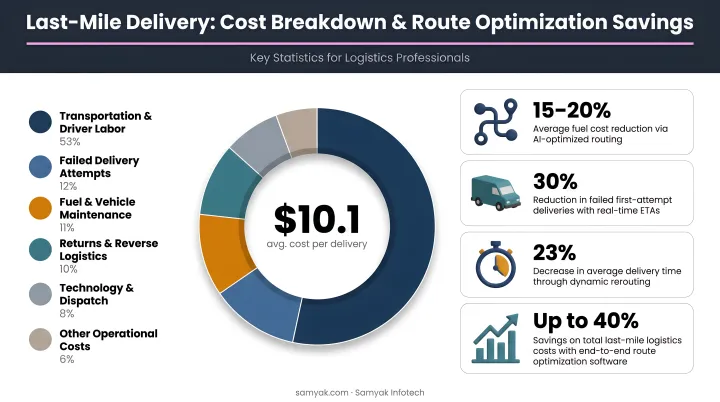
Last-mile delivery now accounts for 53% of total shipping costs, up from 41% in 2018. Route optimisation directly attacks that figure.
These apps calculate efficient multi-stop routes by analysing real-time traffic, delivery time windows, and vehicle constraints. The customer-facing side includes live GPS tracking, proof of delivery via photo or e-signature, and automated status notifications.
UPS's ORION system — which supports over 66,000 routes across the US, Canada, and Europe — has saved approximately 100 million miles and 10 million gallons of fuel per year, demonstrating what route intelligence delivers at scale.
Freight Management and Cargo Booking Platforms
Freight management software handles the end-to-end shipment lifecycle: quoting, booking, documentation (bills of lading, customs forms), multi-carrier tracking, and demand forecasting analytics.
The US Freight Forwarding and Customs Brokers market reached $165.3 billion in 2025 — large enough to justify custom portals with automated quoting, carrier bid comparison, document capture, and customer visibility layers. These platforms serve freight forwarders and 3PLs managing high shipment volumes across multiple transport modes.
Supply Chain Visibility Platforms
These platforms aggregate data from suppliers, carriers, warehouses, and distributors into a single real-time view. That real-time picture is most useful as an early warning system.
McKinsey research found that companies experience a supply chain disruption lasting one to two months every 3.7 years on average, with financial fallout potentially equalling 30% of a year's EBITDA over a decade. Predictive analytics built into visibility platforms help teams detect risk and reroute before disruptions escalate.
Driver and Customer-Facing Apps
Driver apps keep field teams operational regardless of connectivity. Core capabilities include:
- Task dispatch and turn-by-turn navigation
- POD capture via photo or e-signature
- Offline mode for rural or underground environments where signal drops
Offline functionality isn't optional — drivers can't lose access to their task queue mid-route because of a weak cell signal.
Customer apps give end-users live delivery tracking, push notifications, order history, and direct support communication. These directly affect retention — customers who can see where their delivery is generate far fewer service calls.
Key Features Every Logistics App Needs
Miss a core feature during development and you'll pay for it later — either in user complaints, rework costs, or both. These are the features that logistics apps can't function well without, regardless of whether you're building for drivers, dispatchers, or customers.
Must-Have Features
| Feature | Why It Matters |
|---|---|
| Real-time GPS and maps | Live location data gives dispatch teams and customers accurate ETAs; the most expected feature by end-users |
| Order management | Structured list view, search by tracking number, and order detail screens reduce missed deliveries and misrouted shipments |
| Push notifications and in-app messaging | Automated alerts keep drivers, warehouse staff, and customers informed without phone calls; communication trails support dispute resolution |
| Digital POD and document management | Photo and e-signature capture replaces paper, accelerates billing cycles, and satisfies compliance requirements for international shipments |
Advanced Features Worth Planning For
- Payment gateway integration — supports COD, digital wallets, and multi-currency transactions (Stripe's standard US card processing runs 2.9% + $0.30 per transaction, a fee that adds up at scale and belongs in your total cost of ownership calculation)
- Analytics dashboards — delivery performance, fuel usage, and route efficiency data feeds continuous operational improvement
- ERP and WMS integrations — connects logistics data to financial and inventory systems already in use
Apps that bolt on integrations after launch typically spend 30–40% more in development time than those that architect for them upfront — a scope conversation worth having before a single line of code is written.
How to Build a Logistics App: Step-by-Step Process
Skipping early stages — especially discovery — is the most common reason logistics apps fail to deliver ROI. The sequence below applies regardless of app complexity.
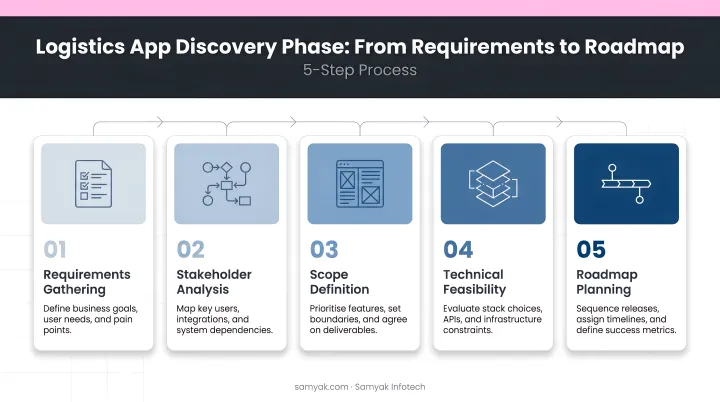
Step 1: Discovery and Requirements Definition
Before a single line of code is written, document the business's logistics workflows, pain points, target users, and integration requirements. The output is a clear feature list and technical specification that defines scope, prevents costly rework, and aligns all stakeholders.
Samyak Infotech's discovery phase for logistics projects covers:
- Requirements analysis and stakeholder alignment
- Competitor research and gap identification
- User journey mapping for drivers, dispatchers, and warehouse staff
- Wireframe prototyping for early validation
- Project roadmap with milestones and deadlines
With over 20 years of logistics software experience, the team consistently uncovers integration requirements and edge cases that clients haven't yet considered, reducing costly rework during development.
Step 2: UI/UX Design and Prototyping
Logistics apps serve field users — drivers and warehouse staff — who operate under time pressure, often with one hand, sometimes in low-connectivity environments. Good UX means:
- Large tap targets and minimal text entry
- Workflows that mirror real operations, not theoretical ones
- Offline functionality designed in from the start
- Interactive wireframes reviewed with actual users before development begins
Skipping field validation at this stage typically results in apps that look polished in demos but fail on the dock floor — where workflows don't match reality and drivers abandon them after a week.
Step 3: Backend Architecture and Frontend Development
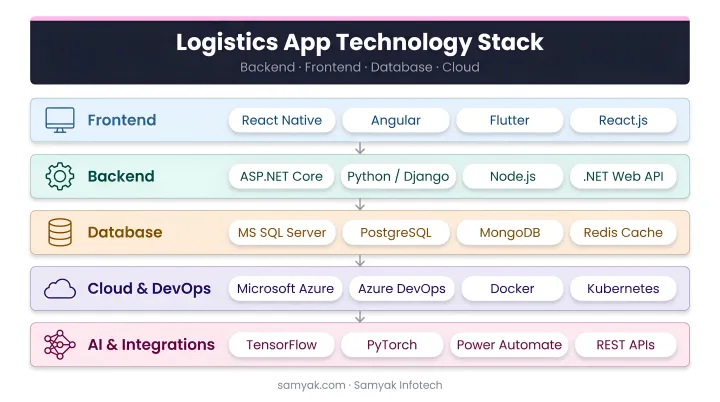
The backend must handle concurrent real-time data from multiple vehicles, warehouses, and users simultaneously. Common technology choices:
- Backend: Node.js or .NET for scalability; Python for ML-heavy features
- Mobile: React Native or Flutter for cross-platform iOS and Android
- Database: PostgreSQL for structured relational data; MongoDB for document-based flexibility
- Cloud: AWS, Azure, or Google Cloud for elastic scaling during peak periods
Samyak Infotech has built logistics applications using Flutter — including a Fleet Master fleet management app that achieved a 40% increase in fleet efficiency and 15% reduction in fuel consumption — as well as React Native for cross-platform delivery. The framework choice depends on performance requirements, UX complexity, and development timeline.
Step 4: Third-Party Integrations and Quality Assurance
Common integration requirements for logistics apps:
- Mapping APIs: Google Maps, Mapbox, or HERE for routing and live tracking
- Payment gateways: Stripe or PayPal for COD and digital payments
- ERP/WMS systems: SAP, Oracle, or custom systems via secure APIs
- IoT/telematics: Vehicle sensors and GSM modems for real-time data collection
- EDI: For standardized data exchange between carriers and logistics channels
QA must test under real-world conditions — poor network, offline mode, high concurrent loads — not just controlled environments. Functional, performance, compatibility, and security testing are all required before deployment.
Step 5: Deployment, Training, and Post-Launch Support
Deployment is not the finish line. Staff adoption determines whether the app achieves ROI.
Post-launch commitments should include:
- User training for drivers, dispatchers, and warehouse staff
- Performance monitoring to catch issues before customers notice them
- Bug fixes, OS updates, and security patches on an ongoing basis
- Feature additions as operations scale or requirements change
Annual maintenance typically runs 15–20% of the initial development cost and should be budgeted upfront.
How Much Does It Cost to Develop a Logistics App?
No two logistics apps cost the same. Here's a practical framework for estimating budget.
Cost Tiers
| Tier | Features | Approximate Range |
|---|---|---|
| Basic MVP | Core tracking, order management, single platform | $25,000 – $50,000 |
| Mid-tier platform | Route optimization, integrations, analytics, two platforms | $50,000 – $150,000 |
| Enterprise system | AI/ML, IoT, multi-fleet, custom integrations, full reporting | $150,000 – $300,000+ |
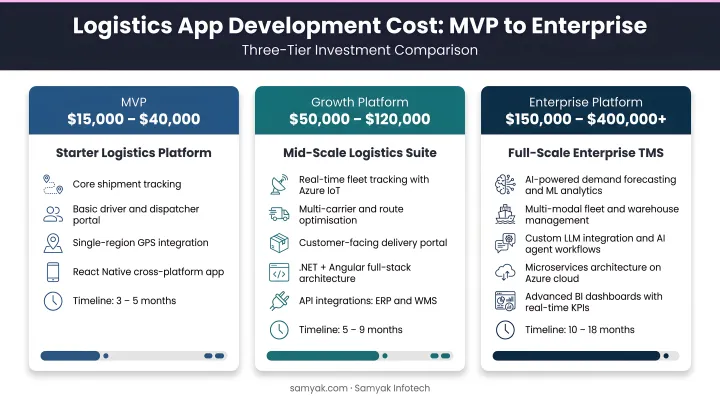
These ranges reflect typical Western market estimates from technology consultancies. Discovery and an itemized estimate are the only reliable way to get a number that reflects your actual build — and offshore development partners can reduce these figures by 30–50%.
Where the Budget Goes
- Development and QA: Largest share — typically 50–60% of build cost
- UX/UI design: 10–15%
- Business analysis and project management: 10–15%
- Integrations and testing: 15–20%
Hidden Ongoing Costs to Budget
- Cloud hosting (AWS, Azure, or Google Cloud — billed by usage)
- Third-party API fees (Google Maps charges per 1,000 requests; AWS WebSocket APIs bill per message and connection minute)
- App store fees (Apple and Google Play)
- Annual security audits
- Platform maintenance: industry estimates place this at $5,000–$30,000 per year depending on complexity
Key Variables That Move Cost
- Number of platforms (iOS, Android, web — each adds scope)
- Number of user roles (driver, dispatcher, admin, customer)
- Integration complexity (ERP, IoT, multi-carrier APIs)
- Development team geography and engagement model
Always request itemized estimates, not lump sums — they're the only way to compare quotes meaningfully.
Custom App vs. Off-the-Shelf Logistics Software
When Off-the-Shelf Works
SaaS logistics platforms offer fast deployment, lower upfront cost, and built-in features. Fleetio's fleet management SaaS, for example, starts at $4 per vehicle per month — fast to deploy for standard fleet maintenance workflows.
Off-the-shelf makes sense when:
- The logistics workflow is standard and commodity
- Speed to deploy outweighs long-term customization needs
- Budget is limited and the subscription model is financially sustainable
The trade-offs are real, though:
- Limited customization options as your operation grows
- Vendor dependency with little control over the roadmap
- Data ownership concerns tied to a third-party platform
- Subscription costs that compound significantly over time
When Custom Development Wins
Custom builds make more sense when:
- The operation has unique workflows that generic software can't accommodate
- Competitive differentiation depends on the software's specific capabilities
- Integration with existing proprietary systems is required
- Data ownership and portability matter for long-term strategy
Custom apps are a capital investment with full source code ownership. Samyak Infotech has spent over 20 years building logistics platforms for clients ranging from regional freight operators to Fortune 100 shippers — each solution built around the client's operational model rather than retrofitting a generic product.
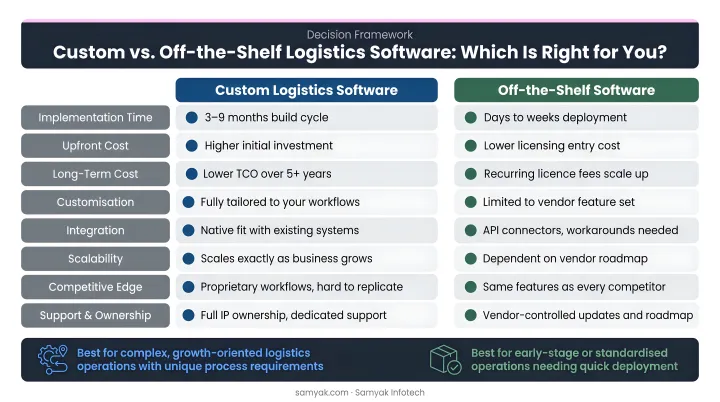
The Decision Framework
| Situation | Recommended Path |
|---|---|
| Standard workflow, speed matters, budget is tight | Start with off-the-shelf SaaS |
| Unique workflows, proprietary integrations required | Custom development |
| Competitive advantage depends on software capabilities | Custom development |
| Uncertain requirements, early-stage operation | MVP first, then evaluate |
Frequently Asked Questions
What does logistics mean?
Logistics is the process of planning, implementing, and controlling the efficient movement and storage of goods, services, and information from origin to destination. The CSCMP classifies logistics management as a core component of broader supply chain management.
What are the 4 types of logistics?
The four practitioner categories are:
- Inbound logistics — receiving raw materials and supplies
- Outbound logistics — delivering finished goods to customers
- Reverse logistics — managing returns and recalls
- Third-party logistics (3PL) — outsourcing logistics functions to an external provider
What are the 7 C's of logistics?
The 7 C's is a practitioner mnemonic — not a formal CSCMP standard — covering the right Customer, Commodity, Quantity, Condition, Place, Time, and Cost. Operations teams use it as a quick checklist to confirm logistics activities are hitting their core objectives.
What is the purpose of mobile app development?
Mobile app development builds software that runs on smartphones and tablets, giving users on-the-go access to business tools, real-time data, and automated workflows. In logistics, this means field teams — drivers, warehouse staff — stay connected and operational away from a desk.
How much does it cost to develop a logistics app?
A basic logistics MVP typically starts at $25,000–$50,000. Mid-tier platforms with route optimization and integrations range from $50,000–$150,000. Enterprise-grade systems with AI, IoT, and multi-fleet management can exceed $200,000, with annual maintenance adding 15–20% of the build cost each year.
How long does it take to develop a logistics app?
A basic MVP takes approximately 3–5 months. Mid-tier platforms with third-party integrations typically run 6–9 months. Enterprise systems can take 12 months or longer, with timeline driven by feature scope, team size, and integration depth.