Introduction
Supply chains have never been more complex — or more fragile. Customer expectations for fast, accurate deliveries keep rising, while the operational reality behind the scenes grows harder to manage. Businesses relying on spreadsheets, phone calls, and manual data entry to coordinate shipments, inventory, and fulfillment are paying for it: in errors, delays, and complete blind spots across their operations.
Logistics management software exists to fix that. Businesses of all sizes — from regional distributors to global manufacturers — are adopting it to replace fragmented manual processes with a single, connected system.
According to Research and Markets, the global logistics management software market is projected to grow from $14.86 billion in 2026 to $21.84 billion by 2030. The pressure to digitize operations is real, and it's accelerating.
This guide covers everything a beginner needs to know: what logistics management software is, the four types of logistics it supports, the key features to evaluate, and how to choose the right solution. No prior technical knowledge required.
Key Takeaways
- Logistics management software centralizes transportation, inventory, warehousing, and fulfillment into one system
- Four logistics types — inbound, outbound, reverse, and 3PL — each require different software capabilities
- Real-time tracking, route optimization, and analytics are non-negotiable features
- Total cost of ownership matters more than licensing fees alone
- Custom-built software often delivers stronger ROI when off-the-shelf tools can't fit your workflows
What Is Logistics Management Software?
Logistics management software (LMS) is a centralized digital platform that automates and coordinates the core functions of a supply chain — including transportation, warehousing, inventory tracking, and order fulfillment — into a single, manageable system.
The Council of Supply Chain Management Professionals (CSCMP) defines logistics management as the part of supply chain management that plans, implements, and controls the efficient forward and reverse flow and storage of goods, services, and related information between origin and consumption. LMS is the technology that makes this definition operational.
The Problem It Solves
Without LMS, businesses typically rely on a patchwork of tools: spreadsheets, email threads, phone calls between dispatch and delivery teams, and manual data entry across disconnected systems. The consequences are predictable:
- Stock mismatches between what the system shows and what's actually on the shelf
- Missed or delayed deliveries with no way to identify the cause
- No real-time visibility into where shipments are or when they'll arrive
- Errors that multiply as order volumes grow
A Supply & Demand Chain Executive report summarizing a Loghub study found that a majority of supply chain professionals still use manual spreadsheets for critical tasks — a fragile foundation for operations that depend on accuracy and speed.
What LMS Enables Instead
LMS replaces this fragmentation with connected, automated workflows. Key capabilities include:
- Real-time inventory updates visible across every location
- Shipment status tracked end-to-end, from origin to delivery
- Automatic alerts triggered when routes change or delays occur
- Order fulfillment that flows from purchase to delivery without manual handoffs
The result: fewer errors, lower operational costs, and enough visibility to make proactive decisions before problems escalate.
The 4 Types of Logistics Management (and the Software That Powers Them)
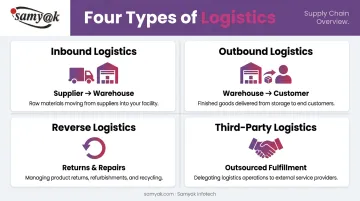
Understanding the four foundational types of logistics helps businesses identify which software category — or combination — they actually need. In practice, many operations span more than one type, which is why knowing the distinctions matters before evaluating any platform.
Inbound Logistics
Inbound logistics covers the movement of raw materials, components, or goods from suppliers to a warehouse or production facility. Software support includes:
- Supplier management and communication
- Purchase order tracking from creation to delivery
- Receiving workflows and inventory intake confirmation
- Integration with warehouse systems to update stock levels automatically
Outbound Logistics
Outbound logistics moves finished goods from a warehouse to the end customer. This is where Transportation Management Systems (TMS) and order fulfillment software do their heaviest work.
Key capabilities on the outbound side:
- Route planning and carrier selection
- Load optimization to reduce wasted space and cost
- Last-mile delivery coordination and customer notifications
- Real-time shipment tracking through to delivery confirmation
Reverse Logistics
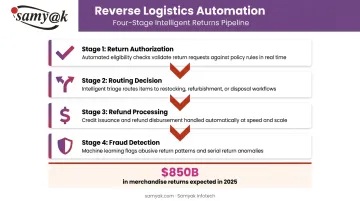
Reverse logistics manages the flow of goods back through the supply chain — returns, repairs, refurbishments, and disposal. The scale of the challenge is significant: the NRF reports that U.S. consumers are expected to return nearly $850 billion in merchandise in 2025, representing 15.8% of annual sales.
Software automates the friction-heavy parts of this process:
- Return authorization and eligibility checks
- Restocking or disposal routing based on item condition
- Refund and credit processing
- Fraud detection for abusive return patterns, which 93% of retailers flag as a growing operational concern
Third-Party Logistics (3PL)
3PL logistics involves outsourcing fulfillment, warehousing, or transportation to a specialised provider. The U.S. 3PL market alone was estimated at $323.4 billion in 2025, reflecting just how widely businesses rely on these providers.
3PL software platforms — typically Warehouse Management Systems (WMS) and Order Management Systems (OMS) — are built for multi-client environments. They track inventory, fulfillment, and shipping across multiple businesses within a single platform, keeping each client's data separate and secure.
Key Features to Look for in Logistics Management Software
Not every feature list in a product demo translates to real operational value. Here are the capabilities that genuinely matter when evaluating platforms.
Real-Time Tracking and Visibility
The ability to see shipment locations, inventory levels, and delivery status at any moment is the baseline expectation for modern logistics software. Platforms should offer:
- Live dashboards accessible across devices
- Automated alerts for exceptions, delays, or threshold breaches
- End-to-end visibility from supplier intake to customer delivery
Without this, teams spend time chasing updates rather than resolving issues.
Inventory and Warehouse Management
Inventory features should go beyond simple stock counting. Look for:
- Replenishment alerts triggered by pre-set thresholds
- Demand forecasting to prevent stockouts before they happen
- Warehouse-specific tools: picking route optimization, barcode scanning support, and goods-to-person workflows
Gartner identifies receiving, picking, staging, inventory management, and shipping as the mandatory core functions of any serious WMS platform.
Route Optimization and Transportation Management
TMS capabilities directly affect two of the most visible cost centres in logistics: transportation spend and on-time delivery rates. Features to prioritise:
- AI-driven route planning that adapts to real-time conditions
- Multi-carrier rate comparison
- Load optimization to reduce per-shipment cost
- Freight audit tools to catch billing errors
Research and Markets projects that AI-powered fleet optimization solutions are expected to reduce management costs by up to 20% and increase driver productivity by 20%, though those figures represent projected gains from market forecasts, not guaranteed outcomes.
Analytics and Reporting
Built-in reporting separates reactive logistics operations from ones that improve continuously. Essential KPIs to track include:
- Order cycle time — how long from order placed to order delivered
- Inventory turnover — how efficiently stock is moving
- Delivery accuracy — percentage of orders delivered on time and in full
- Operational cost per shipment — tracking the true cost of fulfilment
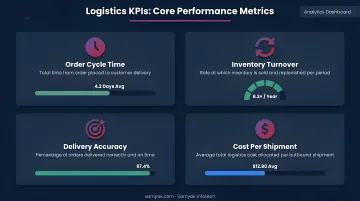
When evaluating platforms, look for dashboards that surface these metrics in real time and allow teams to drill down by carrier, warehouse, or region — not just export raw data into spreadsheets.
Integration Capabilities
Logistics software that can't connect to your existing systems creates new data silos rather than eliminating them. Prioritise platforms that offer:
- Open APIs or pre-built connectors for ERP, CRM, and eCommerce platforms
- EDI support for supplier and carrier data exchange
- Real-time data synchronisation to keep all systems consistent
Before committing to any platform, ask vendors for a specific list of native integrations and test API documentation quality. Integration gaps are far cheaper to catch during evaluation than after go-live.
Key Benefits of Logistics Management Software
Operational Efficiency and Cost Reduction
LMS eliminates the manual effort embedded in repetitive tasks: order processing, invoice generation, carrier booking, and route planning. Automation reduces both labour costs and the compounding errors that manual processes introduce.
IHL Group estimates global retail inventory distortion — driven largely by stockouts and overstock situations — cost $1.77 trillion in 2023. Businesses that address these gaps through software gain a direct cost advantage over those still managing inventory manually.
Improved Customer Satisfaction
Delivery performance directly influences buying behaviour. DHL's 2025 eCommerce Trends Report, based on a survey of 24,000 shoppers across 24 markets, found that 81% of global shoppers would abandon a cart if their preferred delivery option was unavailable, and 7 in 10 would not shop with a retailer if they didn't trust the delivery provider.
Accurate delivery estimates matter just as much. Narvar reports that accurate delivery date estimates can reduce cart abandonment by 9% and increase add-to-cart rates by 17%.
LMS delivers the real-time tracking, accurate ETAs, and reliable fulfilment workflows that underpin those customer expectations.
Scalability Without Heavy Investment
Meeting those expectations consistently requires operations that can grow without proportional cost increases. Cloud-based logistics software scales with order volume, carrier networks, and warehouse locations without adding headcount or infrastructure at the same rate.
The MHI/Deloitte 2025 report shows 91% of supply chain leaders plan to adopt cloud computing within five years — a signal that on-premise, fixed-capacity systems are increasingly difficult to justify as business demands shift.
Key capabilities that support scalable operations include:
- Multi-carrier management — add or switch carriers without rebuilding workflows
- Elastic capacity — handle seasonal volume spikes without provisioning extra servers
- Multi-warehouse visibility — manage distributed fulfilment from a single dashboard
- API integrations — connect new sales channels or ERPs as the business grows
How to Choose the Right Logistics Management Software
The Selection Checklist
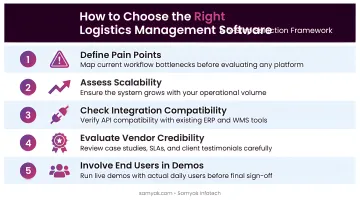
Use this framework before evaluating any specific platform:
- Define your pain points first: identify where errors, delays, and costs are actually occurring before looking at features
- Assess scalability: confirm the platform can handle your projected order volumes, warehouse locations, and carrier relationships in two to three years, not just today
- Check integration compatibility: map your existing systems (ERP, eCommerce platform, CRM) and verify the software connects to them without custom development workarounds
- Evaluate vendor credibility: review analyst assessments (Gartner Magic Quadrant, Forrester Wave), customer references, and support response standards
- Involve end users in demos: warehouse teams, dispatch coordinators, and operations managers catch usability issues that executives miss in high-level presentations
Off-the-Shelf vs. Custom-Built Software
For businesses with standard logistics workflows, off-the-shelf platforms from providers like Oracle TMS, Blue Yonder, or Manhattan Associates are reliable options with proven implementation track records. They implement faster and carry lower upfront cost.
Custom-built software makes more sense when:
- Operations involve specialized freight types, hazardous materials, or industry-specific compliance requirements
- Multi-warehouse or multi-region networks don't map cleanly onto a standard platform's configuration options
- Existing integrations are complex enough that pre-built connectors won't cover the full scope
When those conditions apply, working with a specialist matters as much as the platform itself.
Samyak Infotech has spent over 20 years building real-time, end-to-end logistics tracking software for Fortune 100 companies — including Carisbrooke Shipping, MNX, and Ship Network. Their approach is to design solutions around a client's specific workflows, scale requirements, and integration environment, rather than configuring a standard product to approximate what the business actually needs.
One logistics client achieved over $10 million in added profits within six months through a custom automation solution, without launching new products or additional capital investment.
Total Cost of Ownership
Licensing fees are the most visible cost — and the most misleading basis for comparison. The real cost of any logistics software includes:
- Implementation — configuration, data migration, and go-live support
- Integration — connecting the platform to ERP, carrier APIs, and eCommerce systems
- Training — getting operations staff to proficiency
- Ongoing maintenance — updates, support contracts, and future customisation
Gartner recommends that IT leaders integrate capital budgeting and total cost of ownership into any enterprise software evaluation. Two platforms with similar licensing costs can have five-year TCOs that diverge significantly once implementation and integration complexity are factored in.
Frequently Asked Questions
What is software for logistics management?
Logistics management software is a digital platform that automates and coordinates supply chain functions — including transportation, inventory tracking, warehouse management, and order fulfillment. It helps businesses reduce costs, minimize errors, and improve delivery performance by replacing manual processes with connected, real-time workflows.
Which software is commonly used for logistics management?
The most widely used categories are Transportation Management Systems (TMS), Warehouse Management Systems (WMS), and Order Management Systems (OMS). Recognized leaders include Oracle TMS and Blue Yonder for TMS, Manhattan Associates and Infios for WMS, and project44 and Shippeo for real-time transportation visibility.
What are the 4 types of logistics management?
The four types are inbound logistics (supplier to warehouse), outbound logistics (warehouse to customer), reverse logistics (returns, repairs, and disposals), and third-party logistics (outsourced fulfillment and warehousing).
What is the difference between WMS, TMS, and ERP software?
A WMS manages warehouse operations — receiving, picking, packing, and shipping. A TMS handles transportation planning, carrier selection, routing, and freight management. An ERP integrates these functions with broader business operations like finance, procurement, and HR. Most mid-to-large businesses use all three together.
How do I know if my business needs logistics management software?
Clear indicators include frequent shipping errors, no real-time inventory visibility, rising transportation costs, manual order processing that breaks down during peak periods, or recurring customer complaints about delayed or inaccurate deliveries.
Can logistics management software be customized to fit specific business needs?
Yes. While many off-the-shelf platforms offer configuration options, businesses with complex workflows, unique compliance requirements, or non-standard integrations typically get better results from custom-built software.